
🔤 This Week’s ABC
📖 Advice: 3 Steps To Set Better Boundaries
Here’s the pattern no one talks about:
- You overfunction because you care.
- People expect you to keep doing it.
- You start to burn out—but stay quiet.
- Resentment builds.
- You either implode… or withdraw completely.
**Then you’re also probably **burning out slowly.
Caring is a beautiful thing.
But when you care without boundaries, you trade your long-term sanity for short-term likability.
That is not sustainable.
Let’s be real: most high-achievers overfunction in the name of excellence. (I know I can have this tendency)
But behind every “I’ve got it!” is a system silently teaching others that your time, energy, and well-being are negotiable.
Boundaries don’t make you less committed—they make you sustainable.
So what’s a boundary?
I love Brené Brown’s definition:
I have learned that if you don’t set boundaries, you can become resentful and hateful.
Nobody wants that.
Here are 3 steps I use ALL THE TIME to protect my energy and still show up as a high-impact teammate and leader.
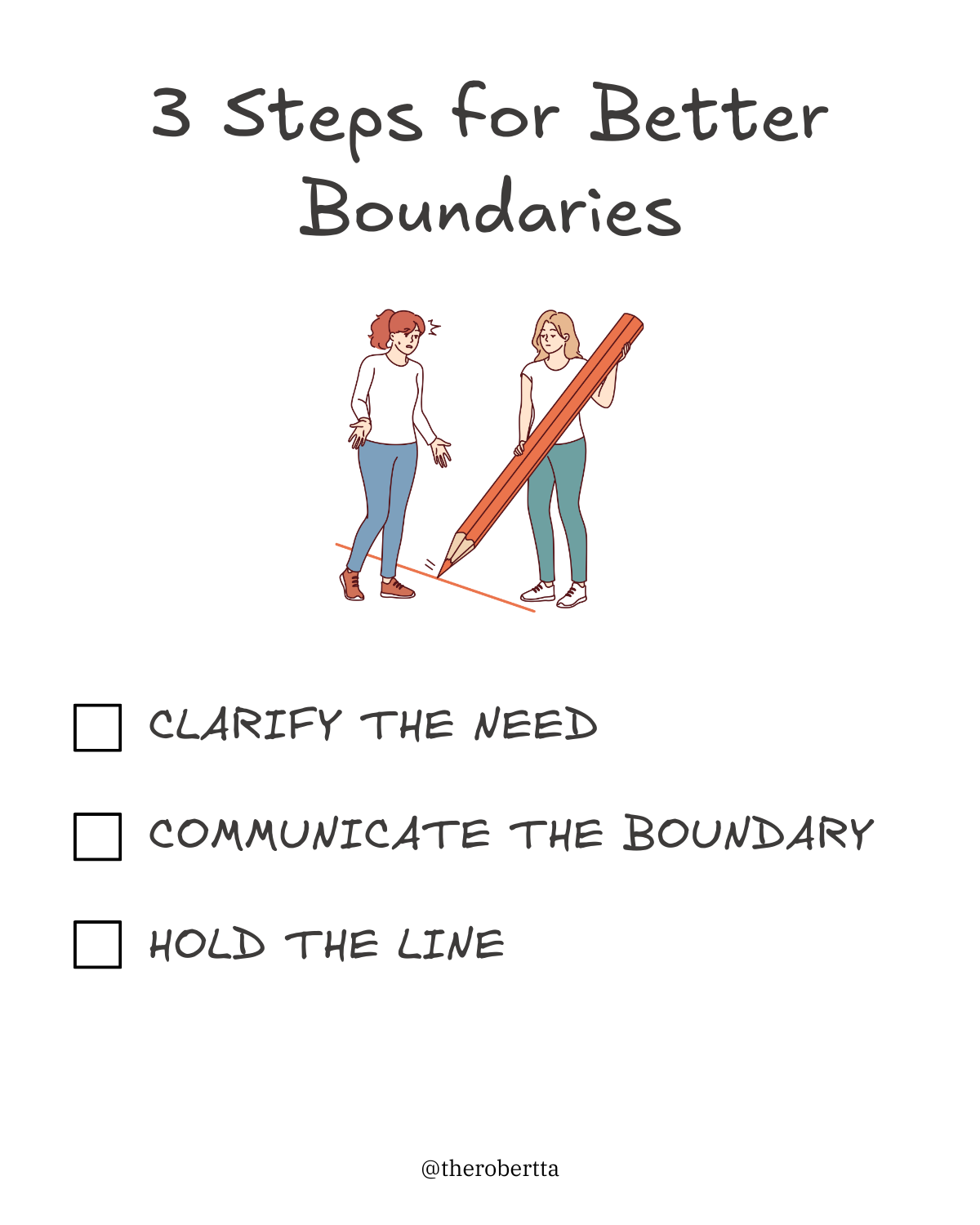
Step 1: Clarify the Need
Before you can set a boundary, identify what you need to feel safe, respected, or balanced.
Ask yourself:
- What’s draining me right now?
- What am I overcommitting to?
- What would help me do my best work and feel good doing it?
“You are not required to set yourself on fire to keep others warm.”— Penny ReidA boundary is simply what’s okay and what’s not okay.
Example*:* “I’m drained by too many meetings lately. I feel like I’ve overcommitting, and 10 meetings is way too much for me. I think 4-5 might be a sweet spot to target because I need focused time in the mornings to get meaningful work done.”## Step 2: Communicate the Boundary
Advice: 3 steps to set better boundaries
Breakthrough: 10 quotes and 1 video for better boundary setting
Challenge: Set a micro-boundary
Step 3: Hold the Line
This one is the hardest part. But you must hold the line. Boundaries protect you and what’s important to you.
Stay grounded. Set and maintain your boundaries.
- Restate it calmly.
- Don’t guilt yourself.
- Offer your reasoning again.
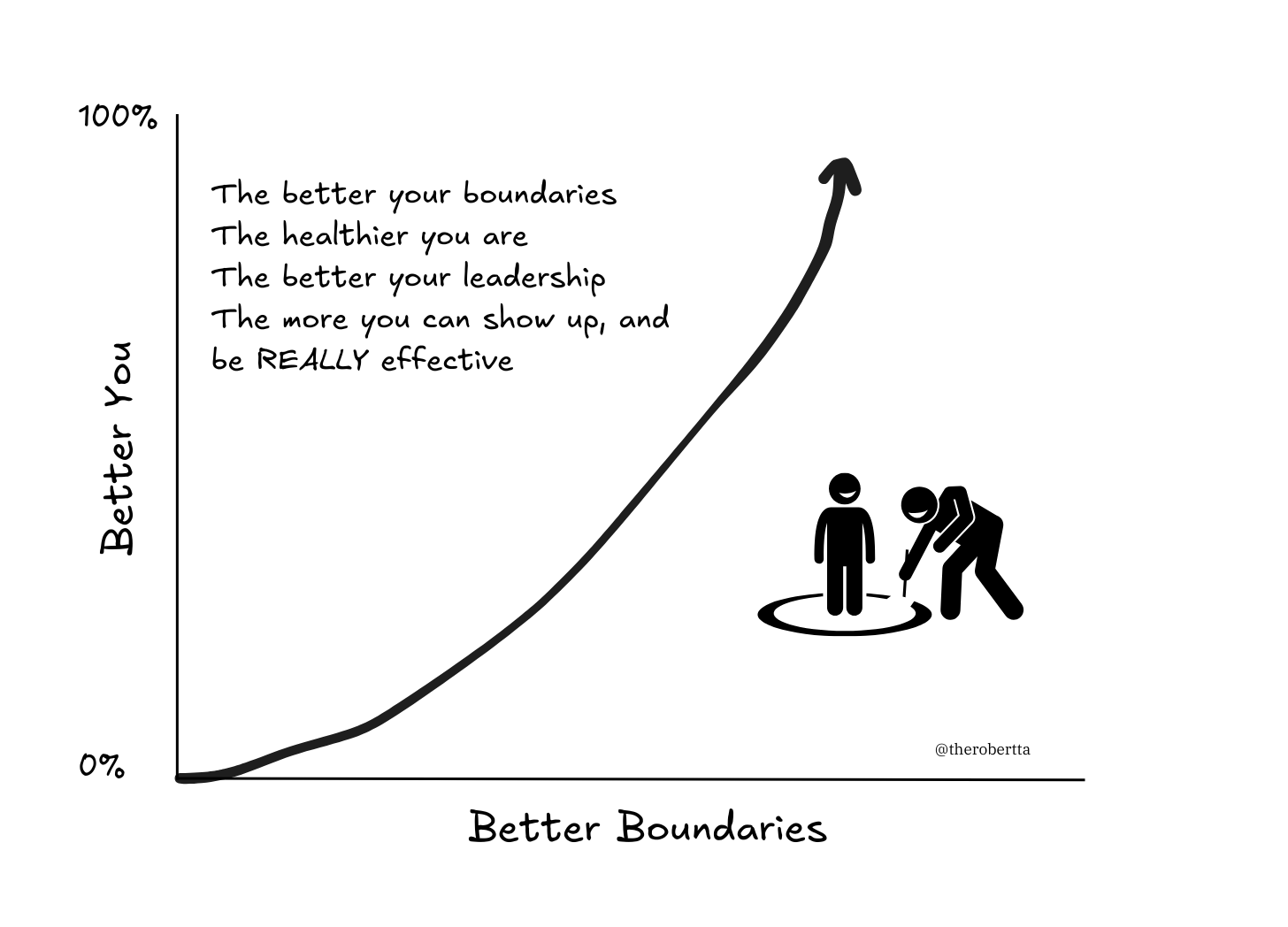
3 Takeaways
- Boundaries don’t damage trust. They deepen it. People trust what’s consistent.
- **The most respected leaders you know? **They’re boundaried. Ruthlessly. That’s what it takes.
- **If you’re always available… **People subconsciously assume your time is less valuable.
Most times though I find that leaders just need reminders.
And that brings us to this week’s Breakthrough…
Example: *“I’m not available for meetings before 7:00 AM because I need to take care of the kids and make sure they have everything they need for a great day at school. Happy to meet later though.”*Use this loose structure: “I’m not available for [X] during [Y time], but I’m happy to support [Z] during [alternate time/way].”If others challenge it:
Example: “Like I mentioned earlier, I’ve blocked this time to focus on deep work. Let’s reconnect later.”State your boundary clearly and kindly—without overexplaining, apologizing, or becoming defensive.
A boundary is only as strong as your ability to reinforce it.
When you don’t hold the line, make your non-negotiables, negotiable.
And you know how that feels in the long wrong—terrible.
Continue reading
Get the full newsletter, free.
Join founders and builders who read Self Aligned every week.
🚀 Breakthrough: 10 Quotes and 1 Video for Better Boundary Setting
I find that quotes are very powerful tools to remind and motivate me.
Here are a few of my favorites on this topic…
“Daring to set boundaries is about having the courage to love ourselves even when we risk disappointing others.”—Brené Brown
RT: Self-love leads to better loving of others
“You teach people how to treat you by what you allow, what you stop, and what you reinforce.”—Tony Gaskins
RT: Boundaries are the real discipline to learn.
“A lack of boundaries invites a lack of respect.”—Unknown
RT: I have experienced this too many times in my life. It never leads to good things.
“No is a complete sentence.”—Anne Lamott
RT: Simple, effective—say no more to say yes to other things.
“Setting boundaries is a way of caring for myself. It doesn’t make me mean, selfish, or uncaring. It’s simply an act of self-respect.”—Christine Morgan
RT: Gotta break those people pleasing biases and tendencies.
“The most compassionate people are also the most boundaried.”—Brené Brown
RT: I have learned that this is true through my own experiences.
“Boundaries are the distance at which I can love you and me simultaneously.”—Prentis Hemphill
RT: I LOVE this one.
“Empathy without boundaries is self-destruction.”—Brené Brown
RT: It truly is, it truly is.
“True self-care is not salt baths and chocolate cake. It’s making the choice to build a life you don’t need to escape from.”—Brianna Wiest
RT: Micro self-care can be salt baths, but true self-care is discipline to set boundaries so you wake up everyday with peace and content.
“Love yourself enough to set boundaries. Your time and energy are precious.”—Anna Taylor
RT: Boundaries = self-love. Truth. Time and energy is all we have.
“Love boundaries and love yourself.”
RT: Had to do it. (:
And here’s a great video by Nedra Glover Tawwab, a relationship therapist and author, that talks to better boundaries. Check it out!
💥 Challenge: Set a Micro-Boundary
This week, set one “micro-boundary.”
Block a meeting-free hour.
Say “Not now” once.
Pause before you say yes.
It’ll take 5 minutes—but it could protect your week.
You got this!
Liked this article?
💚 Click the like button.
Feedback or addition?
💬 Add a comment.
Know someone that would find this helpful?
🔁 Share this post.
ABCs for Growth by Robert Ta is a reader-supported publication. To receive new posts and support my work, consider becoming a free or paid subscriber.
P.S. If you haven’t already checked out my other newsletter, ABCs for Building The Future, where I reflect on my founder’s journey building a venture in the open. Check out my learnings on product, leadership, entrepreneurship, and more—in real time!
P.S.S. Want reminders on entrepreneurship, growth, leadership, empathy, and product?
Follow me on..