
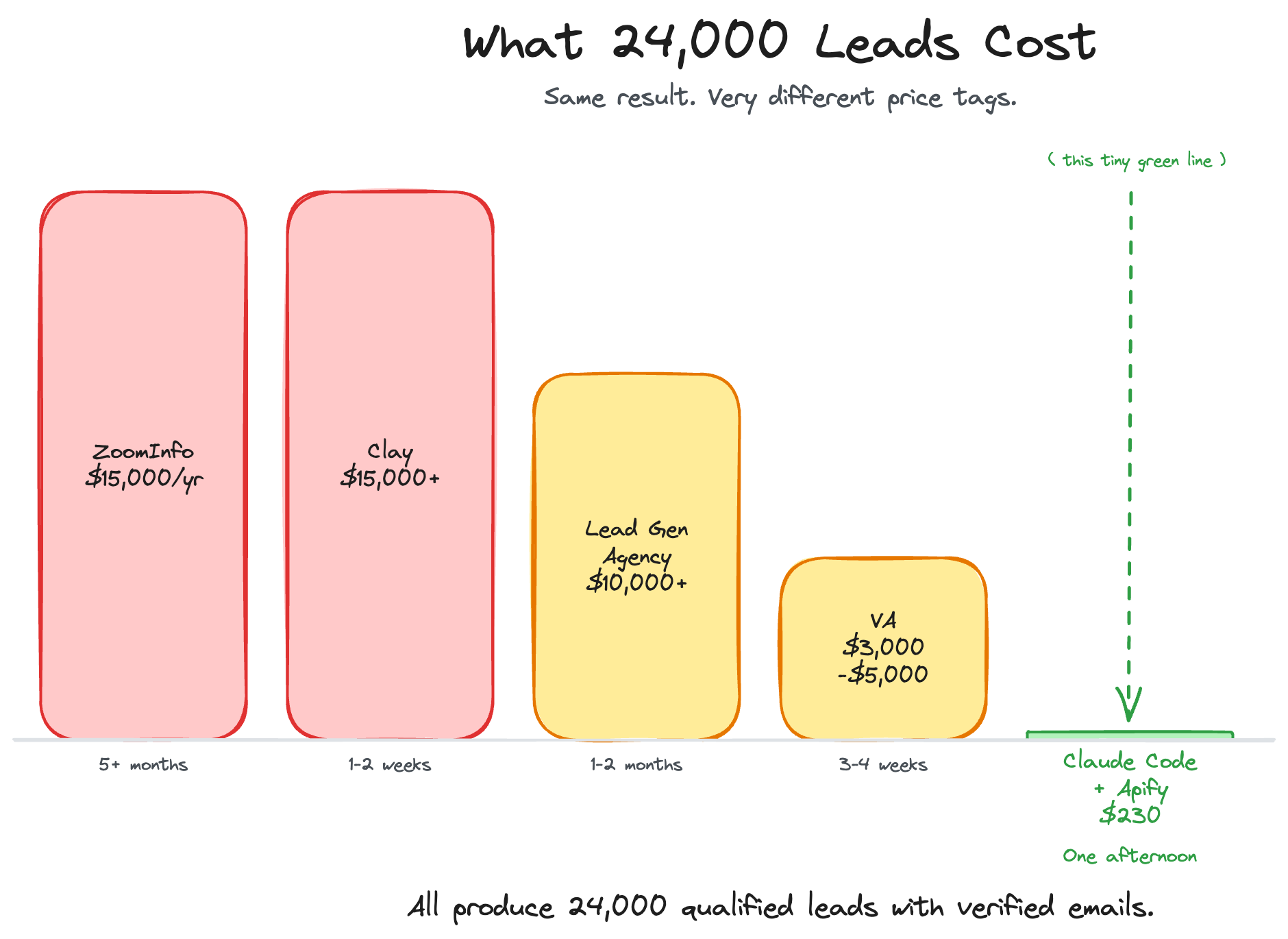
I spent an afternoon and $230 building an outbound pipeline that would have cost me $15,000+ and weeks through the normal channels.
It’s the CEO’s job to fill pipeline to put cash in the bank. One can always do better at that job, is my thinking.
We have some long-term bets around content and community building, but we also need short term bets alongside that to generate capital:
Warm intros and referrals: this is our most reliable acquisition channel so far. We are OK at this, revving this up now with a finder’s fee incentive for anyone who refers us business that we end up closing. (You get 20% of the first contract if you give us a warm intro through email to an AI team that leads to a close for our offer, if you’re interested email me.)
Cold outbound: barely existent and all manual. Not a core business lever, and can’t be one without serious attention.
Paid acquisition: none yet, up next.
So I’d love an outbound team to just get a new channel going.
But I don’t have time or resources to build a cold outbound team. I am familiar with Claude Code and can spare a few hours investing in automation which compounds.
I evaluated 12 enrichment and prospecting tools, hit dead ends with 5 of them, and got what I needed after an afternoon’s work: 20k+ qualified leads for pennies on the dollar.
If you’re an AI-native founder or team thinking about outbound, this is for you.
The AI Builder’s Weekly Briefing
The most interesting things I found this week in AI.
Anthropic Launches Managed Agents: “Prototype to Launch in Days”
Anthropic shipped a cloud service that handles sandboxing, orchestration, and governance for AI agents. $0.08/session hour on top of API token costs. Notion, Rakuten, and Asana are early adopters.
Robert’s Take: Building an LLM wrapper agent is the easy part. Evals is the hard part. Anthropic’s tooling launched here is meant to solve for more common cases and teams that don’t need fully custom solutions and cannot afford data science or AI product development talent.
Claude Sonnet 4.6 Drops as Default: Developers Preferred It Over Opus 59% of the Time
The new Sonnet beats the previous flagship Opus 4.5 in Claude Code testing. 1M token context is GA at standard pricing. $3/$15 per million tokens, unchanged.
59%
of developers preferred Sonnet 4.6 over the old Opus 4.5 flagship in Claude Code testing
Robert’s Take: A cheaper model outperforming the expensive one in coding tasks. The AI pricing death spiral accelerates. If you’re still budgeting based on “bigger model = better results,” you’re leaving money on the table. Test Sonnet 4.6 on your workloads this week.
Microsoft Ships Agent Framework 1.0: AutoGen + Semantic Kernel Unified
The 18-month debate between AutoGen and Semantic Kernel is over. Microsoft merged them into one production-ready framework with YAML-defined agent topologies and MCP support.
Robert’s Take: The framework wars are consolidating faster than I expected. If you’re an enterprise .NET shop that’s been paralyzed by “which framework,” the answer just landed. The YAML-defined topologies with MCP built in is the real unlock. Start building.
Shopify AI Toolkit Lets Agents Modify Live Stores via Natural Language
Claude Code, Cursor, and Gemini CLI can now access live Shopify documentation, full API schemas, and execute real store changes through natural language prompts.
Robert’s Take: We just crossed the line from “AI coding assistant” to “AI business operator.” Millions of Shopify merchants got access to a developer they never had to hire. The agencies charging $5K for store customizations are about to have a bad quarter.
The $230 for 20k+ Leads Outbound Playbook
I’m starting to invest a lot more of our focus into reliable acquisition channels. I picked cold outbound email because it seems the easiest to automate and just get something going (minimal time/resources, high leverage) with Claude Code.
Why is this a good time for us as a business?
Well, we now have a reliable repeatable offer where we can solve customer problems.
Here’s the pitch:
Your AI sucks.
It’s inconsistent, it hallucinates, and every time the foundation model updates, your users feel it.
Or maybe you don’t have AI yet and you want to build it right the first time.
Either way, that’s us.
We do two things.
First, hands-on consulting: we get into your traces with your team and fix what’s broken, using world class evals methodology and techniques that actually catches problems before your users do.
Second, we build software that solves the root cause: your agents aren’t getting the right context at the right time. Clarity fixes that with a context graph specializing in subjective user modeling, at scale, and builds you a data moat your competitors can’t replicate. (Data moat around the causal structures or the “why” of why your customers buy.)
We roll up our sleeves and build alongside AI teams, so best practices and capabilities become embedded.
We’ve figured out some of our supply side constraint here, which is fulfillment of AI consulting in a forward deployed engineer model and software to help with context engineering, by optimizing our delivery engine.
More on that in a future article.
Now, I want to diversify our demand side constraint for healthy consistent pipeline.
I had zero outbound infrastructure.
No lead list, no cold email campaigns, no prospecting system.
I wanted 20,000+ qualified decision-makers with verified emails and LinkedIn URLs, scored and segmented into campaigns.
Instead of buying a tool, I opened Claude Code and described the outcome I wanted in plain English.
Here’s what I learned.
Lesson 1: The enrichment market is designed to confuse you
Every tool looks the same on the surface.
“Find emails.”
“Enrich contacts.”
“Build your pipeline.”
I believe the pricing pages are intentionally vague.
Claude Code evaluated 12 of them at 20K volume against my ICP.
I verified the numbers.
Here was our analysis (do your own research to get the latest numbers, it’s not hard, just ask Claude Code).
TL;DR of the cost analysis:
Verified pricing across 12 tools at 20,000 leads with email + LinkedIn.
Cheapest
$60
Apify Leads Finder — ~$0.003/lead
Most Expensive
$30,000+
ZoomInfo enterprise
- Winner: Apify Leads Finder at ~$60-80 ($0.003/lead). Scraper-sourced but data quality held up. Test a 500-lead batch first.
- Budget tier ($150-$500): Smartlead+SmartProspect, Icypeas, LeadMagic, Prospeo. All under a penny per lead.
- Mid tier ($400-$3,400): Instantly, Dropcontact, Apollo.io. Most have asterisks (API gated, name-required input, credit walls).
- Expensive tier ($2,000-$60,000): Clay, RocketReach, People Data Labs, ZoomInfo. Wrong fit at this volume unless you need enterprise features.
Full verified pricing table (all 12 tools, per-lead cost, fields included, gotchas—you should verify yourself, this was a point in time analysis I did with Claude): open the Google Sheet.
Lesson 2: The real bottleneck
This is the insight that would have saved a lot of time.
Apollo’s search API returns obfuscated last names. Sc***z instead of Schwartz.
Dropcontact, Icypeas, Prospeo, and RocketReach all need a first + last name as input.
From what I encountered, if you don’t have the name, every tool downstream is useless.
I burned $49 and several hours discovering this the hard way.
Here’s what I tried:
DIY email patterns: Take Apollo’s obfuscated results (first name + company) and generate candidates like first@company.com. 39% of companies use first.last@ which we can’t generate without last names.
So I had Claude Code do some SMTP verification: 24 verified emails out of 1,020 candidates.
DIY email patterns
2.4%
hit rate. Dead path.
Apify Leads Finder
100%
verified emails + LinkedIn
New approach.
Dropcontact as primary enricher: 89% email rate, 85% LinkedIn rate. Excellent quality. But it requires full names as input. Same bottleneck.
Shit.
Instantly’s SuperSearch API: Despite having a paid plan, the lead finder is UI-only. Hopefully they change that soon.
I don’t want to leave my terminal to interact with their UI if I don’t have to.
The actual fix:
Apify’s Leads Finder works backwards from everyone else. You describe the role you want (job title + industry + company size + revenue range) and it returns the person (name, email, LinkedIn, company data, tech stack, funding).
$0.002 per lead. No names needed as input.
That was the unlock for me.
Most tools are enrichment tools that assume you already did the prospecting. Apify does the prospecting.
Lesson 3: Claude Code is a better sales ops analyst than most humans
I didn’t write code.
I described outcomes in plain English.
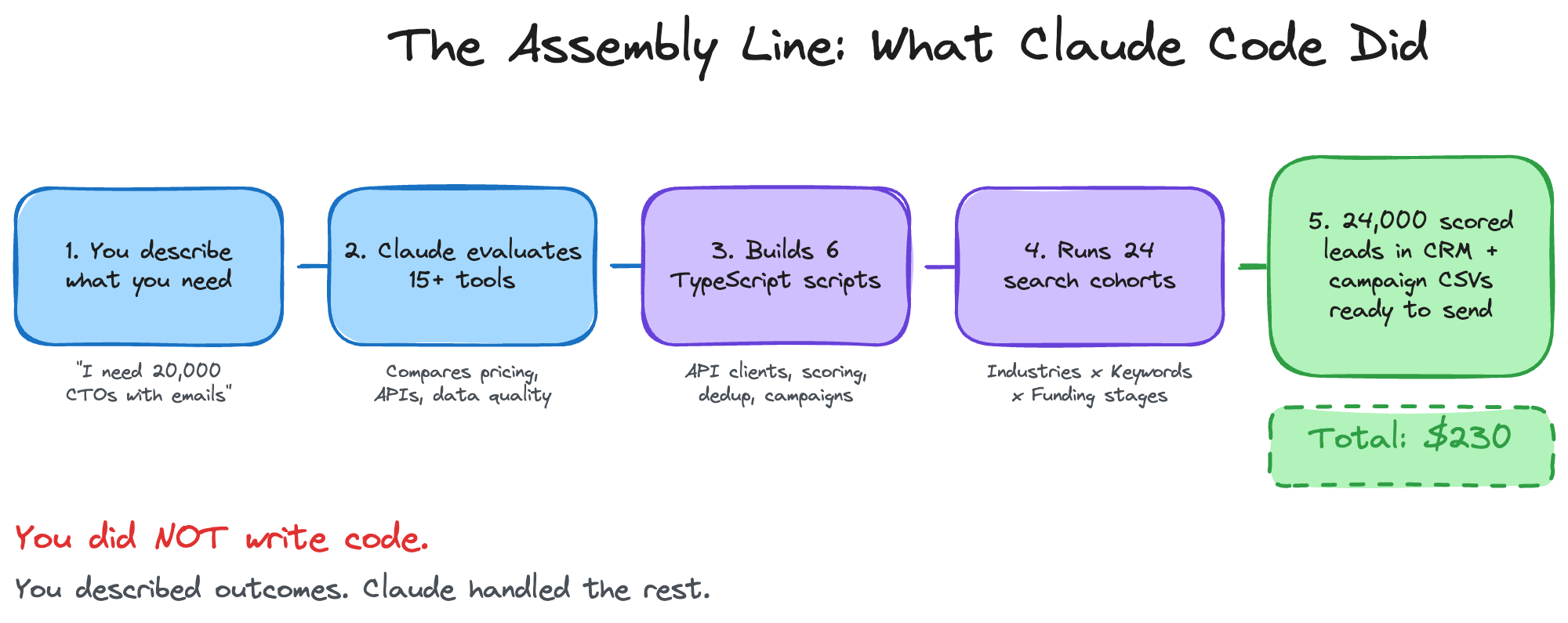
Claude Code:
- Evaluated all 12 tools (pricing, APIs, rate limits, data quality)
- Built 6 TypeScript scripts from scratch (API clients, scoring engine, dedup system, campaign segmentation)
- Ran 24 search cohorts across industries, keywords, and funding stages
- Hit Apollo’s credit wall, diagnosed the bottleneck, pivoted to Apify
- Pushed 24,000 scored contacts to HubSpot
- Generated 4 campaign CSVs for Instantly, split by archetype and outreach approach
The 24 cohorts varied three dimensions:
Industry: SaaS, fintech, healthcare, retail, education, legal, marketing, logistics, telecom, media, staffing, hospitality, real estate, construction.
Company keywords: “personalization,” “chatbot,” “automation,” “data platform.” Each keyword targets a different pain point.
Funding + revenue: Series A-C (investor pressure to ship), Series D+ (market pressure to grow), $10M-50M (sweet spot), $50M+ (can write $50K checks).
I was specifically targeting leads that feel the pain of pressure to ship a good AI product, and in a space that I deem “personalization sensitive” where Clarity can help with our context intelligence layer.
AKA, we can help these prospects with their current and future problems.
Continue reading
Get the full newsletter, free.
Join founders and builders who read Self Aligned every week.
Lesson 4: Score your leads to assess “qualified”
I learned the hard way earlier on that you don’t want to be spending any of your precious founder-led sales time on calls with unqualified leads.
The conversion rate will be close to 0%. Waste of time.
So, try your best to qualify your leads so that when you get on the phone with them you have a higher chance (than 0) to close.
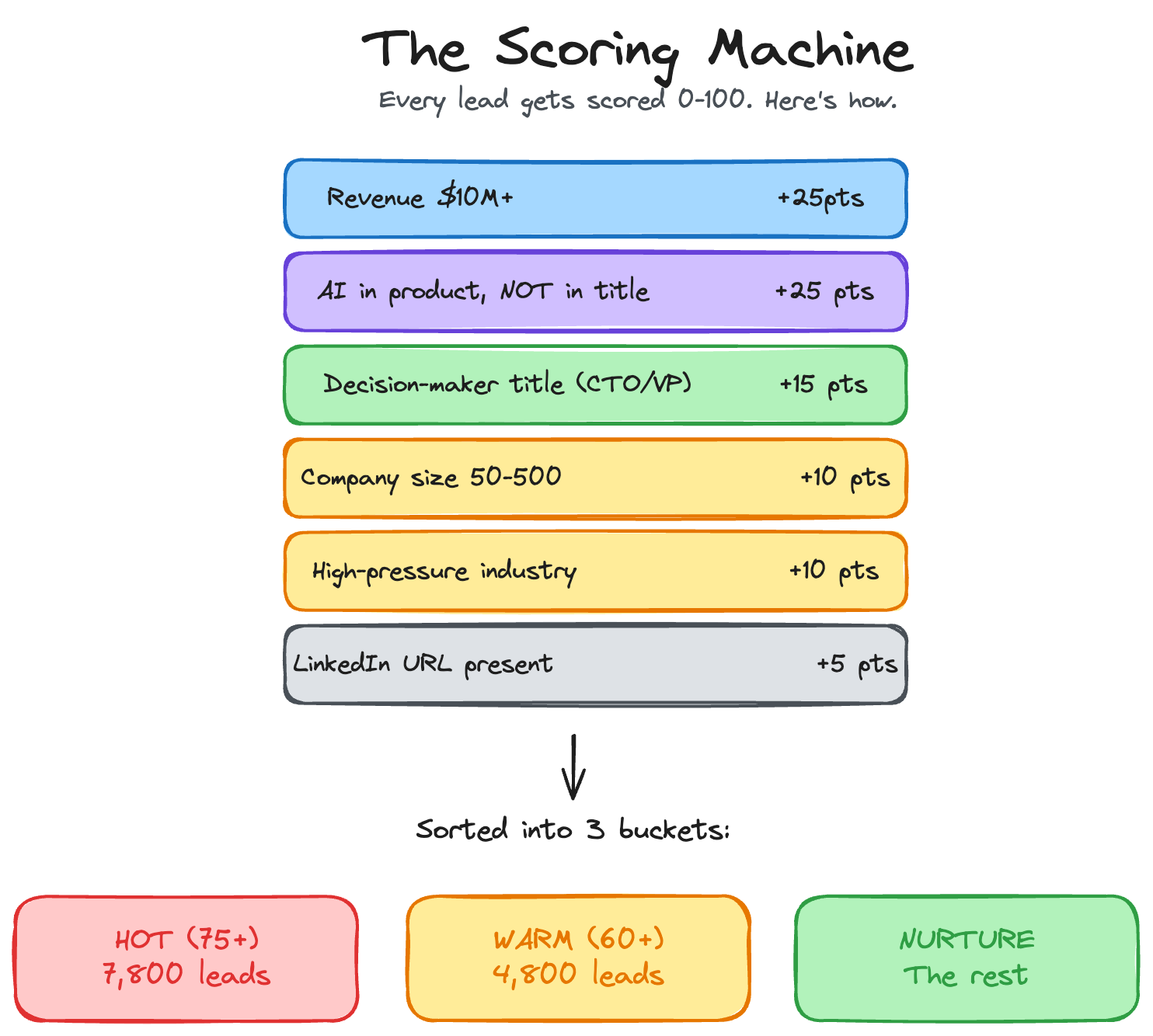
I came up with a basic scoring system, 0-100 on six signals:
- Revenue $10M+: 25 points
- AI in product, NOT in title: 25 points
- Decision-maker title (CTO, VP): 15 points
- Company size 50-500: 10 points
- High-pressure industry: 10 points
- LinkedIn URL present: 5 points (this is for cold outbound email, not LinkedIn DM so I scored this low)
Claude built the scoring logic in 20 minutes.
The numbers
24,000+
qualified decision-makers with verified email and LinkedIn URL
- Leads generated: 24,000
- Verified email rate: 100%
- LinkedIn URL rate: 100%
- Tier 1 (hot): 7,800
- Total cost: $230
- Cost per lead: $0.0096
- Time: One afternoon
- Scripts built: 6 (reusable)
The pipeline runs again with one command.
New leads, new cohorts, same scoring, same CRM push.
The $230 was setup.
Ongoing: $0.002 per lead.
If you want to do this yourself
You need four things:
- Claude Code (
npm install -g @anthropic-ai/claude-code), and my install guide here - Apify account ($29/mo Starter for 5K leads, $199/mo Scale for 20K+)
- A CRM (HubSpot free tier works)
- A cold email tool (Instantly, Smartlead)
Describe your ICP, the tools you have, and the outcome you want.
Claude evaluates providers, builds scripts, runs them, hits errors, debugs, and iterates.
Your job: describe the outcome and keep ushering Claude toward it.
Active work: 1-2 hours defining your ICP and answering questions.
Waiting: 2-4 hours.
Total: one afternoon.
Want to save a bit more time?
Subscribe and reply “send me the prompt” to this email and I’ll send you the exact template I used so you save time.
AI Native is the competitive advantage
ZoomInfo costs $15,000 a year.
A lead gen agency may charge $10,000 per engagement.
Clay runs $15,000+ at scale.
These prices exist because the work used to require specialized knowledge, proprietary databases, and human labor.
I spent $230.
The old way
$15,000+
ZoomInfo, agencies, Clay waterfalls, weeks of work
Claude Code
$230
One afternoon. 24,000 scored leads.
Every enterprise capability that used to require headcount, budget, and vendor relationships is getting compressed into a prompt and an API key.
Sales ops. Data engineering. Market research. Financial modeling… and more.
The moat was access to information and tooling.
That moat is draining. There is an arbitrage for those investing in building AI native skills.
So what does “competitive advantage” mean when an AI founder with Claude Code can replicate in hours what a 5+ person sales team builds over months?
Honestly, it’s looking more and more like the more time you spend building skills to be AI native, the greater your advantage.
This afternoon I spent proved it to me.
Next steps?
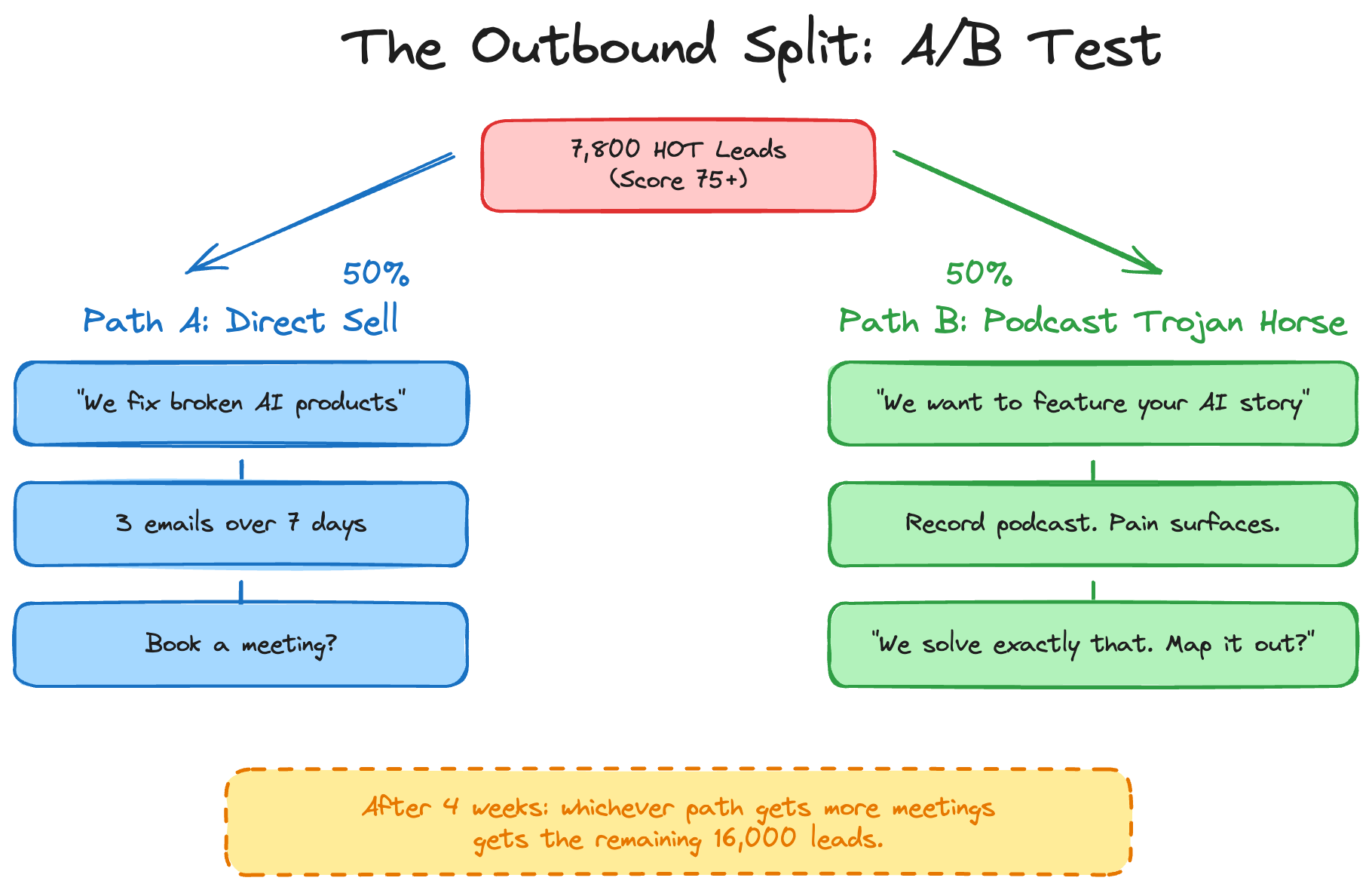
I’ll be starting this outbound split test with a direct cold sell vs. podcast interview approach I got from Alex Hormozi. We’ll see what converts better over time.
I’ve warmed up my email accounts and will be starting these via Instantly.
I may switch that backend for email sends to Resend in the future for better pricing.
Always more to do.
The One-Person $80 Million Company
This was one of my favorite stories last year.
A 31-year-old Israeli developer named Maor Shlomo was traveling through Southeast Asia with his laptop.
No co-founder. No funding. No team.
He started building Base44, an AI-powered app builder.
Ninety percent of his code was written by AI. Cursor, Claude, Gemini.
He structured his entire codebase to make it easier for models to write and maintain.
Three weeks after launch: $1M ARR. Within six months: 400,000 users, $200,000 a month in revenue.
80M
dollars cash. Wix acquired Base44 six months after Shlomo started building it.
Then Wix acquired Base44 for $80 million in cash.
His quote, from a Lenny’s Newsletter interview:
“In the age of AI, one person is no longer just one person.”
— Maor Shlomo, founder of Base44
The tools closed the gap between what one person can do and what used to require a funded team.
Well-funded competitors existed in his space. They had engineering teams, design teams, go-to-market teams.
He had a laptop, Cursor, and grit.
The question I keep coming back to: what are you building with that gap?
The arbitrage is real. It favors the people who invest time in learning how to work with these tools.
Not the people who can afford the most expensive vendor. Not the people with the biggest team.
The people who sit down and figure it out.
Which is why I’m spending all my time obsessed with figuring it out, and sharing it with you all.
What are you building? Hit reply, I’d love to know.
References
- [1]Claude Managed Agents: 10x faster agent buildingTechRadar · TechRadar · 2026
- [2]Claude Sonnet 4.6Anthropic · Anthropic Blog · 2026
- [3]Microsoft Ships Production-Ready Agent Framework 1.0Visual Studio Magazine · Visual Studio Magazine · 2026
- [4]AI Tools Race Heats Up: Week of April 3-9, 2026Alex Merced · DEV Community · 2026
- [5]6-month-old, solo-owned vibe coder Base44 sells to Wix for $80M cashTechCrunch · TechCrunch · 2025
- [6]The Base44 Bootstrapped Startup Success StoryLenny Rachitsky · Lenny's Newsletter · 2025