
Hey there! I’m Robert. Welcome to a free edition of my newsletter. Every week, I share my story of building my AI startup in public, focused on hyper-personalized AI. These newsletters include my reflections on the journey, and topics such as AI, personal growth, CEO-ing, leadership, product, engineering, communication, and more. Subscribe today to follow along.
Last week I sat in a high stakes customer meeting, listening to requirements for our initial 6-figure deal with them.
For us, this deal can expand to potentially be 2M+ LTV payback over the next few years.
Big deal for sure for our young startup. But we gotta work hard and play our cards right. We’re taking the Forward Deployed Engineer approach right now.
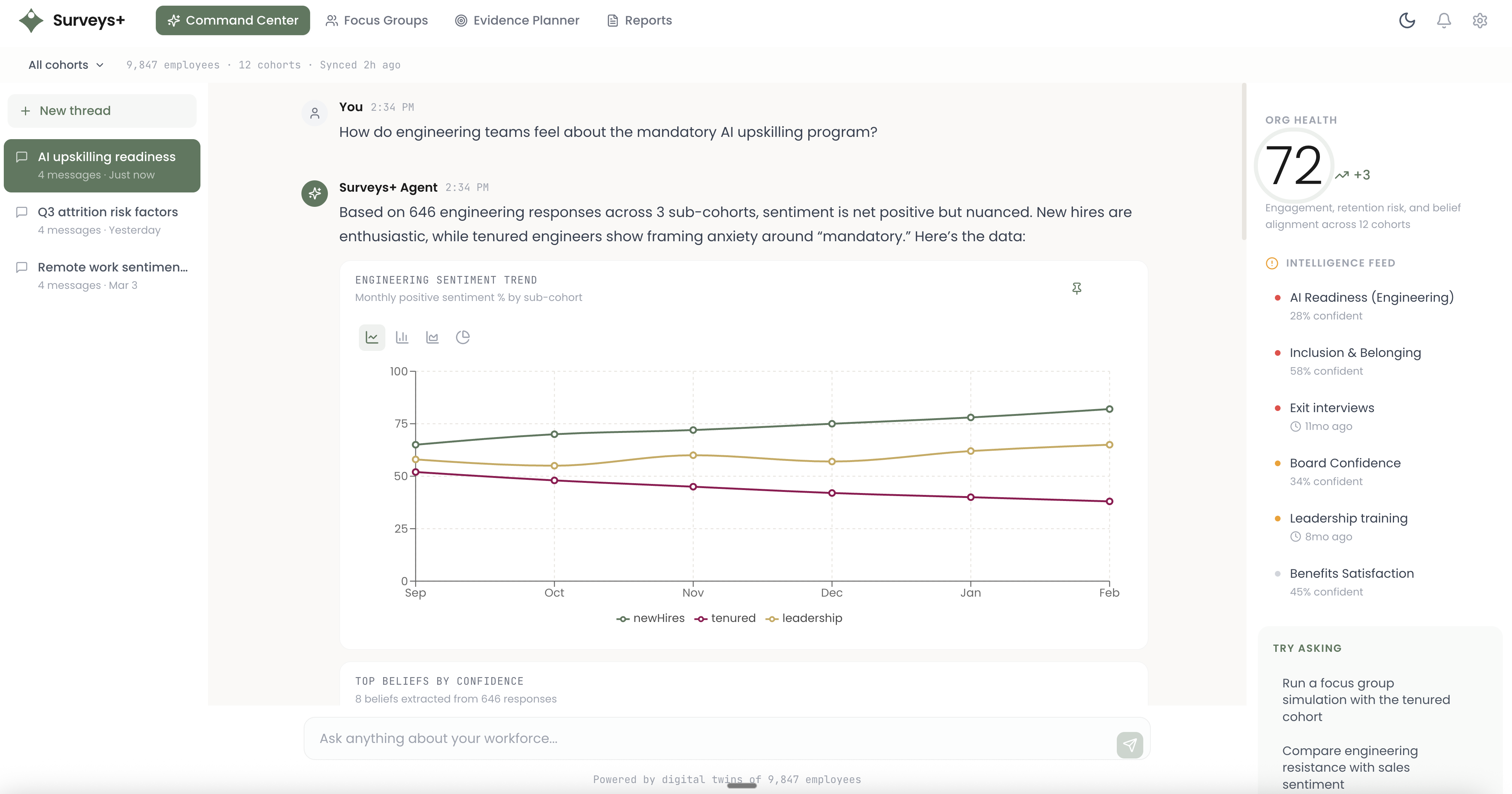
15 minutes later, I had built Clarity digital twins of every stakeholder in the room. The Chief AI Officer, the Head of Platform Product, etc.
Those twins had guided me to a stakeholder-approved prototype.
Not a wireframe. Not a slide deck.
A working prototype that the executives were able to give feedback and validate before the next meeting started.
Anyone in the enterprise software landscape knows how slow B2B cycles are. And I just used our own product, to make this faster by minutes and not days.
Zooming out, I keep thinking about what that means.
Not just for what we’re building at Clarity.
But for everyone building in the AI era.
Software, is definitely no longer the moat. These tools will get better.
This is how I see the layers of moats for software businesses in the AI era, shaped around user models at the very bottom.
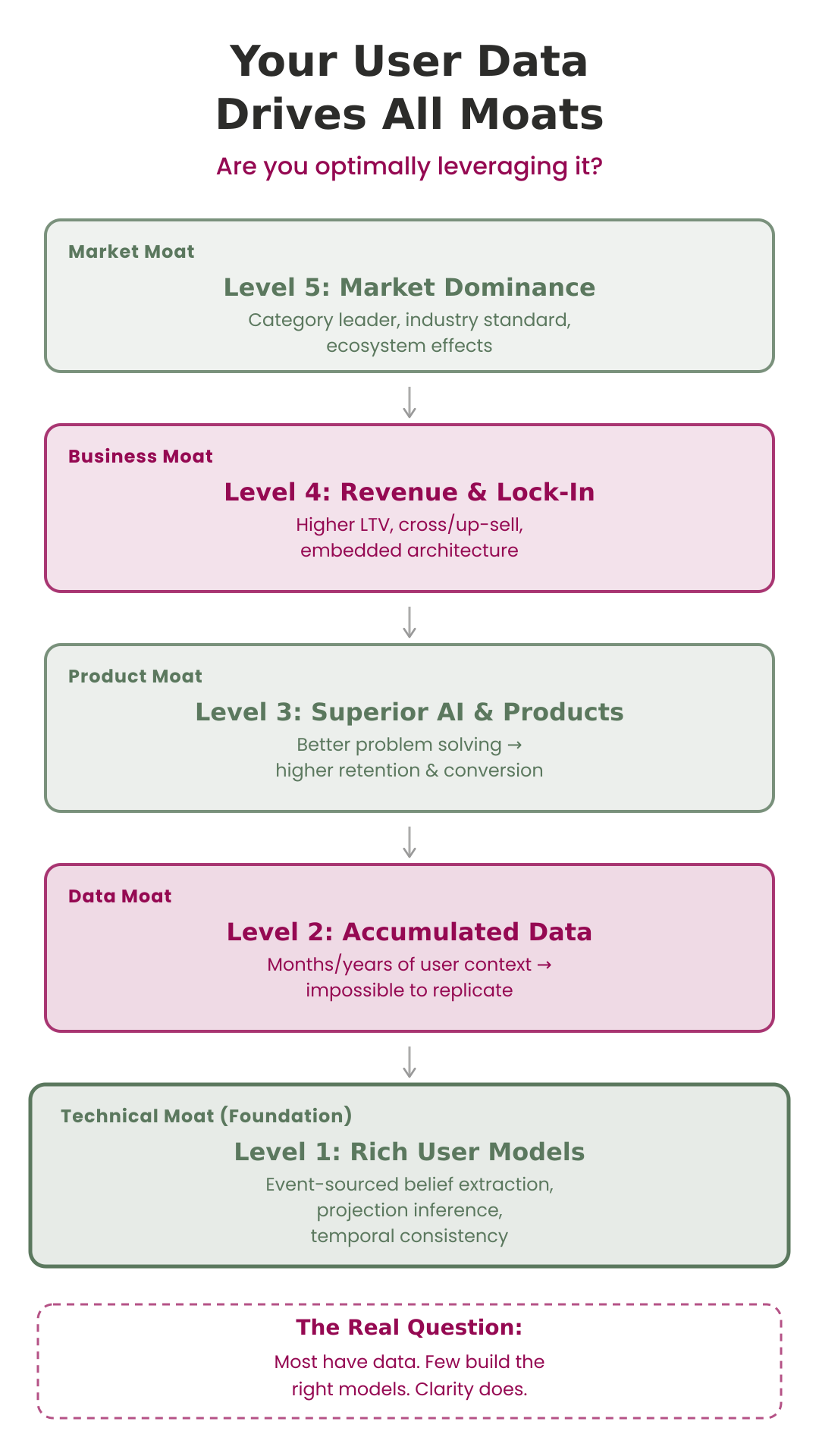
The future belongs to the teams and organizations with the greater ability to capture learning from market signals (demand) and then to create product (supply) to capitalize, and compound it.
And I believe that the companies that will win, will embrace modeling humans as the tip of the spear.
What’s Inside This Week:
🤖 ALIGN: Claude Code Review ships multi-agent PR analysis, NVIDIA open-sources enterprise AI agents
🛠 BUILD: Three ways I use Clarity digital twins to run my startup AI native and lean
✌🏼 CULTURE: The Japanese sword and the fifteen minutes
The AI Moves That Matter This Week
Hand curated AI, tech, and business related topics I’ve found in the past week.
Anthropic Shipped Multi-Agent Code Review, and the Numbers Are Wild
Code Review for Claude Code dispatches teams of AI agents to scrutinize every pull request in parallel, then verifies and ranks findings by severity. Before this shipped internally at Anthropic, 16% of PRs got substantive review comments. After? 54%. That’s a 3.4x improvement in code quality feedback.
0x
improvement in code quality feedback after multi-agent review
This is the real unlock nobody’s talking about. Code output per engineer grew 200% last year. The bottleneck was never writing code. It was reviewing it. Anthropic just turned their biggest internal pain into a product. That’s the founder move. You don’t build what sounds cool. You build the thing that’s been driving you insane.
The bottleneck was never writing code. It was reviewing it.
NVIDIA Open-Sources NemoClaw: Enterprise AI Agents Without Vendor Lock-In
Jensen Huang is revealing NemoClaw at GTC on March 16. It’s an open-source AI agent platform that’s hardware-agnostic (runs on NVIDIA, Intel, AMD chips) and lets enterprises deploy autonomous agents for reasoning, planning, and multi-step execution. They’re pitching it to Salesforce, Cisco, Google, Adobe.
Robert’s Take: NVIDIA making their agent platform hardware-agnostic is a chess move three years ahead. They’re saying “we don’t care whose chips you run on, as long as agents become the default.” When the infrastructure layer goes open-source, the value moves up to whoever understands the actual problem being solved.
Claude Code Is Now the #1 AI Coding Tool
In just eight months, Claude Code leapfrogged GitHub Copilot and Cursor to become the most-used AI coding tool. Engineers now report doing 70%+ of their coding work with AI assistance.
0%+
of coding work now done with AI assistance
I’ve been saying this for months. The gap between “AI-assisted coding” and “AI-native development” is the same gap between using a calculator and understanding math. Claude Code isn’t a tool I use. It’s how I think about building software. The 70% number undersells it.
3 Ways I’m Using Digital Twins For Startup Efficiencies
B2B Enterprise Sales
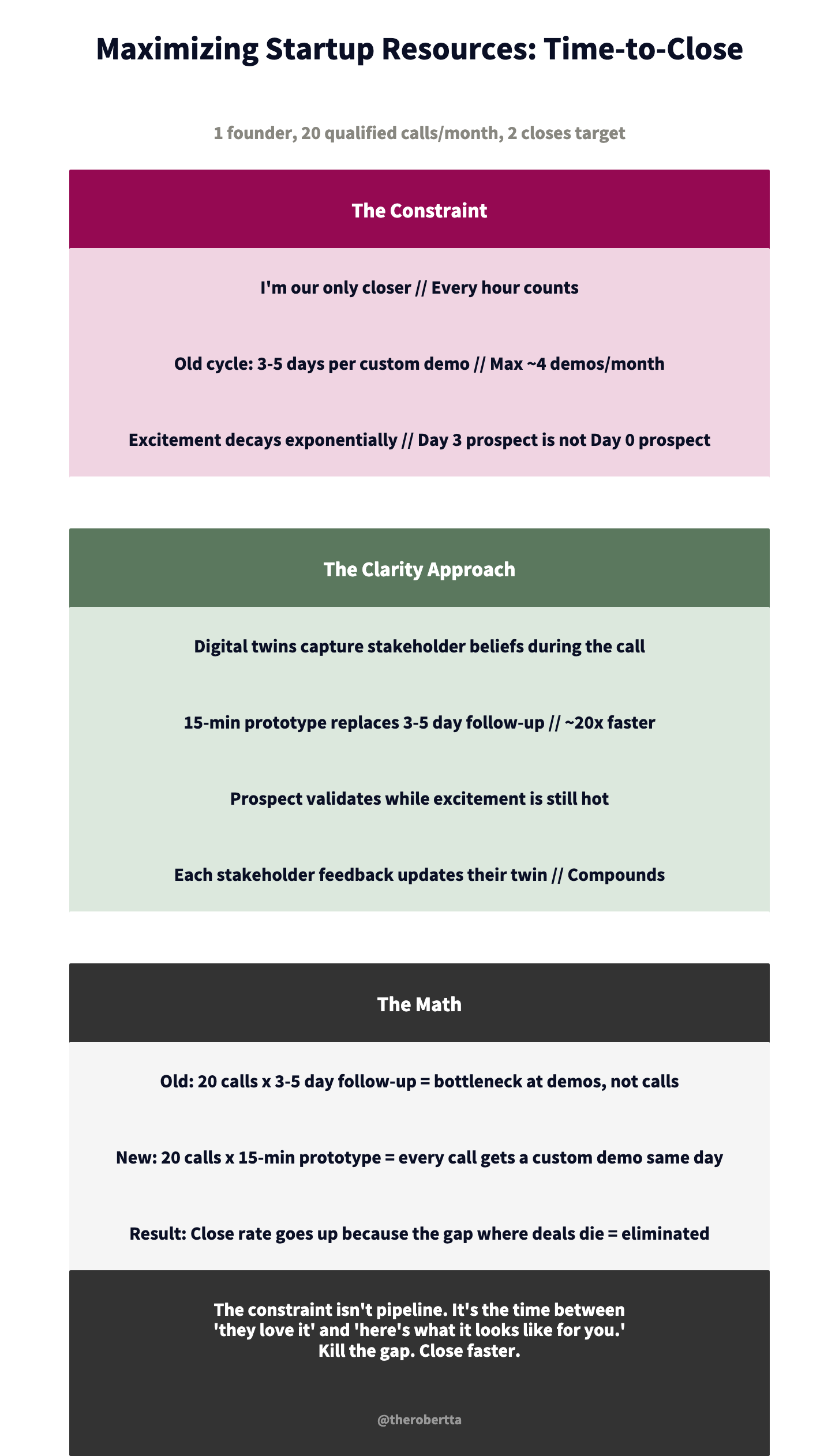
We’re finding more signal that Clarity API B2B is the way to go. With that, comes the need for founder led sales. We need hyper-efficiency because we’re small, and I’m our only closer.
With my new website revamp and GTM engine, I’m targeting 20 qualified leads on a call every month, and at least 2 closes. Those would be great numbers, we’ll see how it goes.
My thinking: I don’t want to be taking calls with just anyone. People with a budget or those who are close to influencing the decision maker. I also want to shorten the cycle of prospect call to closing and us starting fulfillment.
Here’s the old workflow. Tell me if this sounds familiar.
Prospect gets excited on a demo call. You can feel the energy.
They ask the magic question: “What would this look like for us?”
You say the words every founder hates: “Let me get back to you on that.”
Then you spend 3-5 days building a custom demo.
Your engineer grumbles about “one-off work.”
Your designer needs context they don’t have.
By the time you send the follow-up, the prospect’s excitement has cooled from a rolling boil to room temperature.
I know this because I lived it. In my time at Workday leading product architecture, I watched deals die in the gap between “that’s amazing” and “here’s what it would look like.”
So when I started building Clarity and our business from the ground up, I asked different questions:
What if the follow-up didn’t exist?
What does AI native really look like?
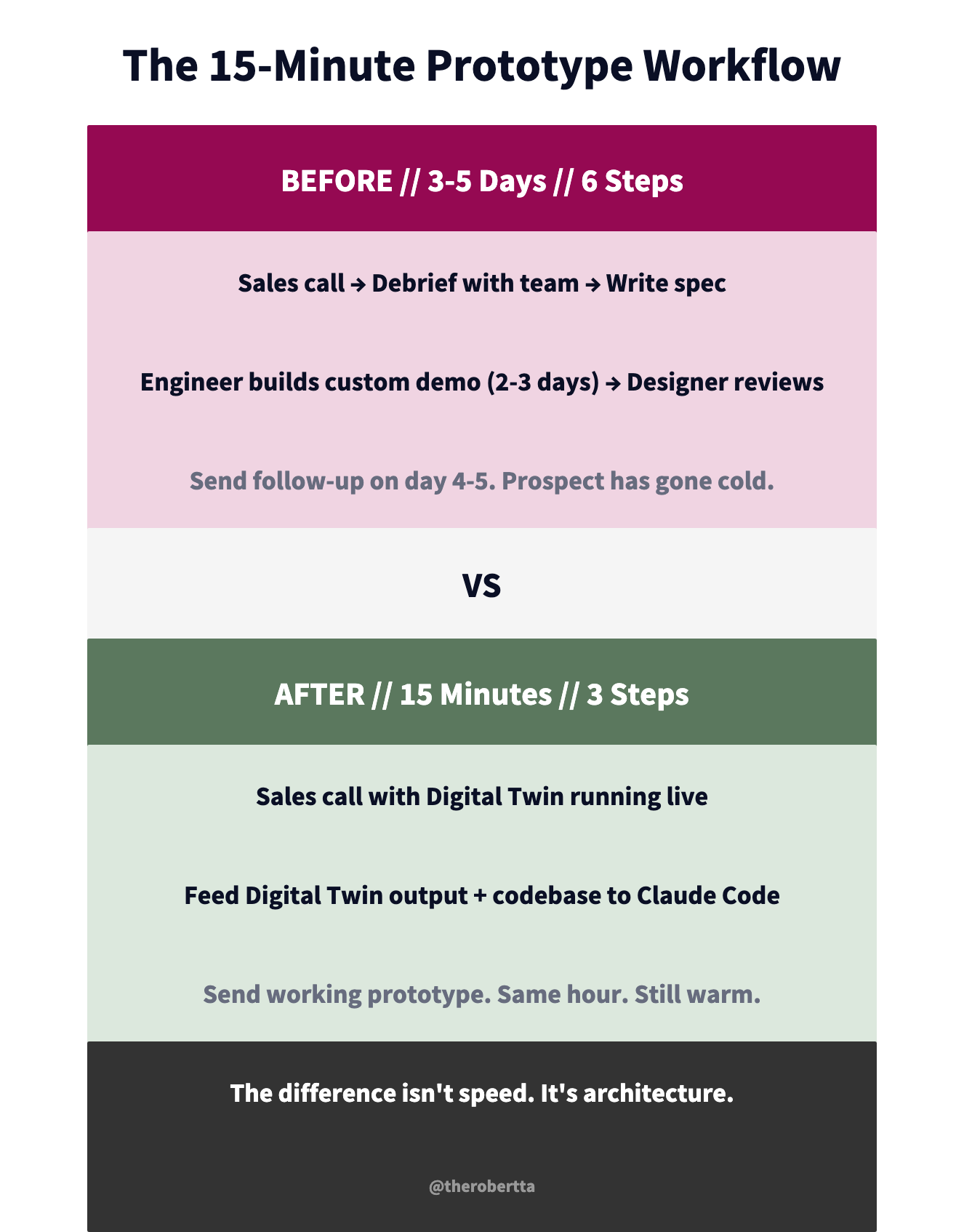
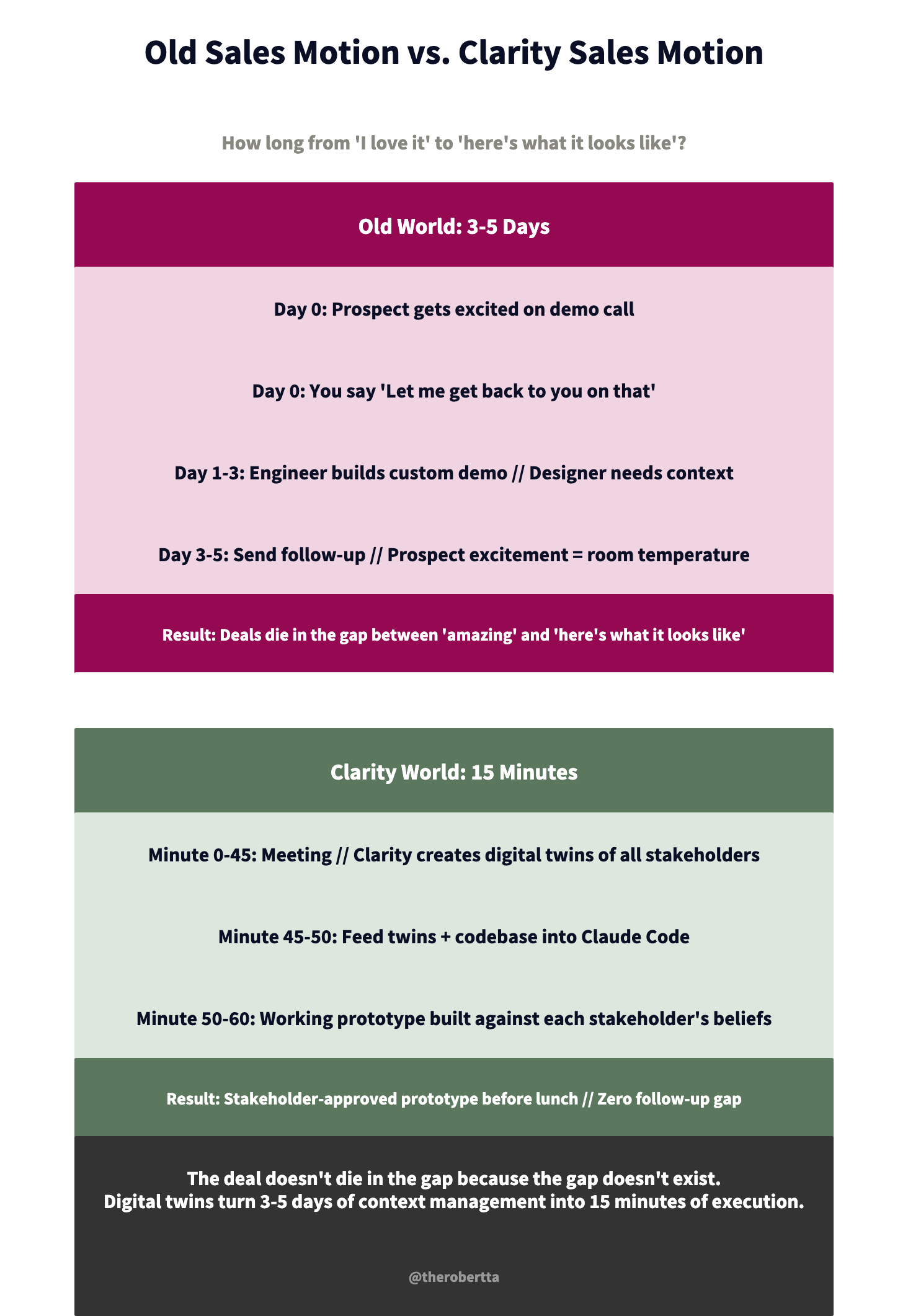
Old World
3-5 days
Build custom demo / engineer grumbles / designer needs context / prospect cools off
New World
15 min
Digital twin captures beliefs / Claude Code builds prototype / stakeholder validates on the spot
My Digital Twin Shipped The Prototype
Here’s what actually happens now.
I’m running Clarity’s own product for our enterprise sales motion. Every call, I feed the transcripts to Clarity and create digital twins of all stakeholders involved.
Clarity doesn’t just collect what someone says. It models their beliefs, their epistemics, their self-model, with probabilistic confidence scoring.
By the end of a 45-minute call, I have something most founders don’t have after months of customer discovery: a structured representation of how this prospect thinks about their problem.
That’s the input.
The output is what happens in the 15 minutes after I hang up.
0 min
from meeting end to stakeholder-approved prototype
One Shot, One Prototype, Move The Deal Forward
I open Claude Code. I feed it three things:
1. The prospect’s Digital Twin output from Clarity. Their beliefs about their problem space, structured as epistemics. Not notes. Not a transcript. A model of them.
2. Our component library. Clarity’s actual codebase, patterns, and API endpoints.
3. A single prompt: “Build a prototype using our design system and brand guidelines, towards the pain points that demonstrates how Clarity solves [prospect’s specific problem], and let’s focus on an agent native architecture around the employee experience to help with HR teams to drive higher throughput of quality decision making.”
Why This Works
The Digital Twin is structured data about the person’s who, what, why, and how.
Most “personalization” in enterprise sales is surface-level. Swap the logo. Change the industry vertical in the slide deck. Maybe reference their company name in the demo. Clarity’s Digital Twin captures epistemics.
Actual beliefs.
How someone thinks about their problem, what they’ve tried, what they believe about why those things failed, and what “success” means to them.
That’s understanding.
Our thinking is: if we can model the person, then we can compound our learning rate towards solving their problem.
From a business lens, just think about how many humans you have to keep aligned from one customer meeting in the old days. That’s a lot of high friction context management.
I’m saying: using digital twins, you keep everything aligned towards the most valuable outcomes for your customers at the intersection of your business.
If we can model the person, then we can compound our learning rate towards solving their problem.
The agentic workflow with the right context from Clarity means it reads our design and brand guidelines, our codebase, understands our patterns, plans changes across multiple files, runs tests, and iterates on failures towards the stakeholders’ goals.
The compound effect of belief-native architecture. Clarity’s entire architecture is built around beliefs as first-class data objects. That is our primitive.
We were very intentional about choosing our data primitive.
If you read the strategies of compound software businesses like Salesforce and Rippling, you see that they were intentional about the data primitives they built their whole empires around.
For Salesforce, that is the customer.
For Rippling, that is the employee.
For us, that is the human.
Our API doesn’t return user preferences or behavioral segments based on surface level clicks. That’s the old world.
Clarity returns epistemics. Self-models. Belief structures.
A deep and highly considered model of the customer.
The data that shows you the why behind the human’s actions.
So when Claude Code generates a prototype against Clarity digital twins, it’s not stitching together generic components in my workflow.
It’s building something that optimizes my chance of winning the sale, landing the deal, and ultimately the throughline to go-live and ensuring the customer gets value.
And when the stakeholders give me feedback, their Clarity digital twins are updated.
Case 2: Co-Founder and Team Alignment
I’m a big believer that habits build results. If we operate with excellence, and have excellent team habits, we will get to our outcomes faster.
If the team is unaligned in their actions, we will be slower to the outcome.
So team alignment is absolutely essential.
My Co-Founder Jonathan and I are now using our Digital Twins for every single one of our meetings to make sure we eliminate “alignment debt” between us. There’s so much happening, conversations to get on the same page can be frictionful.
We are actively keeping our digital twins up to date. They contain our evidencing of our beliefs that inform our perspective on the right strategy and priorities.
Brass tax, that’s what’s happening when you’re arguing about priorities: you’re trying to recall through your human brain all the evidence points that matter that inform the opinion, making sense of it all together as a team.
Therein lies the friction.
Our brains are not made to contain all this context. Many teams will use things like Notion, Spreadsheets, or custom tooling to track their experiments and learning.
We take a radically different approach: our twins are the asset that compounds our individual and collective learning.
So, they also logically help with alignment on priorities.
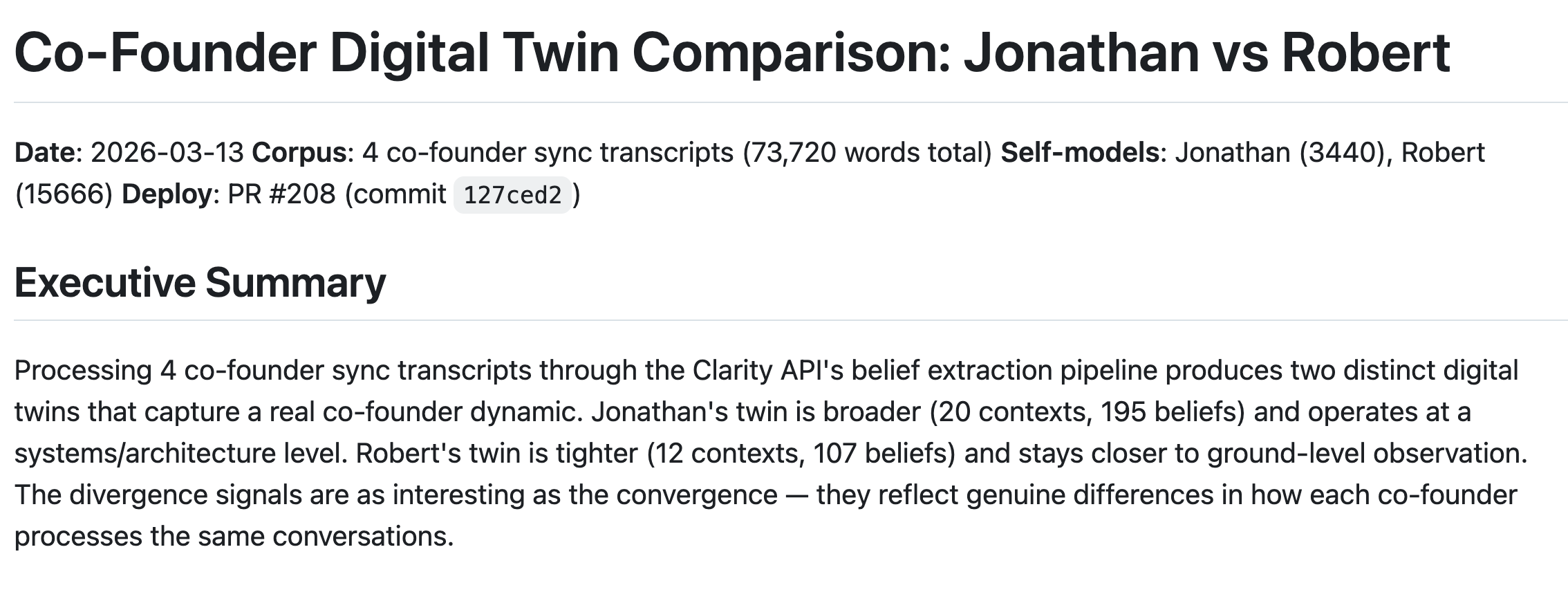
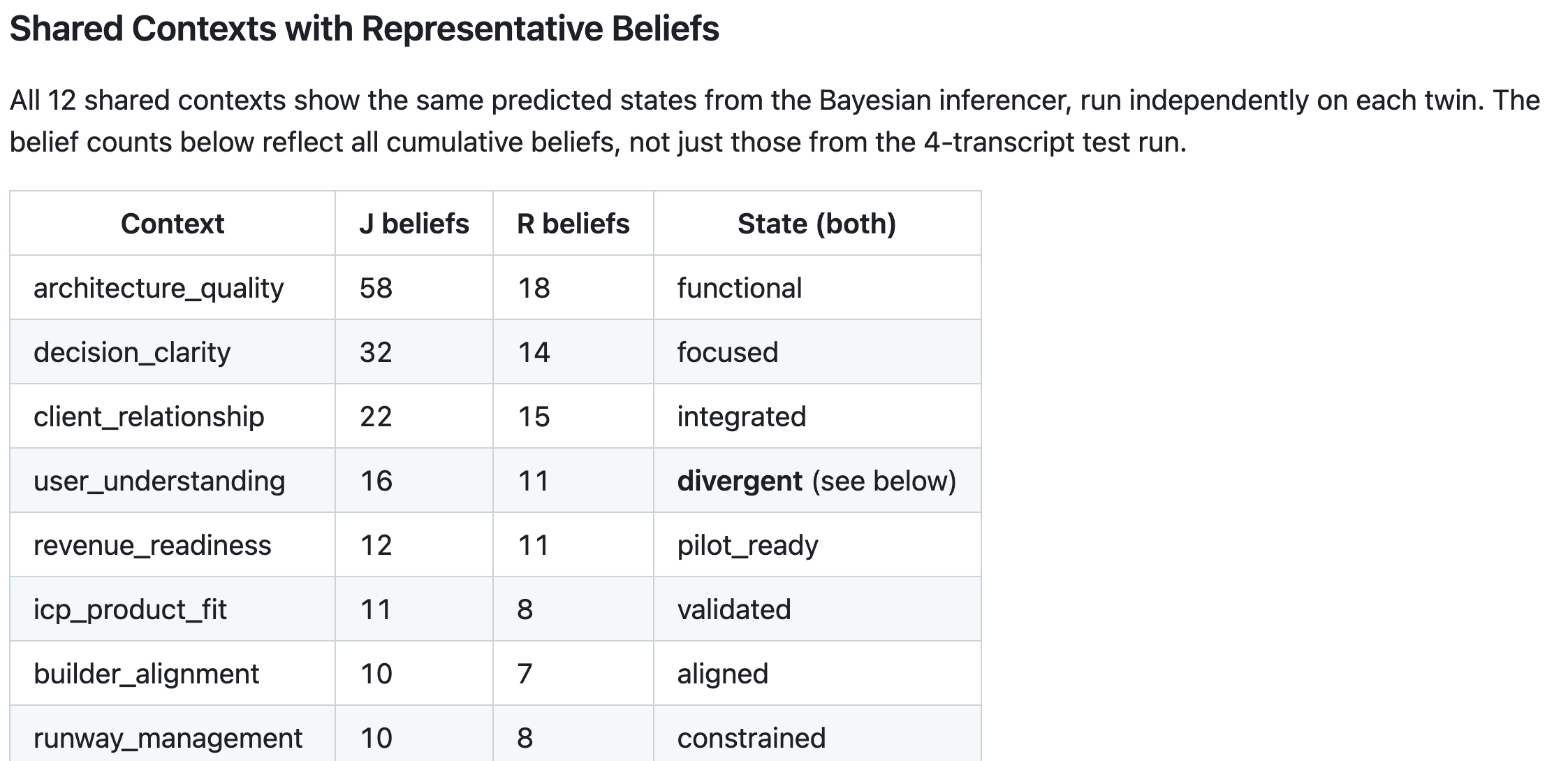
Old World
Argue
Long conversations / maybe arguments / friction to get aligned on priorities
New World
Compound
Digital twins compound learning / get on the same page in a fraction of the time
Case 3: Ship Code That Makes Money
We’re still a small startup. Sam Altman says that this is the era of the first $1B 1 person company. We’re using small to our advantage.
And as I wrote about before on how I am using AI to automate my website and CRO, any time we have an itch to hire we will instead try as hard as possible to use AI and agents to solve the problem.
The problem: Even though we can ship 100+ PRs a week each (and I’m sure this will be 1000s in the near future), we need to make sure we’re super aligned on shipping code that actually makes us money by solving actual customer problems.
Old World
1-2 PRs
Ship 1-2 PRs a week / human review / ensure code builds a software asset that makes money
New World
100+ PRs
Ship 100+ PRs a week / AI + human review / goal-aligned to business and customers at scale
For this problem we started using our digital twins of customers/prospects to help us goal-align our PRs. I also use Jonathan’s digital twin for code reviews on my pull requests for new features on Clarity API.
We can put out so much code now, the aim is actually making sure it’s not AI slop and actually goal-aligned to the business and our customers.
So, we built Clarity Builder to model all our stakeholder digital twins (customers, prospects, each other) to critique all the code we’re shipping and ensure it would move the needle on our stakeholders’ goals.
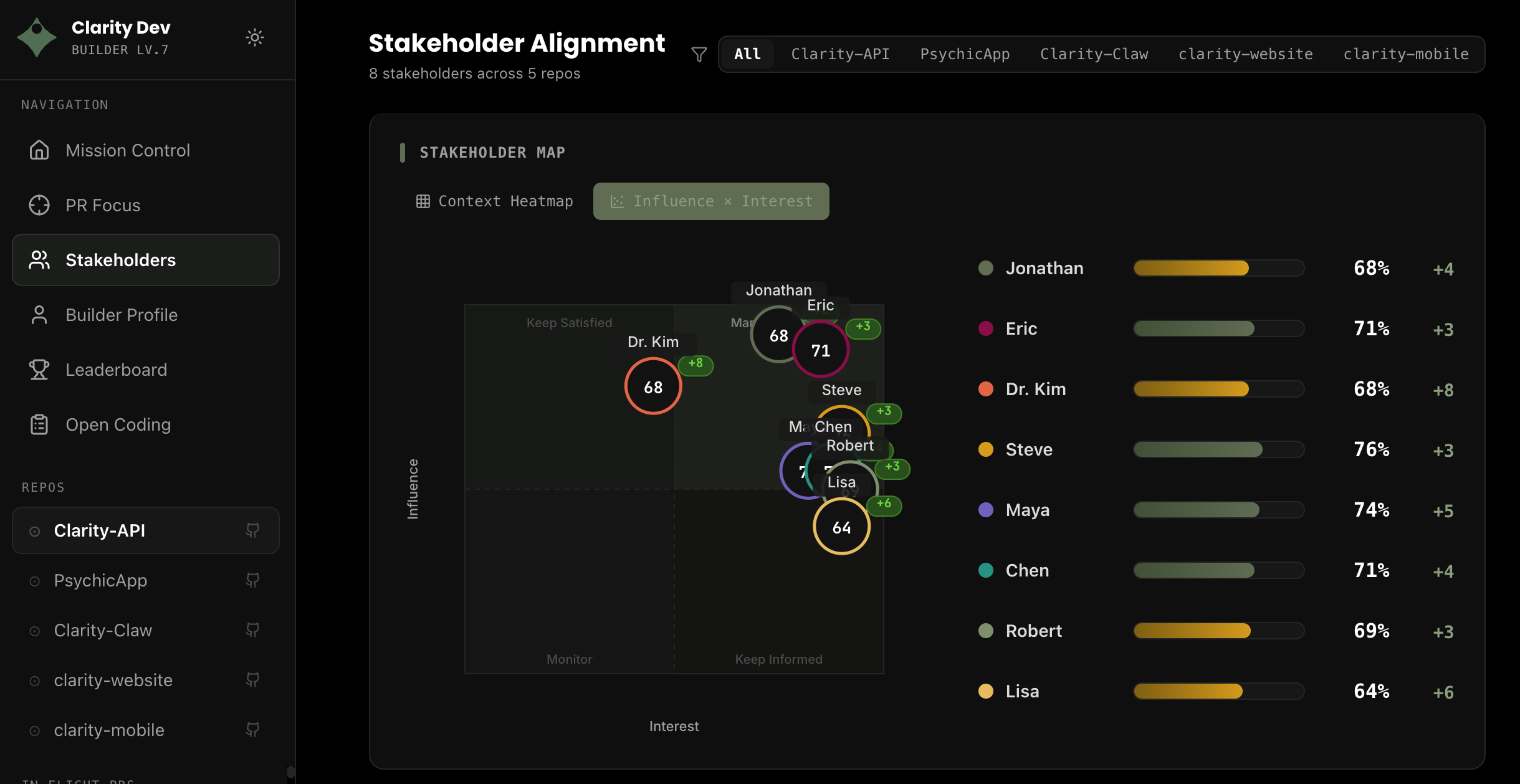
0+ PRs
per week, each goal-aligned to stakeholder outcomes
This is getting better and better as we improve our systematic evals around these features of Clarity API (subjective stakeholder goal alignment tied to code), we’re pretty excited about it.
And those use cases are just scratching the surface on how we are actually building our company and product AI native. We dogfood our own product, to run our own company. Hell yeah.
We dogfood our own product, to run our own company. Hell yeah.
The Japanese Sword and the Fifteen Minutes
Every week I try to learn something new about our vast world, and I share it here. Sometimes it’s related to the main article, sometimes it’s just something cool. Enjoy.
In Japanese swordsmanship, there’s a concept called ikken hissatsu. One strike, certain victory. Years of practice compressed into a single decisive moment.
The cut looks effortless. The preparation was anything but.
Something my Co-Founder Jonathan continuously reminds me of, is that the hard earned secrets are in the details. The details require effort and attention.
We’ve been deep in the weeds building, navigating tiny details on our path to product market fit and beyond. It’s been a joy to see things come above surface from our positioning, to our product.
And, we’re delivering results. (:
One of our customers is up 60% in monthly app revenue from Clarity personalization. Check out the testimonial.
Keep building.
You got this. I believe in you!
Robert
P.S. Want reminders on entrepreneurship, growth, leadership, empathy, and product?
Follow me on..