
What makes a great leader?
Giving presentations?
Rallying people?
Making big, important decisions in ambiguity?
How is someone “good” at rallying people?
How is someone “good” at making big important decisions?
Think about the leaders you truly respect.
The leaders who drive growth in people, and positive change.
The leaders who motivate and inspire you to be better.
The leaders you trust in the face of uncompromising ambiguity.
In those leaders, you will see a consistent pattern: emotional intelligence and empathy.
Empathy is the ability to place yourself in another’s shoes and be able to walk a mile in them, to truly understand what their experiences and feelings are. Empathy allows a path to connection.
Emotional intelligence is the ability to manage your own feelings, and communicate to others about emotions.
Emotional intelligence allows you to solidify connections.
Being able to thoughtfully manage your feelings and effectively communicate with others on an emotional level is absolutely imperative in great leadership.
When you hone this ability - and it is an ability you can hone - you are more centered.
When you are more centered, you *can *lead effectively. You can better connect to those you serve, and serve them better.
Think of them as muscles you can flex, grow, and strengthen. Well then, how do you strengthen these muscles?
Thanks for reading Robert’s Substack! Subscribe for free to receive new posts and support my work.
In mid July of 2019…
I was asked to participate in a pilot leadership development program at Workday in collaboration with Team4Tech, who connects tech companies with NGOs towards pro bono social impact projects.
Workday participated with Adobe in this collaboration.
In this program, I had the privilege to serve on a project with the Cambodian Children’s Fund (CCF).
I was to participate in this program and scout out whether to bring it to the larger employee population at Workday, based on its effectiveness in employee engagement and leadership development.
At the time, I was a bit underwater in my work and personal life.
At work, I was leading a few different initiatives and was asked to put together a brand new team.
To add to all of this, I was also dealing with a lot of confidence issues - and in particular, Imposter Syndrome.
As part of the program, I was asked to define what I wanted to get out of the experience.
I answered: empathy.
I didn’t really know what I was asking for. I was just trying to stay afloat amidst the waves of life and gave AN answer.
Team4Tech had been engaged with CCF for months prior to our kickoff in July. They had worked out what the 4 fuzzy deliverables would be once we were onsite. The overall intention was to empower CCF staff with tools and knowledge to bring more technology-powered education to the classroom and further their mission statement: equip the children of today to be the leaders of tomorrow, to build a better future for all of Cambodia from within.
Towards that, we were to conduct a slew of workshops for the CCF education and IT staff:
- Adobe Photoshop, Indesign, and Illustrator Workshop
- Adobe Animate and Character Workshop
- Adobe Premier & Aftereffects Workshop
- Education Toolkit Workshop
There were 2 volunteers from Workday and 6 from Adobe.
We split into teams of 2, and I got the opportunity to partner with Francis from Adobe towards building an Education Toolkit.
The other teams were involved in providing training pertaining to specific Adobe products, which the CCF staff were incredibly excited to learn about.
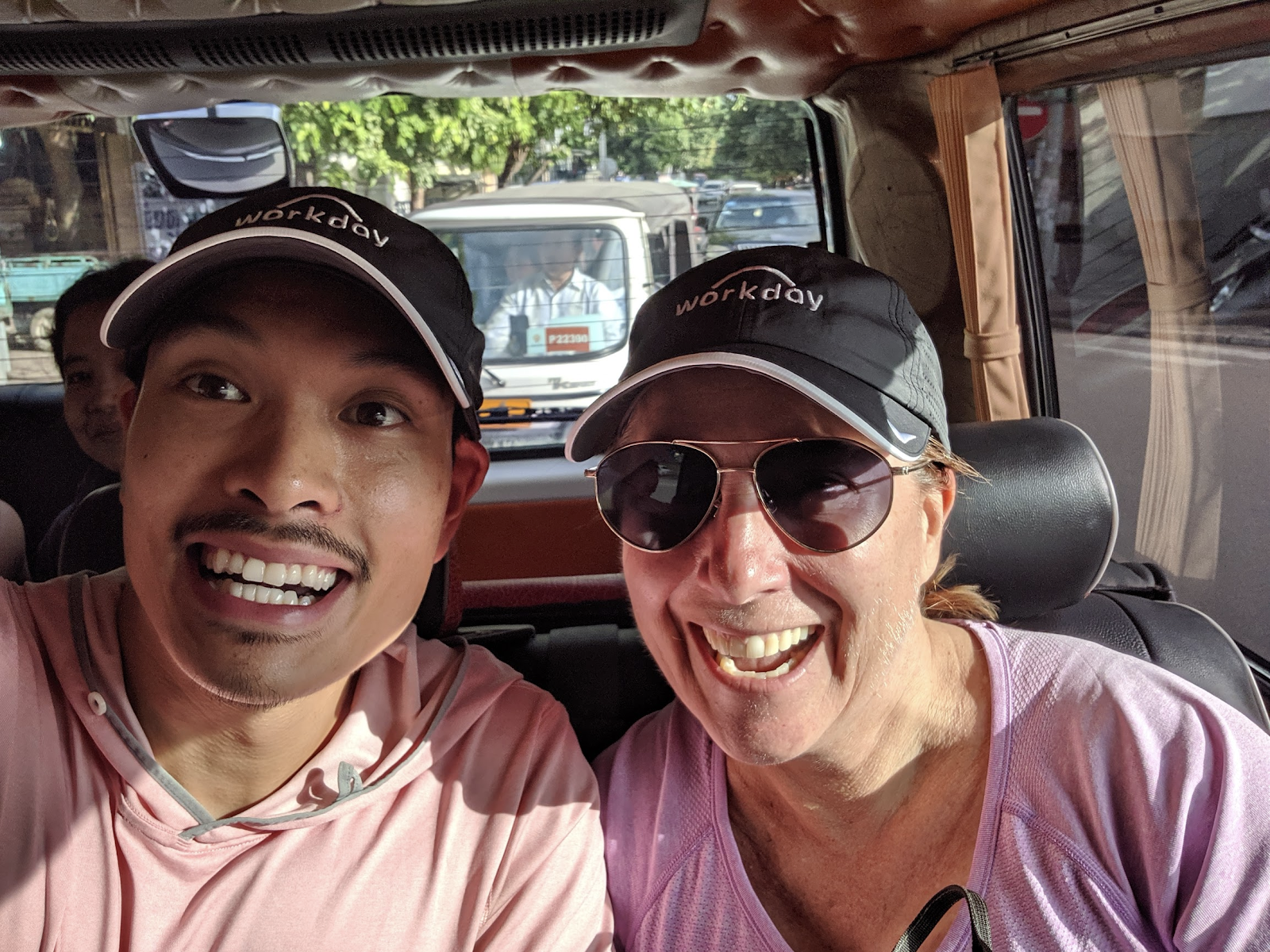
We spent 10 weeks in our Discovery phase prior to being onsite - where we met multiple times a week to learn about leadership capabilities and to create our workshop content. The idea being that once we were on site, we would conduct our respective workshops and action on the leadership capabilities we learned as part of the program.
The intention from the CCF IT staff for my team was to help implement a shared platform for centralized resources - think sharing lesson plans, curriculums, homework, tests, quizzes, etc., to reduce duplicate efforts across their organization.
The goal given to us, was to increase effectiveness and efficiency in CCF’s teacher to teacher collaboration.
Before I ever set foot in Cambodia, I hosted a few virtual deep dive interviews with select CCF teachers to really hear about their challenges and pain points towards technology-powered education.
I didn’t want to design a solution without talking to the end users first. (If any of my design colleagues are reading this - thank you for teaching me user centric design!)
Today, I share with you part 1 of a series where I did just this and learned about leadership first hand. I wrote this series 6 years ago to reflect on my growth, and have never really shared the entire story in full. Here it is. Let me know what you think.Those are actions, but what are behind the actions?
My answer: you dive face first into emotionally demanding situations, and learn.
At home, I was dealing with some family issues and a new stage in my life - home ownership.
My responsibilities were constantly shifting and piling up.
Little did I know - I was in for a LOT of empathy building with this program!
Lost and Confused
As we sat down and started really listening to their problems and frustrations - it became very apparent that a shared platform was the least of their concerns even though it was what they were asking for.
Knowledge was siloed and process was nonexistent. There were a limited amount of IT staff, and many teachers to support.
- Teachers didn’t know what the process was for checking out devices, like iPads, for their students. When we dug into this more, we realized there was no process.
- Teachers could not rely on the equipment they checked out - they didn’t know what to do when apps needed upgrading or laptops were buggy, for example.
- Teachers didn’t know when important events were happening, and how it would impact their classes.
- Teachers would try to find old lesson plans they uploaded to Google Drive, but couldn’t find them because critical resources had no controls and were often deleted.
In all of the above very common situations at CCF - what the teachers felt most was lost and confused.
Those were the feelings that were missing from the original goal that we were handed. If we hadn’t conducted these interviews, and really empathized with the human part of this engagement, we would have missed the mark entirely with our workshops.
With these discoveries, we pivoted a bit from our original goal. We formed and prioritized user stories to enable once onsite to bring the most value to CCF based on our teacher interviews:
- As a teacher, I would like a central source of truth for “what to do when x happens” to unblock me from my main priority in educating my students.
- As a teacher, I would like to have a central point of communication to be in the loop on when things are occurring that can impact my classroom.
- As a teacher, I would like a centralized system of record to reduce duplicate efforts.
And perhaps the most important of all: as a teacher, I don’t want to be lost and confused.
What we saw was a brewing organizational nightmare. Here’s what we found:
Continue reading
Get the full newsletter, free.
Join founders and builders who read Self Aligned every week.
What’s The Vision?
Much of leadership in a corporate setting is to relay a vision and strategy.
What is success for a given project?
How do we measure it - what’s the KPI?
After our discovery phase, my subteam’s KPI was to minimize the IT to education staff ratio. Allow CCF to do more with what they have.
At this point after having done my user interviews, and researching CCF to the best of my ability, I thought I understood their organization’s mission statement and goals pretty well.
And so, our original goal morphed into a new one.
We had a new “Why”: to allow CCF to scale, to get more students into the system and out of poverty.
With this humble goal, Francis and I worked towards building out workshop content to teach CCF staff about organizational efficiency and effectiveness, as well as best practices in using tools such as Google Team Drive and Google Sites to centralize resources and event communication.
We aimed to arm the teachers with the knowledge and tools to enable these stories for themselves.
I thought I knew what they needed, and that I had enough context.
I thought that I truly understood the “Why”.
Oh BOY was I dead wrong!
Tune in next week to find out what happened next…
Thanks for reading Robert’s Substack! Subscribe for free to receive new posts and support my work.
EDIT:
Liked this article?
💚 Click the like button.
Feedback or addition?
💬 Add a comment.
Know someone that would find this helpful?
🔁 Share this post.
P.S. If you haven’t already checked out podcast, ABCs for Building The Future, where I reflect on my founder’s journey building a venture in the open. Check out my learnings on product, leadership, entrepreneurship, and more—in real time!
P.S.S. Want reminders on entrepreneurship, growth, leadership, empathy, and product?
Follow me on..