
Messages From Past Self
Here’s the deeper insight tying neuroscience, to consciousness, to living and being as a human in our world:
As Anil Seth says on the science of consciousness,
“Our experiences of being and having a body are ‘controlled hallucinations’ of a very distinctive kind”
*“The brain makes its ‘best guess’, based on its prior beliefs or expectations, and the available sensory data. *
In this case, the relevant sensory data include signals specific to the body, as well as the classic senses such as vision and touch.”
And according to Karl Friston, belief systems are not static but dynamically adjusted through active inference where the system (your brain as a prediction machine) updates its internal model or changes the environment to align with its predictions.
Tell me if this is familiar…
You wake up around the same time.
You brush your teeth.
You brew your coffee, make breakfast, open your laptop, check email—because your model of how morning flows is predictable.
Let’s say something unexpected happens—maybe you ran out of toothpaste, there might be a power outage, maybe your phone died, maybe you wake up to a plumbing leak.
You feel a little “off” or anxious because the world didn’t match your model.
To reduce surprise you either update the model, or you act to restore predictability:
In Friston’s terms, you would be minimizing surprise in your prediction machine.
You act to reduce or minimize prediction errors.
If we accept that our brains are prediction machines, we can see that the thoughts and feelings driving these behaviors are simply compressed pieces of information from previous versions of you, signaling to current you.
Your past self, sending a message to your current self.
According to Levin’s work, that is the core function of memories: they are simply messages from your prior self, to your current self.
If I have more days where my morning routine is typical, my brain will come to expect those typical mornings.
But there are contexts in which these signals from your brain, do not serve your future self.
In my own experience, I’ve let emotionally triggering situations affect how I react instead of respond.
I have many regrets of being my worst self instead of my best self—expressing my anger or frustration in ways that hurt others.
There’s a question there at the intersection of this topic: Why do we get triggered at all?
(or flooded, as the Gottman’s would say from their expertise around relationship psychology)
We can view emotional triggers as simply just messages from your past self that this current situation is not good for your survival or self-actualization.
Like a cell trying to differentiate based on outdated environmental signals.
They run their lives on autopilot, executing beliefs downloaded years ago, in completely different contexts.
I know I have before, and I’ve reacted instead of responded with deep regret.
And this is where I’ve learned experientially that relationships (with others, and with yourself) can fail catastrophically.
Some examples…
But your partner, family, and friends need vulnerability to feel connected and they need to know how you’re doing to help you.
I used to believe “I’m not creative” because I had hardcore pressure to go into the sciences as a kid, not to be an artist or writer.
But creativity is subjective, and of course you can be creative in your own right.
I used to believe that talking about emotional and mental health was weakness because my family imbued that in me from childhood.
But, to be a great future dad, I’ll need to be able to be emotionally intelligent, and make space for vulnerability and connection.
Different context, different needs, same underlying messages from my past self that does not serve my future self.
Limiting beliefs, and mis-wired signals, can cause you to lose sight of purpose.
And your purpose evolves as you evolve and experience things in the world.
Maybe the old beliefs got you here, but do they serve you now?
I’ve discovered in my life that you can’t show up authentically in any relationship until you align your beliefs.
If you don’t believe you can be a better partner to your lover, you won’t take steps to do so.
If you don’t believe you can be a creative person, you won’t even try to lift a pen or brush.
If you don’t believe you can be a successful startup founder, you won’t be.
Because you can’t become your target self if you’re operating on beliefs that served past you—not future you.
“I’ll get extra toothpaste and extra groceries today, and I’ll make sure to charge my phone overnight tomorrow.”
“I’ll use a backup light, or go to a coffee shop with reliable internet, and call a plumber.”## The Representation Crisis and Clarity
Every multicellular organism faces the same challenge: How do individual cells represent their needs to the collective?
Your blood cells need oxygen.
Your immune cells need resources to fight infections.
Your neurons need glucose to think.
This is the representation problem.
And nature solved it with bioelectric signaling according to Levin’s work—what I interpret as a voting system where cells communicate needs through ion channels.
Your friend group needs to decide where to vacation.
Your family needs to navigate caregiving responsibilities.
Your neighborhood needs to address the rising cost of living.
Your book club needs to pick what everyone actually wants to read.
I used to believe “asking for help is weakness” because that’s what I learned growing up. Most human groups solve this through social and political hierarchy, maybe some democracy. This is unlike our cells which do so around the goal of maximizing information flow.
Think about your morning routine.
You have a belief system, that drives your brain as a prediction machine. The most assertive personality typically dominates because that’s what our society rewards.
The person who “always handles things” gets stuck with all the responsibility.
Decisions get made by whoever speaks first, loudest, and is willing to pay the most, not by who has the clearest needs. Because that’s what our society rewards.
It’s the same broken model we see everywhere: one or two people trying to interpret signals from dozens of relationships, making decisions with incomplete information about what everyone actually needs.
This may work in simple, stable times.
When life moves slowly.
When everyone’s needs are obvious.
When the environment doesn’t change much moment to moment.
When there’s relative homeostasis at the community level.
Now? Inadequate—especially in the age of AI.
Because life is changing so fast right now. There are new emerging technological breakthroughs every single day.
We need distributed awareness.
You need every person in your web of relationships to have goal-directedness, belief clarity, and the ability to signal their needs accurately.
If belief systems form the basis of who we are, and who we are becoming, then why isn’t everyone examining their beliefs intentionally?
If clearly signaling feelings and needs, and fueling a sense of purpose, is needed to become your best self in any context…
The answer?
In my experience, it’s just really, really hard.
It’s hard to juggle the societal demands of keeping a roof over your head,
and go find your purpose,
and go to therapy to heal your childhood wounds,
and go find the community where you finally feel you belong.
Life is complex—humans are complex, and we make things complex to boot.
In reality, changing your beliefs and investing in your own self-development and personal growth, are really hard things to juggle.
It’s taken me >8 years of therapy and 1000s of hours of reflection in solitude and intentional habit change, to get to the point where I can finally say I really love myself.
When I started therapy years ago, I hated who I was.
I had so many limiting beliefs: that I was an imposter, that I didn’t deserve love, that I could never be super fit, that I might not be a great dad in the future, that I wasn’t good at anything.
Now, I believe in myself and I have a lot of self-love.
Now, I’m training for a 100 mile unsupported ultramarathon.
Now, I’m training to climb V10 in bouldering.
All while bootstrapping my startup to a projected 6 figure annual run rate.
Now, I’ve set my sights on bigger goals: to empower every person and team on the planet to become their best selves.
I’ve learned that truly understanding myself, my feelings, my needs, and the identities that are important to me, help fuel purpose.
And I change every day—we all do. We’re dynamic. We’re not static.
It’s a virtuous cycle: if I know who I am and who I want to be, and I can act in alignment with who I want to be—then I feel purposeful every single day.
Goal-directedness.
It’s a tool that aligns being with becoming.
I originally built it, to demonstrate the power of our Hyper-Personalization for AI SDK, Epistemic Me to aid in our B2B sales cycles.
And I decided I’ll solve my own problems: fragmented journaling I don’t go back to, static personality tests not correlating with dynamic life, not being able to fully trust ChatGPT or Claude to support my decision making because they don’t consider who I want to become.
So I built Clarity, your personal thinking partner for navigating life’s complexities.
I originally built it as a demo.
Now it’s taken a life of its own as a standalone product, as more and more people are flocking to our waitlist everyday.
I believe in a future where every person has a high-fidelity representation of their current self, their target self, and the gap between them.
Where people can see how well they’re aligned in daily actions, towards their best self.
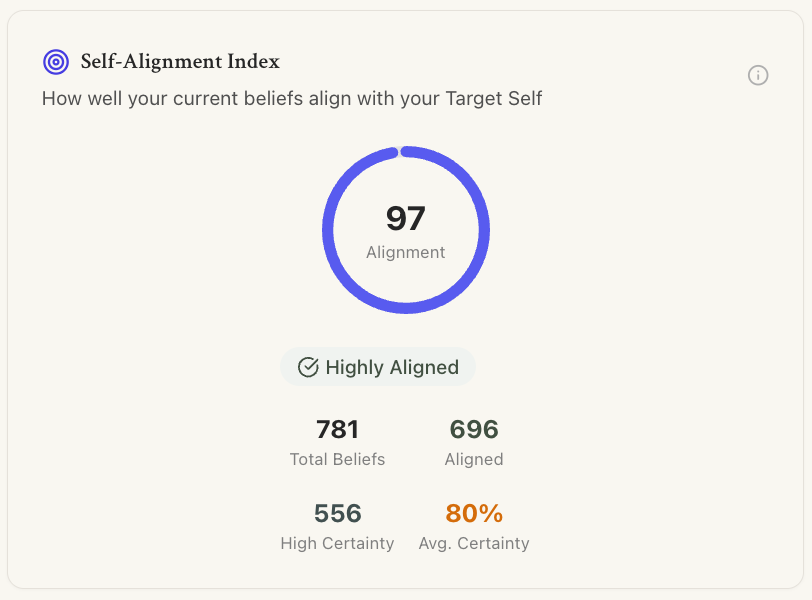
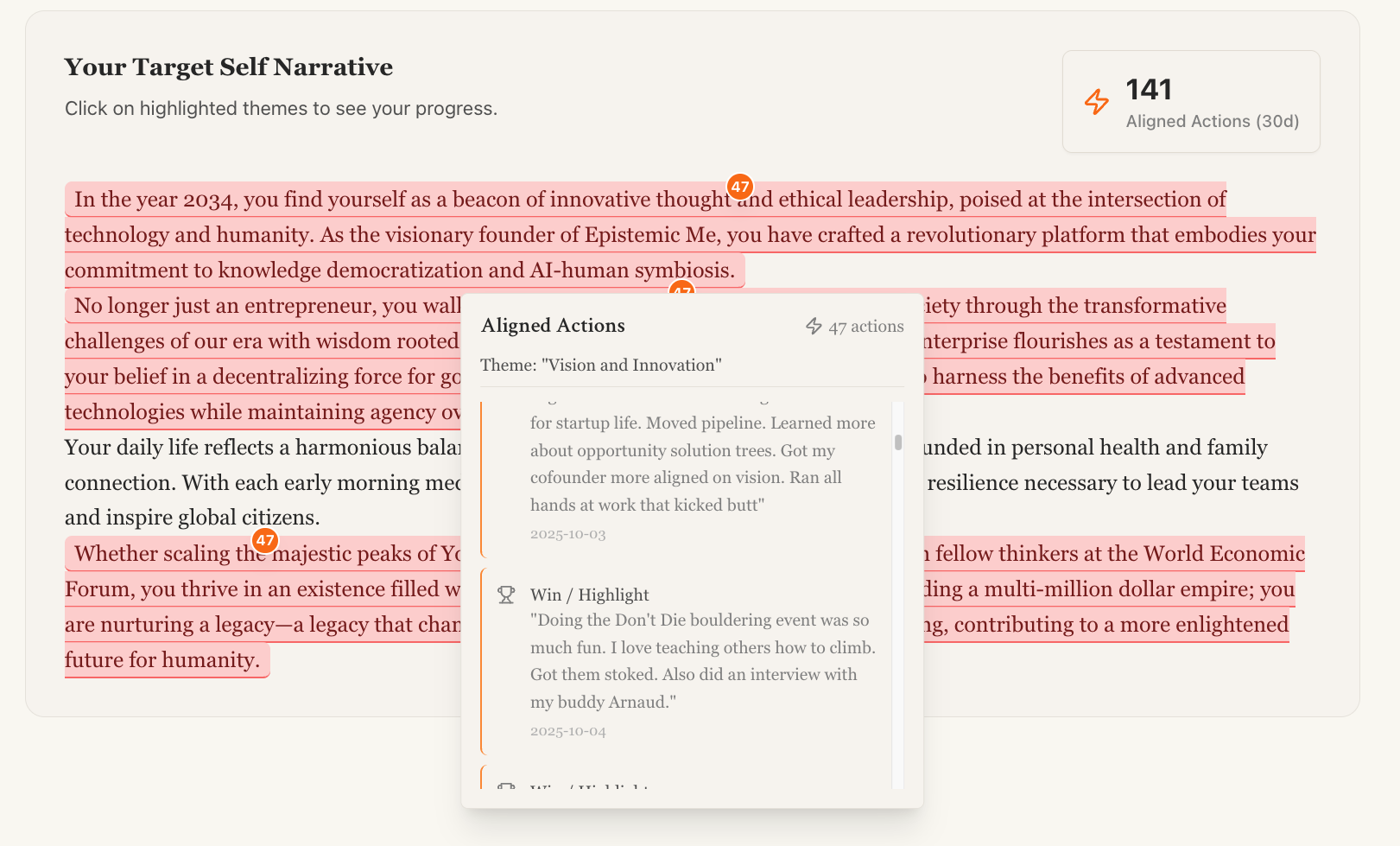
Because the fidelity of your representations determine survival and self-actualization (or beyond actualization, what I like to call self-alignment).
Not just in biology, but in every relationship you have, you have representations about the other people you’re surrounded with.
And most important from my perspective, is your relationship with yourself.
And the fidelity of that representation dictates the outcome: whether you live a life fueled with purpose, or not.
Whether your life declines further, faster, or prospers deeper, longer.
So, who decides how to allocate resources?
Communities of people face the same challenge.
On Alignment
AI alignment, to me, isn’t about controlling a single super-intelligence.
It’s about creating conditions where billions of humans, each with their own goals, can co-evolve and coordinate with AI systems to achieve collective flourishing.
Things are changing faster than any single person can track. Think about it: your cells solved this problem.
37 trillion agents, each with subjective experience, each pursuing individual goals, somehow coordinate into a single organism that can write poetry, build rockets, fall in love.
And that’s why I’m building Clarity.
Continue reading
Get the full newsletter, free.
Join founders and builders who read Self Aligned every week.
Then why aren’t we all doing that? How?
Information flow. Belief systems. Goal-directedness. Representation.
The same framework that makes multicellular life possible makes AI alignment possible.
And here’s the wild part: we’re at an inflection point.
For the first time in history, we have tools to create high-fidelity representations of human context.
And that’s exactly what I’m doing with Clarity, to show you…
Your beliefs.
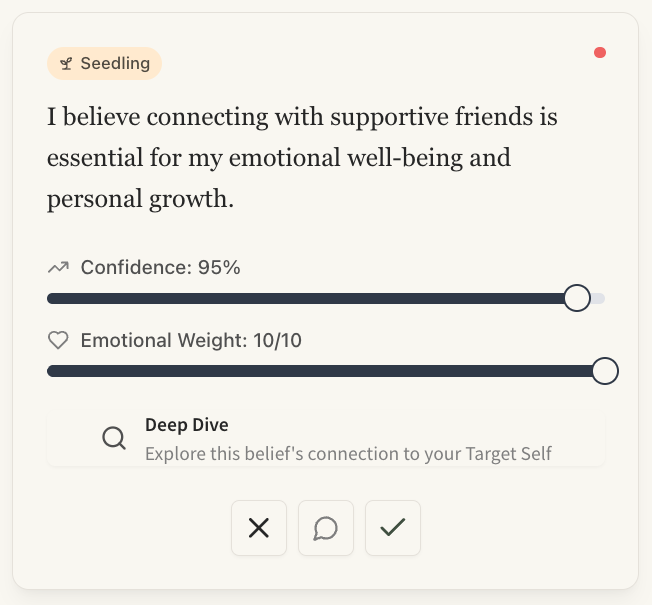
Your evidence of those beliefs.
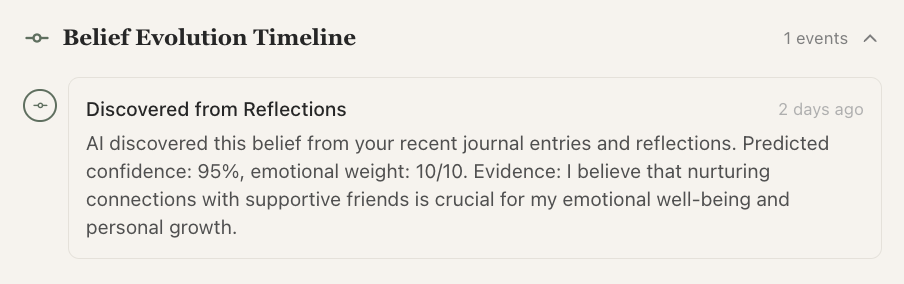
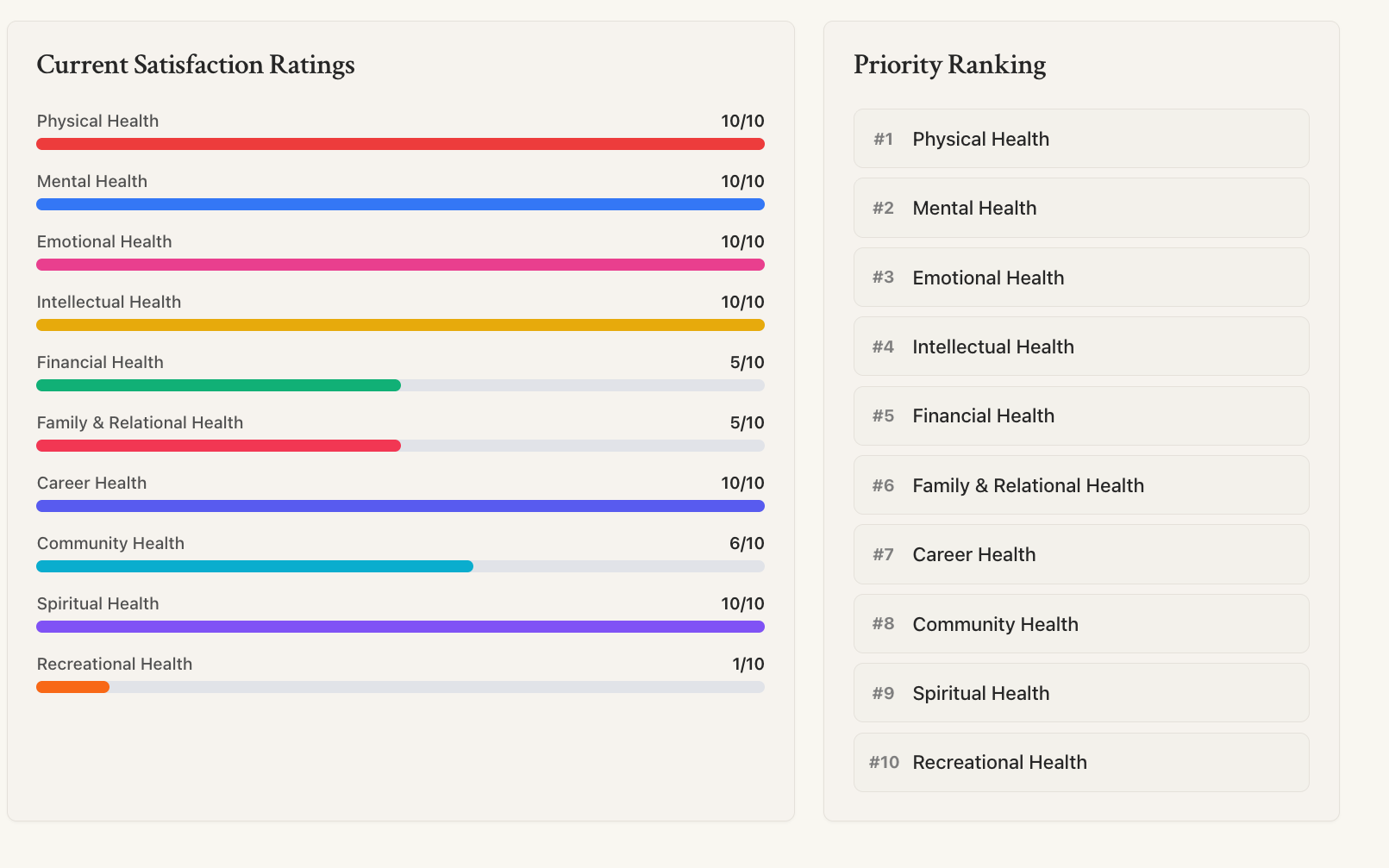
Your pillars of health.
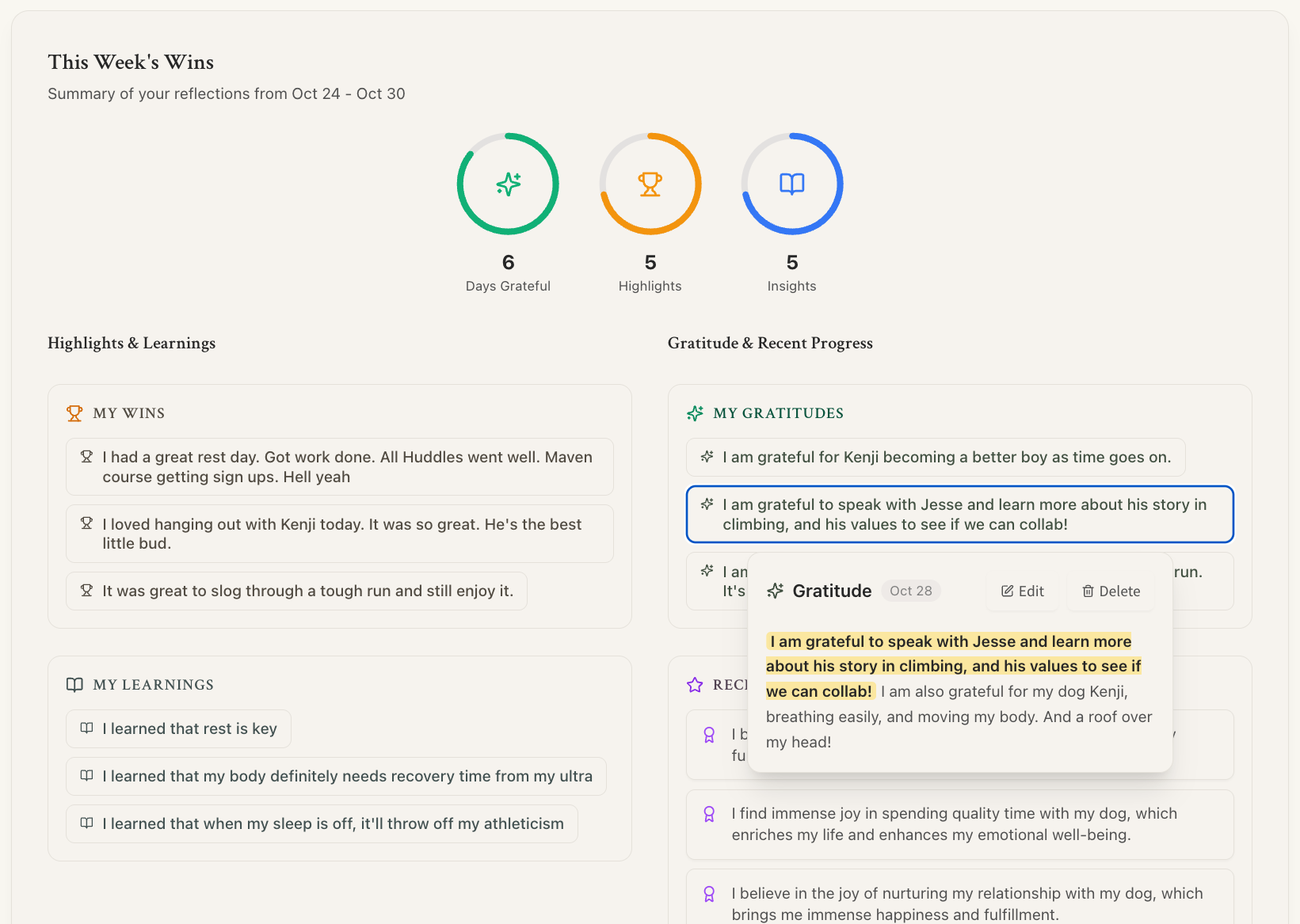
Your wins and highlights.
Many are scared of AI.
There are reasons to be scared, and there are reasons to be excited.
We should solve for what makes us fearful, and lean into what makes us joyful.
From my perspective, AI can help us become who we are meant to be, by amplifying the fidelity of our representations of self. To help us live in alignment with our stated purpose and who we want to become.
It’s the same kind of environmental awareness that a stem cell has when it decides what to become.
That’s why we’re building hyper-personalization infrastructure.
Because AI alignment at scale requires understanding every human (at the n=1 level) as a developing organism on a journey of becoming.
Not just as users.
Not just as data points.
But as we truly are—subjective beings with goals that deserve representation in the collective community we’re building together.
This is the future.
And it starts with Clarity.
If you’re interested in getting access to Clarity, we have a closed beta that you can sign up for.
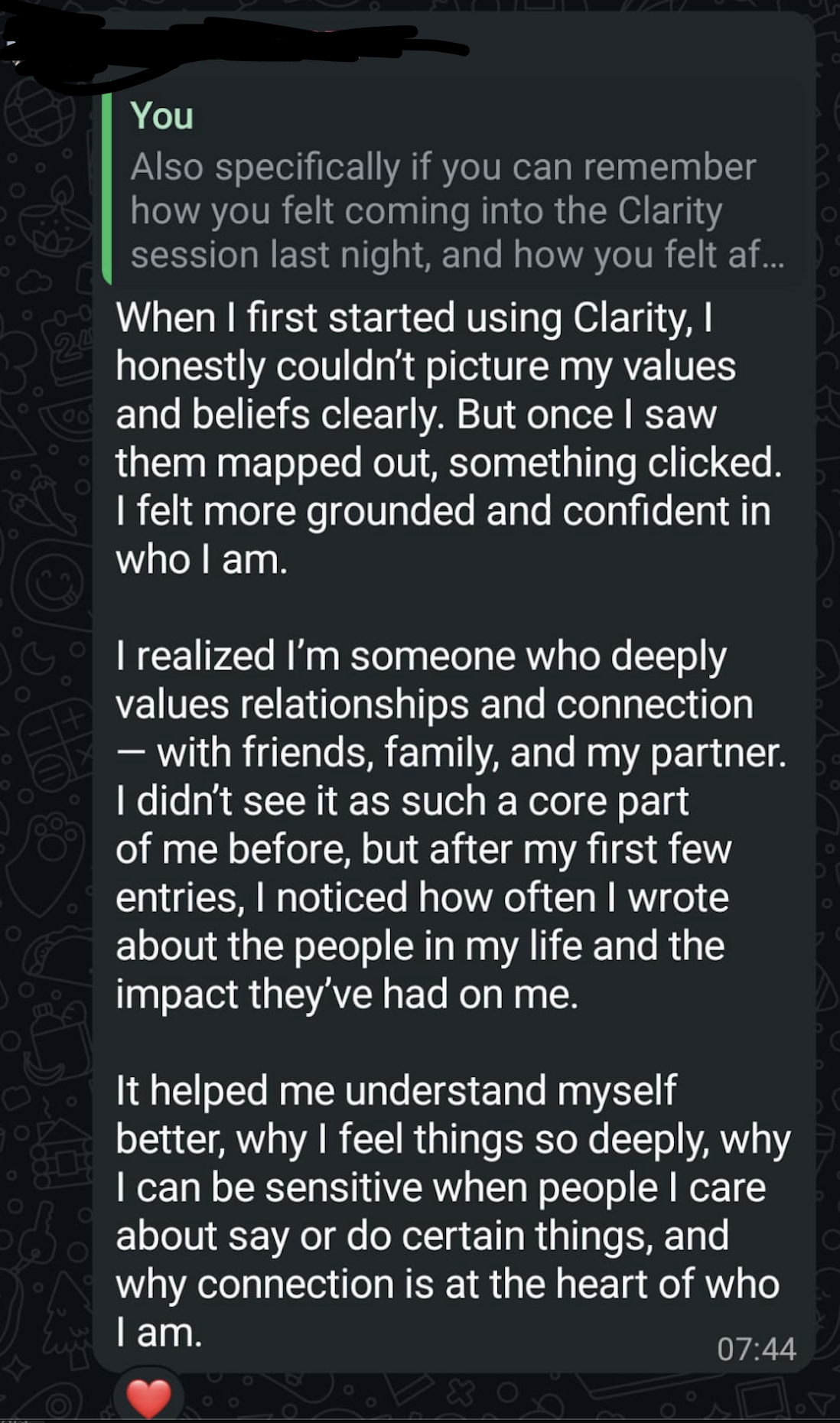
Already, I’m seeing people use it for 3 days, and get life changing results.
Here’s one such testimonial.
“I need this much headcount to meet that financial forecast.” “I need this budget, to deliver on the product strategy.” *“I need these skills on my team, to meet the demands of the business.”*Most people never examine these signals. In Bhutan, they don’t measure GDP. They measure Gross National Happiness across nine domains that look a lot like our pillars of health.
“The phrase ‘gross national happiness’ was first coined by the 4th King of Bhutan, King Jigme Singye Wangchuck, in the late 1970s when He stated, “Gross National Happiness is more important than Gross Domestic Product.” The concept implies that sustainable development should take a holistic approach towards notions of progress and give equal importance to non-economic aspects of wellbeing and happiness.”
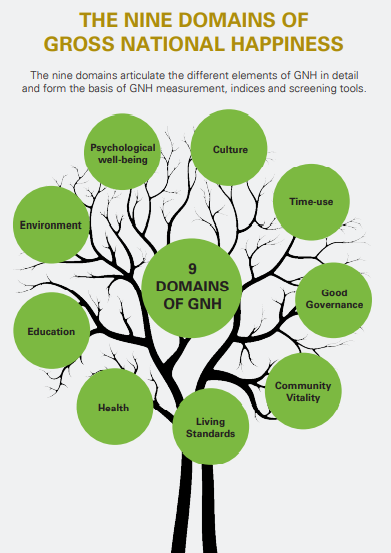
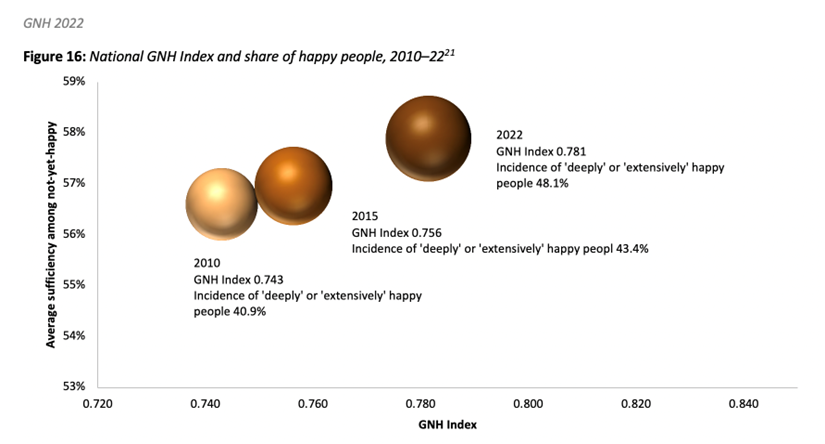
What the Bhutanese discovered through Buddhism, Michael Levin proved through biology: sustainable systems require goal-directedness across multiple dimensions simultaneously.
You can’t optimize for one metric.
Cells that only focus on growth become cancer.
Companies that only focus on revenue become toxic.
Humans that only focus on career become burnt out.
Every cell in your body is already doing this calculation to maintain balance.
And it’s so cool to see that the people of Bhutan are taking their people’s happiness so seriously!
Liked this article?
💚 Click the like button.
Feedback or addition?
💬 Add a comment.
Know someone that would find this helpful?
🔁 Share this post.
ABCs for Growth by Robert Ta is a reader-supported publication. To receive new posts and support my work, consider becoming a free or paid subscriber.
P.S. If you haven’t already checked out my podcast, ABCs for Building The Future, where I reflect on my founder’s journey building my AI startup in the open and invite awesome guests building the future to talk about theirs. Check out my learnings on product, leadership, entrepreneurship, and more—in real time!
P.S.S. Want reminders on entrepreneurship, growth, leadership, empathy, and product?
Follow me on..