
Hey fam. Big update.
I’ve been heads down for weeks building something I’m really excited about. If you’re reading this on the new blog, you’re already seeing it. If you’re reading this in your inbox, click here to see the full immersive experience.
Every newsletter going forward will be an interactive scrollytelling experience. Animated stats, data visualizations, phase transitions, pull quotes, shareable insights. This is the new standard. More features coming soon.
I also refreshed the Clarity website and my founder blog. I’d love your honest feedback on all of it. Hit reply and tell me what you think.
Going forward, expect Self Aligned in your inbox every Sunday at 8:30 AM PST. This one’s a bit late. Lots of last minute go-live stalls getting everything shipped. But the cadence starts now.
Now, onto this week’s issue. This one is personal.
I spent 85 newsletters on Substack. It was good to me. Easy to use. Great discovery network. 1,500+ subscribers from places like Google, Apple, Amazon, Meta.
Then I tried to make a blockquote look different.
And I realized I’d been renting a studio apartment when I needed to build a house.
What’s Inside This Week:
- ALIGN: Ajeya Cotra’s AI forecast blown out of the water, the Pentagon vs Anthropic saga, Cursor’s new agentic automations, and the mythology of conscious AI
- BUILD: Why I left Substack, what I built instead, and the closed-loop content engine powering my entire GTM
- CULTURE: The Year of the Snake and the art of shedding what no longer fits
This Week in AI
The most interesting things I found this week in AI.
1. Ajeya Cotra Underestimated AI Capabilities. Again.
Ajeya Cotra, one of the sharpest AI forecasters at Open Philanthropy, published her January 2026 forecast predicting AI agents would hit ~24-hour time horizons on METR’s software engineering benchmark by end of year. Claude Opus 4.6 hit ~12 hours in 2.5 months. She’s now revising upward to 100+ hour time horizons by EOY 2026 and says superexponential progress looks increasingly likely.
When the person whose job is literally forecasting AI progress keeps saying “I was too conservative,” pay attention. The gap between what we think AI can do and what it actually does is widening, not closing. I’m building Contentbert on this assumption: the capabilities I’m designing for today will be table stakes in 6 months. The question isn’t whether to invest in AI-native infrastructure. It’s whether you can afford to wait.
2. The Pentagon Blacklisted Anthropic. Then Everyone Rushed to Download Claude
After the Pentagon removed Anthropic from its approved vendor list over a policy dispute, something unexpected happened: consumer downloads of Claude surged past ChatGPT in both app stores. The Streisand effect in real-time. Anthropic’s consumer app briefly hit #1 in Productivity.
The best marketing Anthropic never paid for. But here’s the deeper signal. The market is starting to see Claude as the “thinking person’s AI.” The Pentagon drama positioned Anthropic as the company that won’t just do whatever the government asks, and that resonated with exactly the audience that matters: builders, researchers, and founders who care about how their tools are built. Brand is what happens to you, not what you plan.
Brand is what happens to you, not what you plan.
3. Cursor Just Launched Automations. Agents That Trigger Themselves
Cursor shipped a new feature called Automations: AI agents that automatically launch when triggered by codebase changes, Slack messages, or timers. Think CI/CD but for AI coding agents. Push to a branch? An agent reviews your code. Timer fires at 6 PM? An agent writes your daily standup. Slack message mentions a bug? An agent starts investigating.
Tool
Ask
AI that responds when you ask / manual triggers / reactive
System
Act
AI that acts when conditions are met / event-driven / proactive
4. The Mythology of Conscious AI
Anil Seth, one of the leading neuroscientists studying consciousness, published a piece in Noema arguing that consciousness is unlikely to emerge from digital computation. His core claim: brains are fundamentally different from computers in their material complexity, temporal dynamics, and embodied nature. Consciousness may require the self-regenerating biological processes unique to living systems.
This matters for builders, not just philosophers. If Seth is right, the “AI will become conscious” narrative is a distraction from what AI actually does well: pattern recognition, generation, and automation at scale. I don’t need Claude to be conscious. I need it to understand context, execute reliably, and learn from feedback. The mythology of conscious AI makes us ask the wrong questions. The right question is: what can I build with the intelligence that already exists?
I Broke Up With Substack and Built a Content Engine
Here’s the thing about Substack that nobody talks about.
It’s great for starting. It’s terrible for scaling.
I’m not talking about subscriber count. I’m talking about what you can do with your content once it exists.

The Breaking Point
Three things broke me:
1. I couldn’t control the reading experience.
I write newsletters with pseudo mathematical frameworks (IS = (C x P) / (V x S)), data visualizations, emotional arc shifts between sections.
On Substack, all of that becomes… a wall of text with some bold words.
Unless you’re wanting to create images then screenshot them as PNGs into the article. Which I was doing for quite some time.
But recently with all of the customer development activities, I’ve felt myself not wanting to do that.
But, I still want to have meaningful visualizations for storytelling.
I wanted animated statistics that count up as you scroll to them. Pull quotes that feel like they belong in a magazine. Charts that reveal data as you read through the argument.
Phase transitions, where the background shifts from warm cream to deep charcoal as the content moves from reflection to building to culture.
Substack gave me: a text editor and an image uploader.
2. I couldn’t close the content loop.
Here’s my philosophy: every newsletter I write should make the next one better.
Not because I’m “learning” in some vague sense, but because the system literally tracks what resonates, what gets shared, where people spend time, and feeds that signal back into the content hypothesis engine.
I’m a product guy. I want signal to feed more signal. I want the shortest high throughput optimized learning loops.
On Substack, I got open rates and click rates… and some vanity ways to slice them.
That’s it. No scroll depth. No section timing. No share tracking by element. No way to connect reader behavior to a beliefs model that informs what I write next.
3. I couldn’t unify identity.
I’m building Clarity.
AI personalization infrastructure that models user beliefs.
My newsletter readers are also potential Clarity users.
But on Substack, my subscriber list lived in Substack’s database, disconnected from everything else in our ecosystem.
They don’t have an API that I can use.
What I Built Instead
So I did what any AI-native founder who’s too stubborn to accept limitations would do.
I built the whole thing myself.
The Site
Built on Astro + React + Tailwind CSS. Resend and Inngest for the email infrastructure.
Every newsletter is an interactive scrollytelling experience with:
- 15+ custom React components: animated stat counters, cliff charts, canyon visualizations, waffle charts, pull quotes, formula blocks, insight strips
- A 3-phase reading system: ALIGN (cream), BUILD (warm sand), CULTURE (deeper warm), each with distinct visual treatment that maps to the emotional arc of the content
- Scroll-driven animations: progress bars, section reveals, reading pulse indicators on viewport edges
- Share infrastructure: every stat, quote, and insight is individually shareable with branded OG image cards generated on-the-fly
0
prototypes before settling on the canonical template
I designed it to feel like the intersection of a NYT interactive feature and a warm, personal journal. Cohabited display font for headlines. JetBrains Mono for the developer-credibility metadata layer. Caveat handwriting font for personal touches.
The Engine: Contentbert 3000
This is the part I’m most excited about.
Contentbert (ridiculous, unoriginal name I know) is a closed-loop Content Marketing Framework (CMF) engine. Here’s how it works:
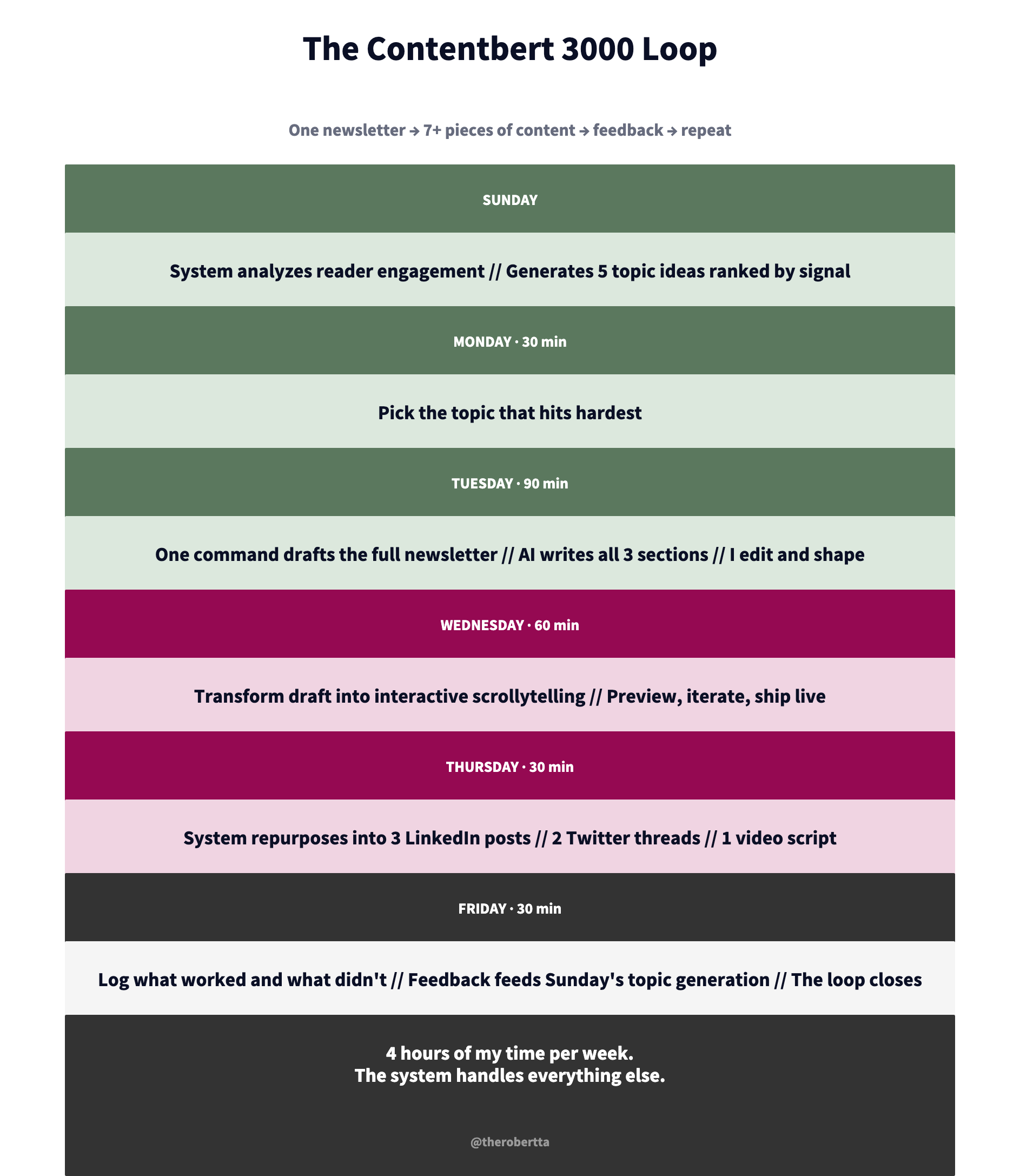
Every week, one newsletter becomes 7+ pieces of content. Here’s the rhythm:
- Sunday: The system looks at what you all actually read, shared, and spent time on this past week. It generates 5 topic ideas ranked by signal strength and drops them in Slack.
- Monday: I pick the one that hits hardest. (30 min)
- Tuesday: One command drafts the full newsletter. It knows how I write, researches the topic across the web, and builds all three sections. I edit and shape it. (90 min)
- Wednesday: Another command turns the draft into the interactive reading experience you’re looking at right now. Previews it, I iterate, ship it live. (60 min)
- Thursday: The system breaks the newsletter into 3 LinkedIn posts, 2 Twitter threads, and a short-form video script. I review and schedule. (30 min)
- Friday: I log what worked and what didn’t. That feedback feeds Sunday’s topic generation. The loop closes. (30 min)
0 hrs
of my time per week. The system handles everything else.
All of this used to take 8+ hours of time, and it was worse because of human error in looking at the analytics. After a few test runs through the system, I’m confident this is the right direction to get the most leverage and compound all my content + analytics towards growing our distribution.
The key insight is the loop. Reader engagement on my new blog (shares, scroll depth, section timing) flows through my analytics pipeline. That goes into my content generator.
Which generates the topics I choose from on Monday. Which I create drafts from.
Which become the newsletter you read the following Sunday.
Learning loop.
New Website
I’ve really hated Substack’s email design. I’ve hated it for a long time. But it’s been so low on the backburner that I haven’t done anything about it.
But… we just did a website refresh based on all the learnings we’ve had from our work, and from the market.
Take a look. The new website looks SICK.
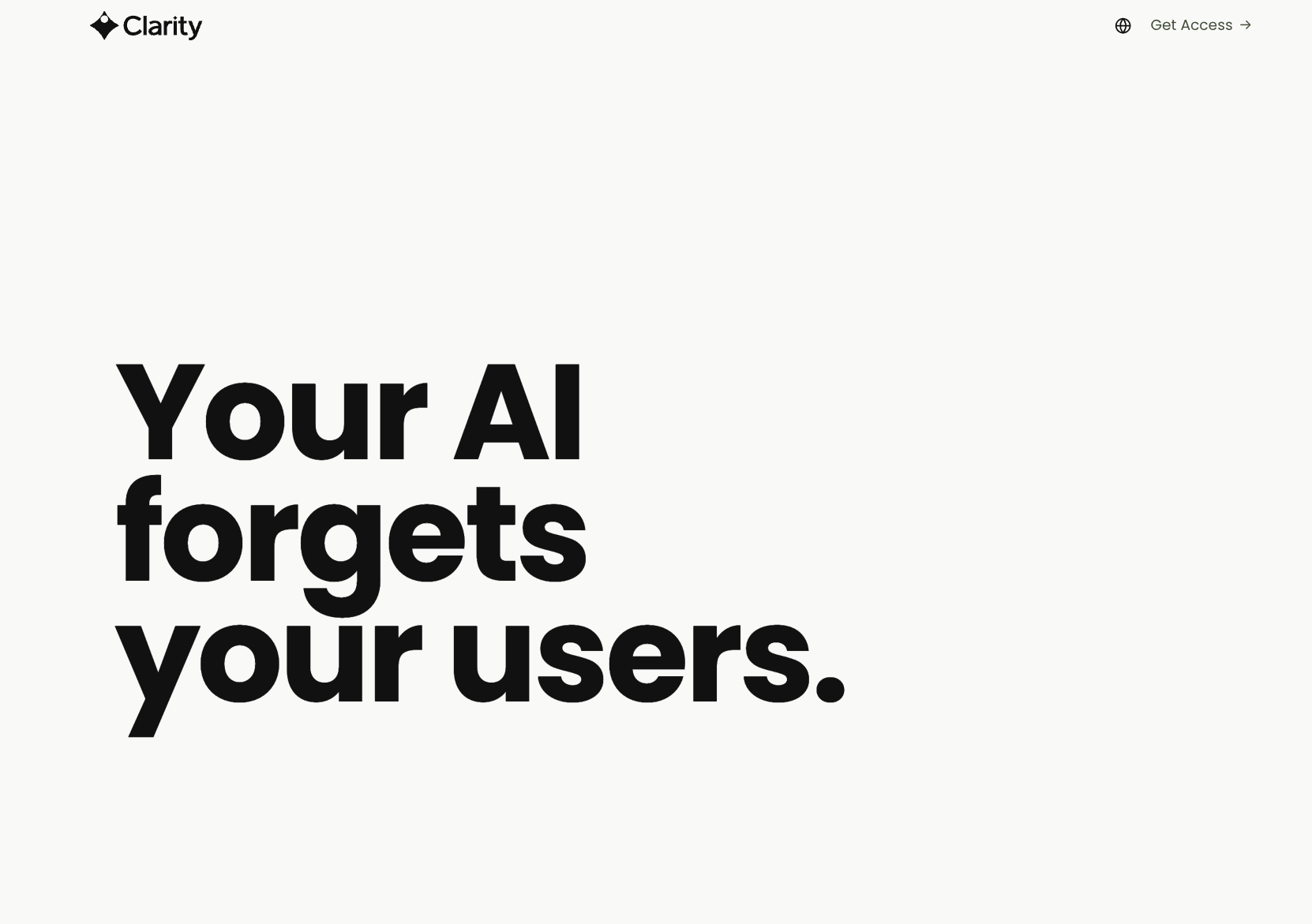
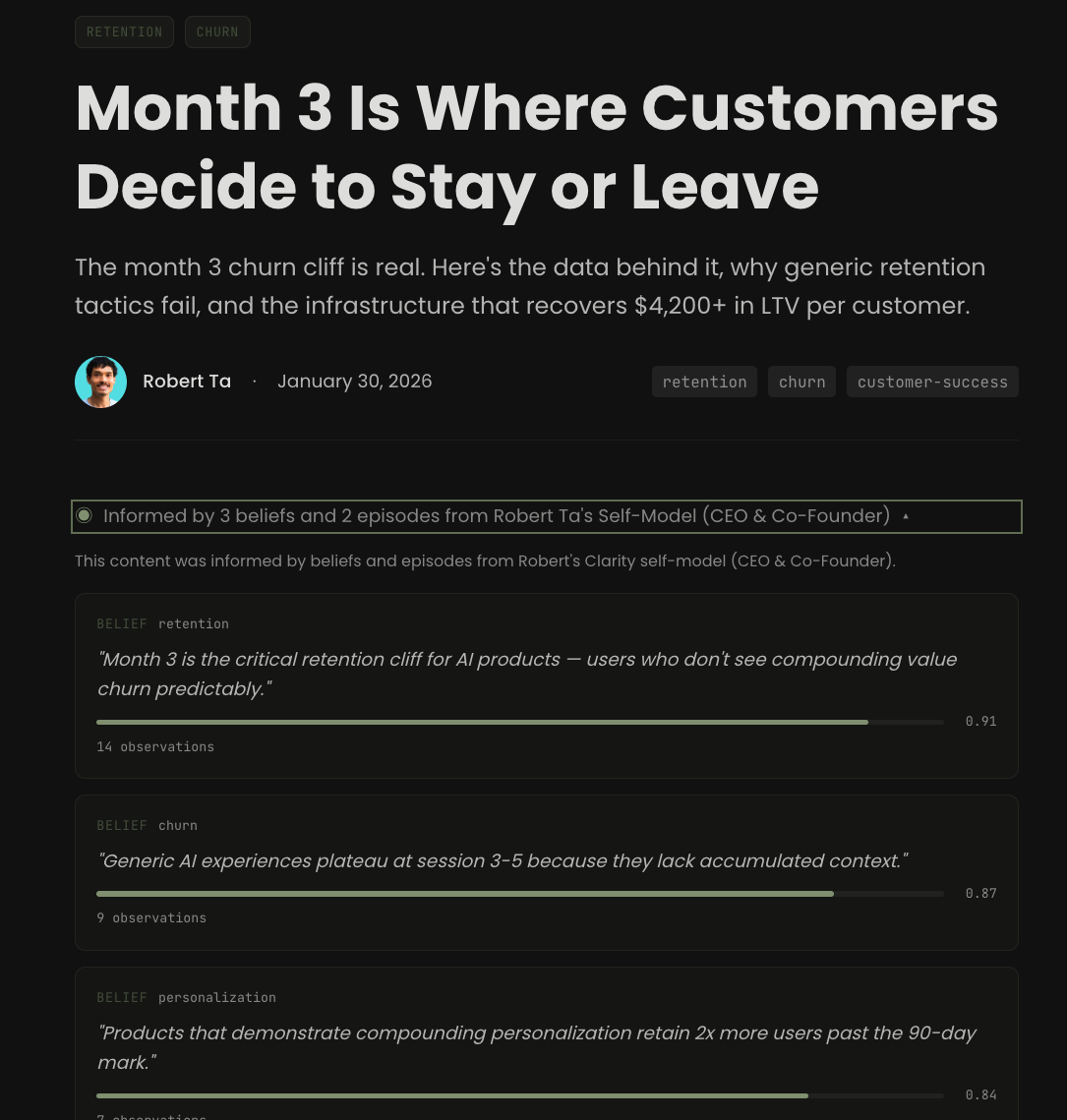
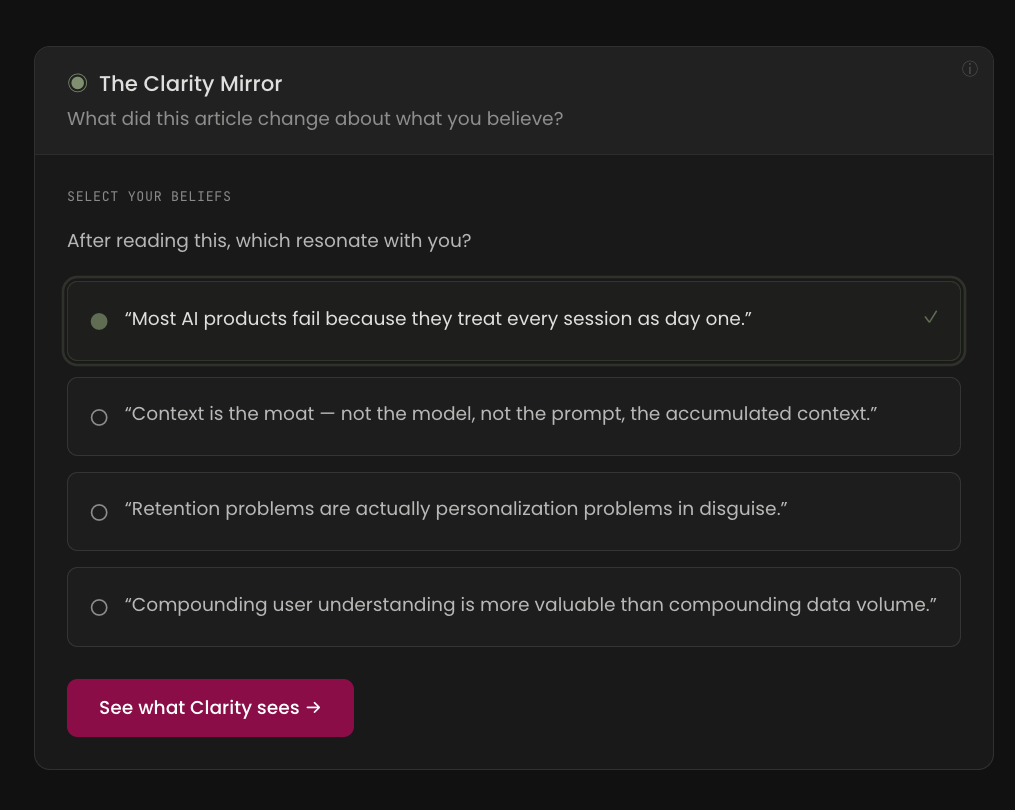
Our new SEO/AEO strategy at the top of funnel, leads with a Product Led Growth philosophy: Clarity informs the content, and we show it on all our blog posts.
Here’s one that’s live, informed by my own Self Model.
And as I was refreshing our website and systems for AI native GTM, I went for new email infrastructure and user experience for our new Clarity blogs AND my founder newsletter.
We had custom needs.
So I moved email delivery to Resend.
Custom-designed email templates that match the site’s brand.
Not Substack’s template, my OWN template.
The one I designed to FEEL like Self Aligned.
The subscribe flow is mine now too.
The Design Evolution
This didn’t happen overnight.
The project started as “let me just move my newsletters off Substack.”
Then it became “well, if I’m building a custom site, I should make the reading experience amazing.”
Then it became “if I have amazing reading experience with engagement tracking, I should close the loop back to content generation.”
Goddamn perfectionist me.
But hey, I think innovation occurs with obsession. It certainly did here.
The design itself evolved through three phases:
- Phase 1: Port existing newsletters to MDX with basic scrollytelling components
- Phase 2: Bridge the design language between my editorial warmth and heyclarity.dev’s developer-credible aesthetic
- Phase 3: Full page redesigns (homepage, archive, about page) that feel like “a founder who codes” not “a blogger”
I built 31 prototypes with curated components.
Each newsletter automatically gets the right components inserted based on content pattern matching.
Your content is your distribution. Your distribution is your moat.
Why This Matters For You
I’m not telling you to go build a custom newsletter platform.
That would be insane for most people.
But here’s what I am saying:
If you’re a founder building in public, your content is your distribution. Your distribution is your moat.
I decided none of our distribution will be on rented land.
I want to own it as we build it.
I heard something in the startup ecosystem, something about how great founders make very deliberate choices early.
This was a very deliberate choice. I could’ve hired this problem out.
Instead I asked: how can I use this as a learning opportunity to be even more AI native, and completely automate this as a closed loop system that learns and optimizes?
In doing this, I discovered I can take a Product Led Growth approach to our CONTENT.
I’m excited because this is just a V1. As the system learns and compounds the learning, we’ll iterate further towards business outcomes.
I believe the ability to bring systems to life from that perspective, will be a key vector to arbitrage in this competitive environment.
The tools exist now to build something that would have taken a team of 5 engineers multiple quarters two years ago.
I built this entire system solo in two weeks.
AI-native means I can punch way above my weight class.
The question isn’t whether you should own your distribution. It’s whether you can afford not to.
Continue reading
Get the full newsletter, free.
Join founders and builders who read Self Aligned every week.
The Year of the Snake and the Art of Shedding
We just passed Lunar New Year.
2025 was the Year of the Snake.
The snake sheds its skin not because the old skin is broken. It sheds because it’s outgrown it. The old skin did its job. It protected. It served. But at some point, the thing that once fit starts to suffocate.
There’s a Vietnamese saying my mom used to repeat every Tết: “Năm mới, phải mới.” New year, must be new.
She didn’t mean buy new stuff.
She meant become new.
Let go of what you’ve been holding onto out of comfort.
I think about this a lot as a founder.
We hold onto tools, processes, partnerships, even identities long past their expiration date. It’s comfortable.
But this blog is all about moving into the uncomfortable. Shedding the skin feels risky.
But I’ve found framing it as growth, always paid off.
The snake doesn’t shed in a day. It’s a process. It starts with the eyes clouding over.
Vision gets blurry before it gets clear.
Then the old layer loosens, starting from the head. The snake literally pushes forward through its own past, leaving it behind in one continuous piece.
In the AI native landscape, I find myself asking this question basically everyday: what am I holding onto that no longer fits?
And tactically…
What are the ways of the old world (like GTM) that we can recreate in the new world?
There’s a lot.
May you outgrow something beautiful this year.
If you made it this far, you’re experiencing the new site. Welcome home.
I built all of this because I believe the content deserves better than a wall of text. You deserve better.
I’d genuinely love your feedback on three things:
- This newsletter experience on the new blog. What works? What doesn’t?
- The Clarity website refresh. Does the product story land?
- The newsletter archive. All 85 issues are now interactive scrollytelling experiences.