
This Week’s ABC
Advice: 1 Formula and 3 Strategies for Imposter Syndrome.
Breakthrough: A simple counterattack.
Challenge: Start smiling against imposter syndrome.
📖 Advice: My Imposter Syndrome Equation
If you’re in a room full of incredibly capable people, and you feel like the dumbest person there… congratulations.
You’re exactly where you should be.
Instead of seeing it as a threat, use it as fuel.
I like thinking about things in terms of mathematical models. (I’m a nerd, get at me)
It’s helpful for me to understand the variables at play, and the levers I can control vs. cannot control.
Then I focus on what’s in my control.
Same thing with Imposter Syndrome.
Here’s my take on Imposter Syndrome as an equation.
Imposter Syndrome As Math
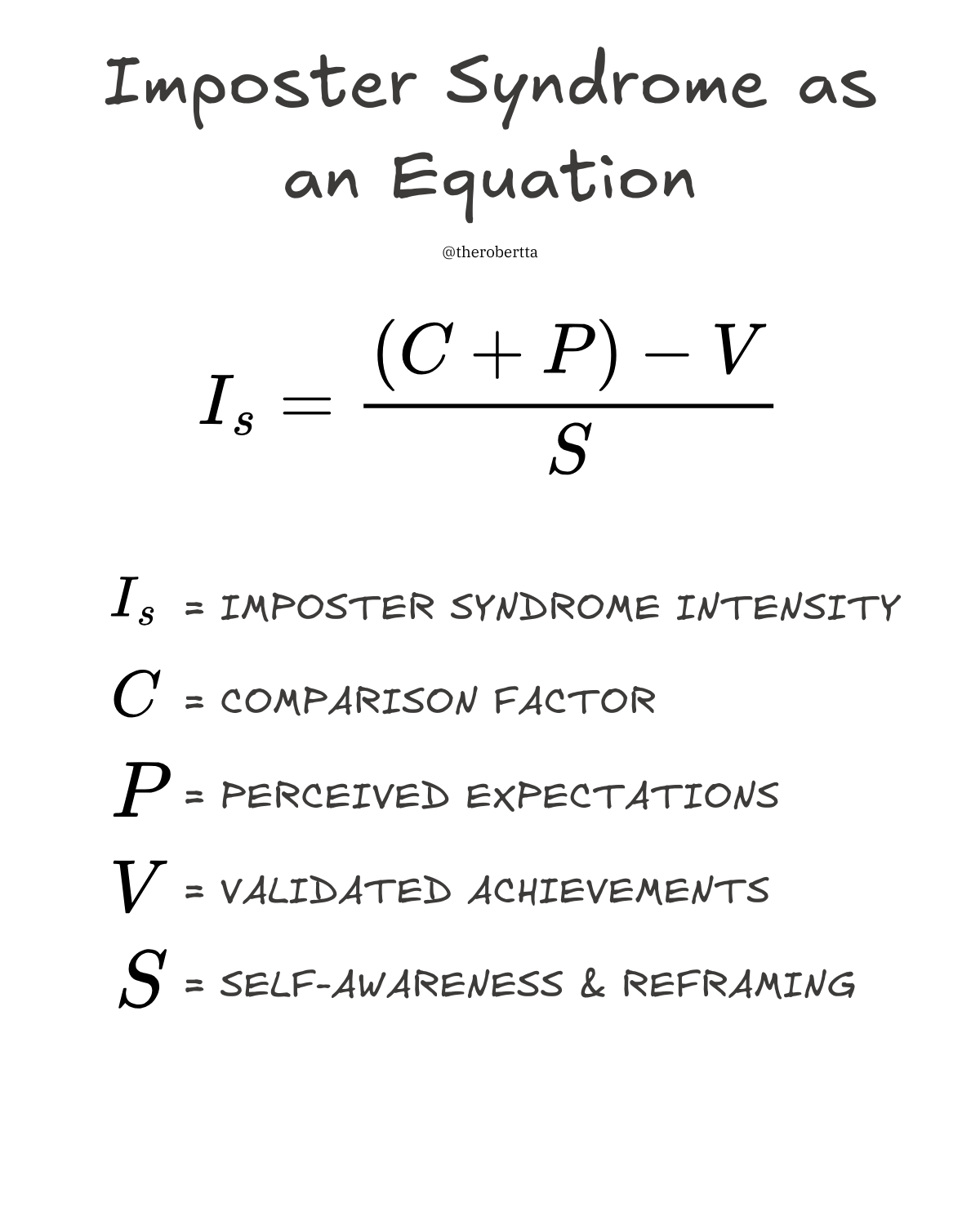
Is = Imposter Syndrome Intensity → higher values equals stronger imposter feelings
C = Comparison Factor → how much you compare yourself to others
P = Perceived Expectations → how high you believe the bar is set for you
V = Validated Achievements → evidence of your competence, e.g., past wins, positive feedback
S = Self-Awareness & Reframing → your skill and ability to recognize imposter thoughts and reframe them
The intensity of imposter syndrome manifests as the anxiety,
the fears,
the “what ifs”
—all of the things that can throw off your mental game.
And your mental game is EVERYTHING in life.
I think about killing imposter syndrome as simply minimizing or eliminating the intensity of it, to keep your mental game strong.
How It Works
- The more you compare yourself to others**(C)** and internalize expectations that are impossibly high**(P)**, the stronger the intensity of imposter syndrome.
- The more you validate your achievements**(V)** and have self-awareness to challenge negative thoughts**(S)**, the less imposter syndrome affects you.
You’ll notice in this equation—EVERYTHING is in your control.
So focus on:
- Increasing Validated Achievements and Self-Awareness & Reframing
- Minimizing **Comparison **and Perceived Expectations.
Here’s how.
“If you are the smartest person in the room, you are in the wrong room.” — ConfuciusWhat if imposter syndrome isn’t a problem to solve—but a sign you’re in the right place?
The key is learning how to reframe imposter syndrome.
3 Steps To Kill Imposter Syndrome
1. Stop Comparing—Start Contributing
Negative Comparison and poorly Perceived Expectations fuel the bad sides of imposter syndrome.
- What experiences or perspectives do I bring to this table?
- How can I add value to the conversation?
- What unique experience do I bring to this room?
Then go DO things about it. Contribute.
You don’t need to be the smartest person in the room. You just need to offer something only you can bring.
Own it.
2. Own Your Own Frame
You need to own your own framing of a situation.
Your skills in Self-Awareness & Reframing are your friend here.
When your brain tells you the imposter thoughts, reframe them.
It gets easier over time. Trust me, I know—with deep experience.
3. Get Comfortable With Uncomfortable
The best leaders intentionally put themselves in uncomfortable situations because that’s where the growth happens.
They chase it.
They’re not satisfied with being comfortable.
And if you’re reading this newsletter, you’re about growth—you shouldn’t be satisfied with being comfortable either.
- If you’re stretching beyond your comfort zone, you’re leveling up.
- If you’re doubting yourself, you’re probably on the right path.
- If you feel like an imposter, it means you’re in a room that will push you to become better.
But what about Validated Achievements**?**
That’s a tricky one.
“Comparison is the thief of joy” —UnknownAnd contribution kills it. 🚫 **Imposter Thought: **“I don’t belong here.” ✅ Reframe: “I’m in the middle of growth. Let’s get after it.” 🚫 Imposter Thought:“I’m going to be exposed as a fraud.” ✅ Reframe: “I bring a unique perspective that others don’t have.” 🚫 **Imposter Thought: **“Everyone here is smarter than me.” ✅ Reframe: *“I get to learn from smart people. Hell yeah.”*Instead of measuring yourself against others, focus on what you can contribute.
Ask yourself these questions:
Don’t compare. That’s a losing game.
There’s only one you in the entire world.
Your unique perspective, is your value.
Continue reading
Get the full newsletter, free.
Join founders and builders who read Self Aligned every week.
*🚀 Breakthrough: Keep A Smile File *😃
“You are not your worst day. You are all your best days combined.” —Unknown
I used to hate looking at my own wins.
For years I lived a life where I didn’t ever stop to smell the roses.
This came from childhood habits that no longer served me as an adult.
My parents were immigrants of a war-stricken country. They were hard on me. I’ve come to terms with that in lots of therapy.
When I got an A, they asked “Why is this not an A+?”.
When I got the A+, they asked me “Why aren’t you going to Stanford?”
Me: “I’m 12, Dad.”
(Shoutout, mom and dad—thanks for giving me a better life than you had. Love you.)
Perhaps some of you reading this had similar stories in the early stages of your life, where the goalposts were constantly moved.
Where you were never encouraged to stop and smell the roses, or take any amount of satisfaction in your achievements.
If that’s familiar, I have the antidote:
A Smile File.
What’s a Smile File?
A Smile File is a collection of all the wins, compliments, and moments that remind you of your value.
Think of it as a counterattack against imposter syndrome.
Every time you get:
- A glowing email from your boss or colleague
- A kind Slack message about your impact
- A small win that made your day
- A personal achievement that meant something to you
Save it.
Screenshot it.
Write it down.
Put it in a folder labeled “Smile File”.
Then, when self-doubt creeps in, open your Smile File and remind yourself:
*You’ve done hard things before. *
You’ll do them again.
This Will Feel Weird… At First
Warning: if you’re not used to smelling the roses and taking any amount of satisfaction in your own wins or achievements, this is going to feel really weird at first.
It was for me. It felt foreign and not right.
That’s okay. That’s normal.
Think of it like a muscle.
You don’t go to the gym and get healthy overnight after one workout.
You don’t kill the imposter syndrome intensity in one reframe or one act of smelling the roses.
You need to get the reps in.
I’ve gotten thousands of reps in. It was hard work. But so worth it.
Now I feel unshakable confidence, and RUN towards the feeling of imposter syndrome—without letting it ruin my mental game.
💥 Challenge: Make A Smile File, and Smile
Start your Smile File today.
Take 5 minutes to:
- Scroll through old emails, messages, or projects and save one thing that made you feel proud.
- If you don’t have anything handy, write down a personal win from the last 6 months.
Then, the next time imposter syndrome sneaks in, open your Smile File and remind yourself:
You’ve earned your seat at the table.
Keep getting the reps in and eventually you’ll kill imposter syndrome.
You got this!
Liked this article?
💚 Click the like button.
Feedback or addition?
💬 Add a comment.
Know someone that would find this helpful?
🔁 Share this post.
ABCs for Growth by Robert Ta is a reader-supported publication. To receive new posts and support my work, consider becoming a free or paid subscriber.
P.S. If you haven’t already checked out my other newsletter, ABCs for Building The Future, where I reflect on my founder’s journey building a venture in the open. Check out my learnings on product, leadership, entrepreneurship, and more—in real time!
P.S.S. Want reminders on entrepreneurship, growth, leadership, empathy, and product?
Follow me on..