
The Emergent Nature of Culture
From Hannah, I learned there’s no such thing as “no culture”.
There’s only unconscious** culture.**
As I reflect, every team I’ve worked in—no matter how structured or chaotic—had one.
The question was never “Do we have a culture?” but rather…
Is it intentional or accidental?
At startups, culture is raw and hyper-reactive—beautiful in its energy, volatile in its inconsistency. You have less people, it’s easier to keep less people aligned.
Mid-sized tech sits in between: culture in flux, often pulled between the inertia of scale and the intimacy of small teams. You have more people now, it’s harder to keep 100s of people aligned.
At big tech companies, the culture is usually well-documented but perhaps ossified. It’s professionalized—but not always lived. You have even more people, and it’s hard to keep thousands of humans aligned.
Hannah’s framing takes out any sort of moralistic judgments…
Culture isn’t good or bad—it’s emergent.
It’s a thing that exists, that we feed—intentionally, or unintentionally.
It’s the collective expression of how people actually behave. Which means, if you want to change culture, you have to change behavior at scale.
And that starts with the people who set the tone: leaders.
Leadership as Cultural Infrastructure
This sounds obvious—but it’s not.
Most leaders think of culture as a thing they can design.
Hannah reminded everybody in the room that it’s a force they must embody.
In big tech, I’ve seen beautifully written culture documents that exist in total disconnect from lived reality.
Values are celebrated on stage and forgotten in sprint planning.
You might hear someone say “we value collaboration”—then watch how promotions reward individual heroics.
That misalignment—between stated values and rewarded behaviors—is where culture fractures.
As Hannah put it:
The same principle applies inwardly:
If what I say I value doesn’t match how I act under stress, I’m out of self-alignment.
It’s how a group’s stated principles meet their practiced patterns.
The more consistent the two are, the stronger and clearer everything is.
The more they diverge, the more confusion and distrust creep in.
That’s what I’ve found in my experience.
The Four Levers of Culture
Hannah shared a framework on how she thinks about culture.
She called it the four points of leverage—a system for steering culture intentionally.
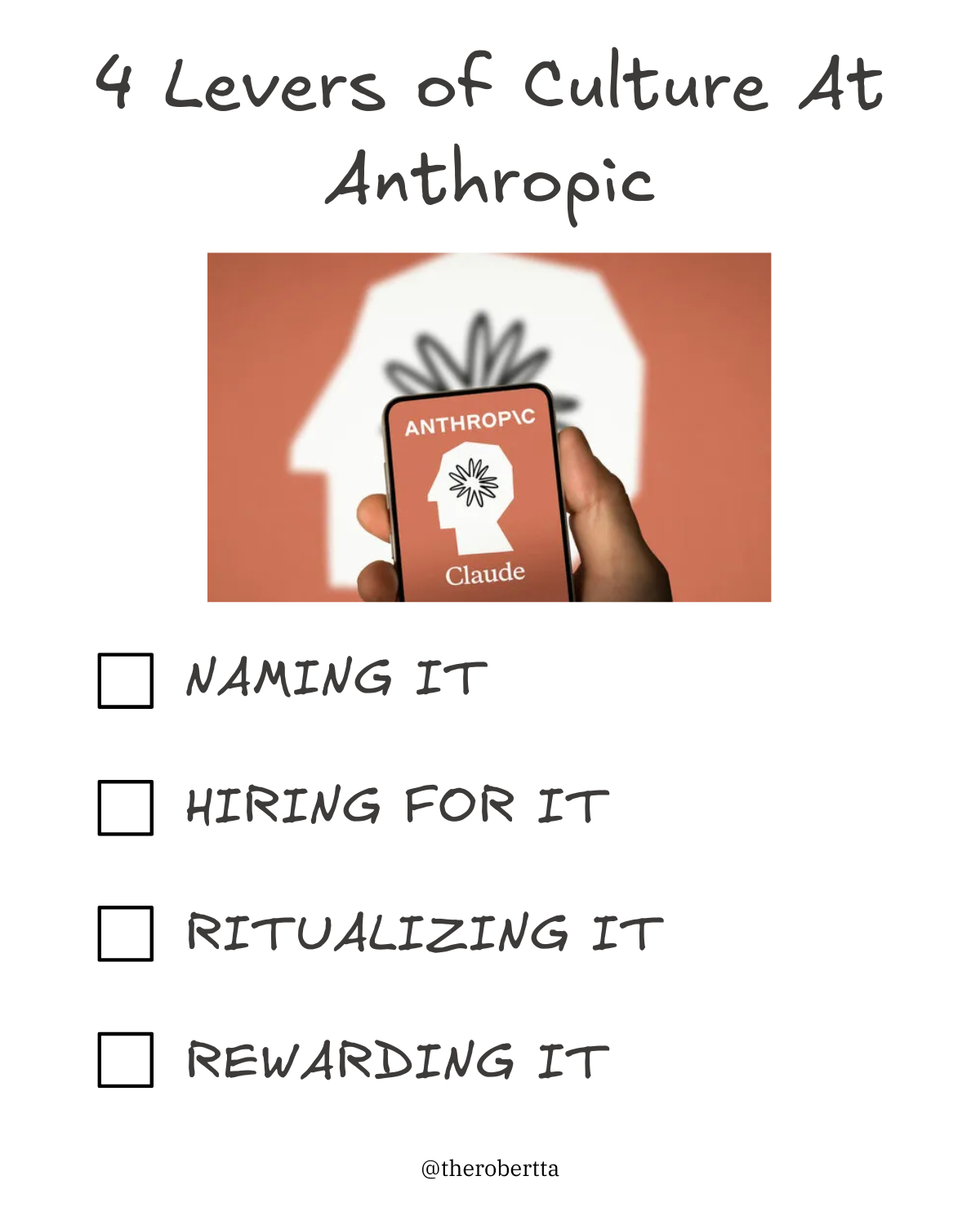
“You have a culture at your company whether you like it or not… because it is manifest in the ways that humans show up and behave and interact with each other.”**“It is best and easiest if [culture] also comes from the top… because you need people to be role modeling it.”
“You want what you’re saying and what you’re doing to be consistent.”## 1. Naming It.
It’s diagnostic, and directional.
Actually naming your culture and values empowers the conditions to continuously reveal the delta between the named idealistic culture and the performed behaviors in reality.
And the truth is, culture is collective self-alignment.
2. Hiring For It.
And people either flow with it or against it. Pick the ones that want to flow in the direction of that culture.
Find the people whose natural behaviors reinforce the flywheel you’re trying to spin.
3. Ritualizing It.
It’s intentional, she said.
Because rituals are where beliefs become embodied.
Every company has rituals—standups, demos, reviews.
The question is whether those rituals reinforce the culture you claim to have.
If you say “transparency” but all critical decisions happen behind closed doors, your rituals are lying for you.
It’s kind of like a cultural nervous system.
Being intentional about the rituals your teams exercise daily/weekly/monthly/quarterly/yearly, shapes the team they become.
*“Actually articulating: what do we want our values to be? What do we want our culture to be?”*Naming brings awareness to the invisible. *“You should be deliberate about hiring people who are excited about that culture, who are going to flow in the direction of that culture.”*It’s where “how we do things” becomes “why we do them.”
*“What are the things that we all come together and do as a company? Do those things reinforce our culture or run against it?”*But Hannah also warned that naming exposes hypocrisy—when the words don’t match the behavior.
I love her use of the word flow here.
Culture is not static—it’s a current.
She advocates for using culture as a differentiator, and picking people that lean in.
Continue reading
Get the full newsletter, free.
Join founders and builders who read Self Aligned every week.
4. Rewarding It.
“Think about what sorts of behaviors get attention… who gets the interesting new project or the opportunity?”
This is the linchpin.
Rewards reveal the truth. How are your people incentivized?
At Anthropic, Hannah mentions that all members of technical staff are called just that: Member of Technical Staff.
That’s one of the ways they go against the grain against typical performance management to build their intentional team-oriented culture, where everyone is on the same team solving problems.
Egos can be left at the door.
People are incentivized for meritocracy in their problem solving, they are not incentivized for any sort of fancy title.
When rewards, rituals, hiring, and naming are aligned, you get what Hannah calls a “positive flywheel.”
When one slips, you regress—to the default behaviors everyone imported from their last company.
So if you are trying to change culture, you have to use these 4 leverage points intentionally.
Or as she put it:
“If you let up on any of those pieces at any point, what you are going to get is regression to the mean.”
The old cultural habits that feel comfortable but keep you stuck.
Closing Reflections
Listening to Hannah, I learned:
Every company—and every person—is always practicing culture.
The question is whether it’s being practiced consciously or not.
I really enjoyed her concept around the 4 points of leverage. It’s given me some new language and perspective in seeing and shaping culture.
It helps to ask myself:
“What behaviors am I repeatedly reinforcing?”
And anyone can ask themselves that in any identity they hold dear.
You can be a leader no matter your title, because you can always choose to role model through behavior and action.
In the end, culture is not something that is built once then taken out for spring cleaning once a year.
It’s what we maintain—deliberately, daily, together.
And if we can keep that flywheel turning—naming, hiring, ritualizing, rewarding—we not only align teams.
We align selves.
More to ponder on.
For now, I will keep aligning my daily actions towards my better self.
You too!
Get after it.
You got this.
Your future self will thank you.
Liked this article?
💚 Click the like button.
Feedback or addition?
💬 Add a comment.
Know someone that would find this helpful?
🔁 Share this post.
ABCs for Growth by Robert Ta is a reader-supported publication. To receive new posts and support my work, consider becoming a free or paid subscriber.
P.S. If you haven’t already checked out my other newsletter, ABCs for Building The Future, where I reflect on my founder’s journey building a venture in the open. Check out my learnings on product, leadership, entrepreneurship, and more—in real time!
P.S.S. Want reminders on entrepreneurship, growth, leadership, empathy, and product?
Follow me on..