
An Opportunity for Entrepreneurs
Before getting into the newsletter for today, I want to share an opportunity for entrepreneurs.
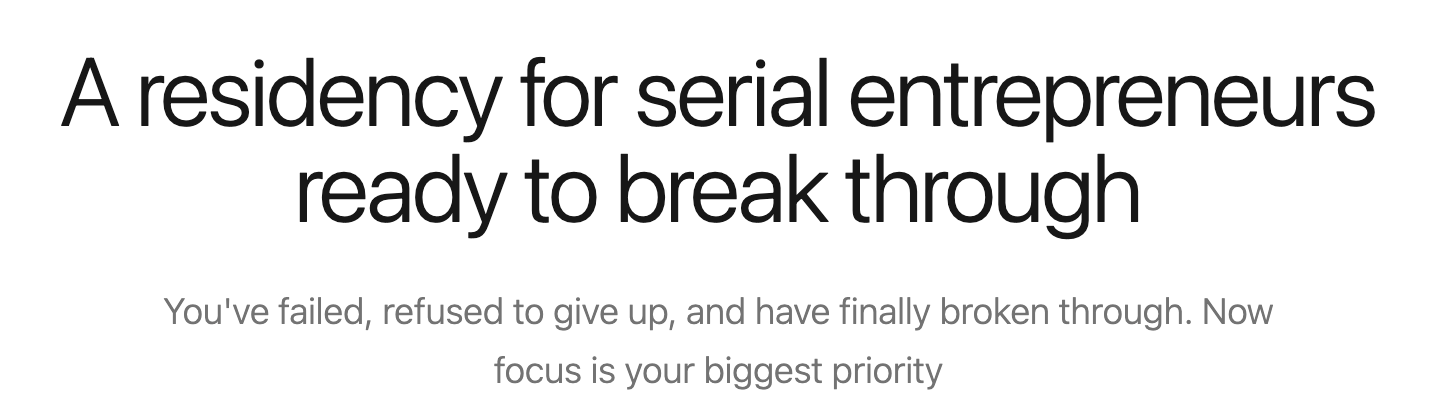
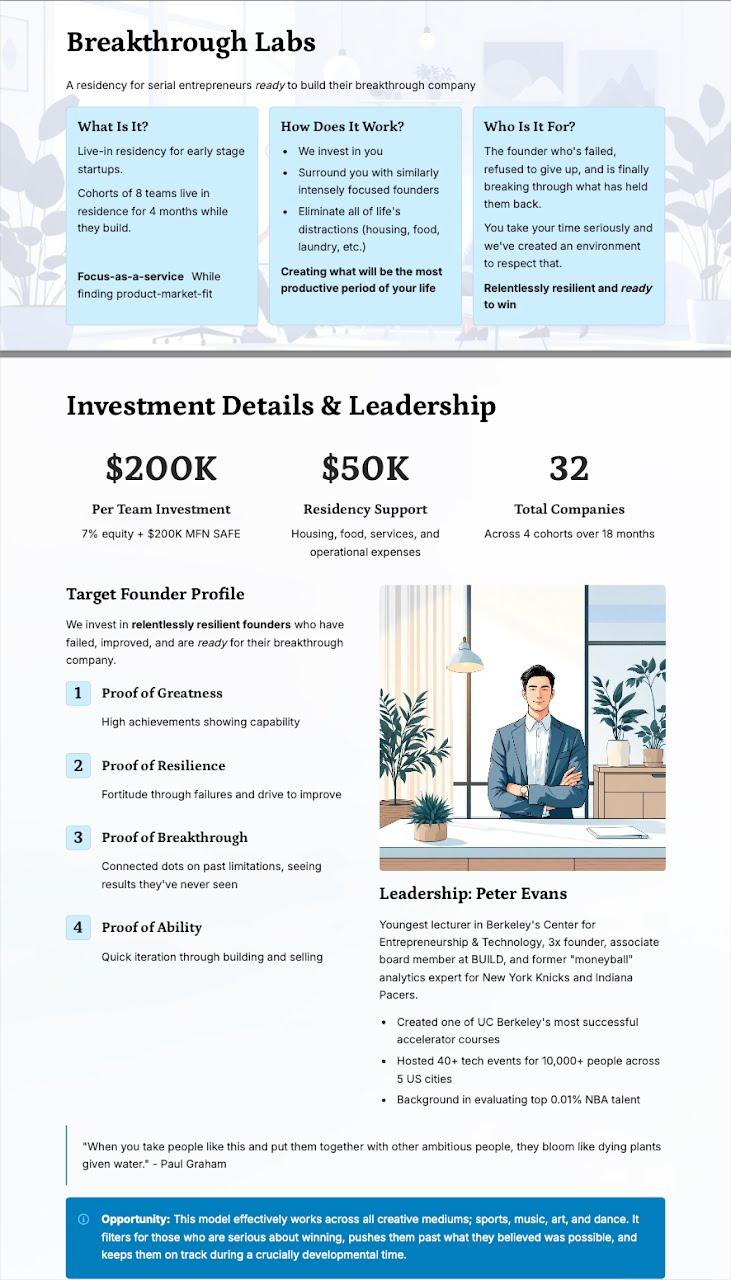
Breakthrough Labs is a residency for serial entrepreneurs ready for their breakthrough company.
Here’s a note about Peter to introduce himself.
I’m the youngest lecturer in Berkeley’s Sutardja Center for Entrepreneurship & Technology (S.C.E.T.) department teaching a startup accelerator course. I’m a 4x founder who’s found more success with each venture as I’ve learned from my mistakes and become more aligned with what I’m building.
*I’ve personally experienced this journey of fortitude and understand exactly how it leads to success. *
If this sounds like you, apply today.* Deadline in ~7 days from this email.*
This Week’s ABC…
This is a differentiated venture strategy where in addition to investing directly in your startup, we relocate a cohort of 8 teams to live together in residence for 3 months.This is for the founder who has relentlessly pushed through every failure, has finally broken through what has always held them back, and is beginning to see results that they’ve never seen. Now focus to go all in is their biggest priority.
From Peter Evans, who is leading this:
Advice: You don’t fit in a box
Breakthrough: You are what you do
Challenge: Questions to ponder
📖 Advice:* You Don’t Fit In A Box*
Circa 2018
Fast forward to today. I’d never questioned the frameworks themselves.
I thought these tests gave me a level of identity.
A framing.
Lazy self-relection.
So I stopped being proud of collecting labels.
The labels were fun, but my therapist helped me realize that the real work was done in between therapy sessions when nobody was watching.
We eagerly sort ourselves into neat categories—MBTI types, Enneagram numbers, astrology signs—because they offer something our chaotic inner worlds desperately crave:
But like any filing system, they’re only as useful as what we do with the information once it’s organized.
The danger lies in mistaking the filing cabinet for the actual contents of our lives.
I really relate to existentialism: we are not predetermined beings waiting to discover our “true nature.”
Instead, as Jean-Paul Sartre argued, “existence precedes essence”—we exist first, then create who we are through our choices and actions.
The labels I had been collecting were comfortable illusions, suggesting that my identity was something to be discovered rather than something to be created daily through my lived experience.
Existentialist philosophy offers a liberating yet terrifying proposition: you are not what you think about being, dream about becoming, or plan to do someday.
It is freeing.
It is scary.
Both at once.
Consider this through a business systems lens: if your company’s mission statement says “customer-first,” but your actual processes prioritize profit margins over customer satisfaction, which one represents your true organizational identity?
The stated values or the operational reality?
The same principle applies to personal identity: Your authentic self isn’t found in personality tests or aspirational thinking—it emerges from the consistent patterns of how you actually spend your time and energy.
What you do, informs who you are.
This perspective transforms how I understood personal growth.
Instead of searching for our “authentic self” as if it were a hidden treasure waiting to be discovered, existentialism suggests we’re actively authoring ourselves through every choice we make.
The person who thinks about exercising daily but never does is not “someone who values fitness deep down”—they are someone who, through their actions, demonstrates that other priorities consistently take precedence.
The person who watches and reads self-help resources constantly, but never actually does shadow work, journaling, meditation, or takes care of themselves is NOT someone who is personal growth oriented—they are someone who, through their actions, demonstrates that they are the opposite.
My therapist’s question catalyzed a deeper exploration into what I now understand as the more substantial work of self-development.
While personality tests offered surface-level insights wrapped in the satisfying packaging of categorization, shadow work demanded something far more uncomfortable: genuine self-examination.
Through practices like expressive writing and meditative self-inquiry, I began engaging with questions that no multiple-choice assessment could address:
*What aspects of yourself do you hide from others? *
*What is your deepest fear and why? *
*What do you need to forgive yourself for? *
How did past traumas shape your beliefs about yourself?
Try these out for yourself. You’ll find out more of who you are.
It will be uncomfortable, but it will be freeing too.
🚀 Breakthrough:** **You Are What You Do
“Existence precedes essence” — SartreBut actually, they’re just cozy boxes. I was telling my therapist about my recent personality test scores. I just did the Enneagram and loved it. Enneagram 1, wing 2. I was telling her all about it. How it helped me understand myself more. It made me feel like I did some work on myself. I felt proud. Then she asked a powerful question. “How do you know those are accurate?” Silence.Think of personality tests as elaborate filing systems for the human experience.
Order and explanation.
You are, quite simply, what you do.
They’re just talkers.
They don’t walk the walk.
Continue reading
Get the full newsletter, free.
Join founders and builders who read Self Aligned every week.
The Birth of Self-Alignment Philosophy
From this foundation of existentialist thinking and shadow work emerged what I’ve come to call Self-Alignment—a personal philosophy centered on the radical idea that we can live in alignment with who we wish to be, not just once in a while during peak moments, but every single day in every single action.
Self-Alignment operates like a precision instrument for daily living.
Imagine your ideal self as a North Star—not a destination to eventually reach, but a constant point of reference for navigation.
Every decision, from how you respond to frustration to how you spend your free evening hours, becomes an opportunity to either move toward or away from that alignment.
Every. Single. Decision.
We are what we consistently do.
We become what we consistently do.
And that includes what beliefs or perspectives we feed and nurture.
My philosophy here diverges from simple “positive thinking” or goal-setting frameworks: Self-Alignment includes perspective itself as an action.
The beliefs you choose to nurture, the mental narratives you feed, the emotional responses you cultivate—these are all active choices that shape your identity just as surely as your external behaviors.
This philosophy emerged from a recognition of something I call the**“fragmentation problem”** in personal development.
Throughout my journey, I encountered dozens of powerful tools and frameworks:
personality assessments,
journaling techniques,
meditation practices,
therapy modalities,
goal-setting systems.
Each offered genuine value, but they existed in isolation from each other.
It was like having a workshop filled with high-quality tools but no workbench to bring them together into a coherent project.
I found myself switching between different approaches without a unifying framework to integrate their insights.
One week I’d be deep in Enneagram analysis, the next I’d be focused on cognitive behavioral techniques, then I’d discover a new journaling method—all valuable, but lacking systemic integration.
The fragmentation wasn’t just logistical—it was philosophical in nature. That was a conundrum to me.
Different approaches often operated from incompatible assumptions about human nature, change, and growth.
Some emphasized discovering your “true self,” others focused on behavior modification, still others prioritized emotional processing.
Without a unifying philosophy, I was essentially running multiple, sometimes contradictory operating systems simultaneously.
Self-Alignment emerged as the integrating philosophy that could synthesize these various approaches.
There is your Current Self.
Who you are now.
And there is your Target Self.
Who you want to become.
And there are the inputs or actions you can take, to move from your Current Self to your Target Self.
This philosophical evolution naturally led to a practical question: if personal development tools are fragmented and identity is created through daily actions, how might we design a system that supports continuous self-alignment?
The answer became Clarity—not just another app or tool, but an embodiment of Self-Alignment philosophy in digital form.
The development of Clarity so far has forced me to translate abstract philosophical insights into concrete, actionable systems.
How do you build technology that honors the existentialist insight that identity is self-created?
How do you design for the integration of multiple growth methodologies without losing their individual power?
How do you create space for shadow work and deep self-reflection within the constraints of a digital interface?
All very poignant questions at the intersection of psychology, philosophy, cognitive science, neuroscience, design, and product work.
Stuff, my brain LOVES.
I’ve learned in my journey that personality tests and other assessment tools can provide valuable data points…
But they become obstacles when we treat them as destinations.
The real work—the work that actually shapes who we become—happens in the unglamorous moments between sessions with therapists, outside the inspiring workshops, beyond the motivational content.
It happens when nobody is watching.
The real work is in the journey itself.
Self-Alignment is my own personal philosophy, informed by many of life’s experiences.
And it’s a systematic approach to bridging the gap between intention and action, between who we aspire to be and who we actually are in the mundane moments of daily life.
And**Clarity** represents my attempt to create technology that supports this work rather than substituting for it.
Next time, we’ll dive deep into the design process behind Clarity—exploring how abstract philosophical principles became concrete features, and how the fragmented landscape of personal development tools informed every decision we made.
💥 Challenge: Think About It
Ask yourself:
Who are you?
What is important to you?
Who do you want to become?
And what are you doing, daily, to become that person?
Liked this article?
💚 Click the like button.
Feedback or addition?
💬 Add a comment.
Know someone that would find this helpful?
🔁 Share this post.
ABCs for Growth by Robert Ta is a reader-supported publication. To receive new posts and support my work, consider becoming a free or paid subscriber.
P.S. If you haven’t already checked out my other newsletter, ABCs for Building The Future, where I reflect on my founder’s journey building a venture in the open. Check out my learnings on product, leadership, entrepreneurship, and more—in real time!
P.S.S. Want reminders on entrepreneurship, growth, leadership, empathy, and product?
Follow me on..