
🔤 This Week’s ABC
Advice: 5 Tactics for Easy No’s.
Breakthrough: How Steve Jobs focused.
Challenge: One small action to protect your priorities.
📖 Advice: 5 Tactics for Easy No’s
Most high performers I’ve worked with say “yes” to everything.
Early in my career, I was the same way.
What I didn’t realize was…
When everything is a priority, nothing is a priority.
For leaders—especially in tech, product, and engineering—this moment happens every day.
And it’s costing you. You don’t see it in the moment.
It’s death by 1,000 yeses.
Every “yes” you give without intention is a withdrawal from your limited attention, energy, and time.
They add up.
Say yes too often, and you wake up in a life that belongs to everyone but you.
Why Saying No Feels So Damn Hard
Let’s begin here.
You’re not weak.
You’re not broken.
You’ve simply been wired and trained—by upbringing, by culture, by corporate pressure, by everything else besides who you really are—to believe that saying no equals letting someone down.
Here’s why “no” feels difficult:
- Fear of judgment: You worry they’ll think you’re lazy, unhelpful, or arrogant.
- Desire to belong: You don’t want to lose status or favor.
- Avoidance of conflict: Saying no might lead to discomfort, and we’re wired to avoid tension.
- Habit: You’ve been praised for being reliable and accommodating. The yes reflex is ingrained.
Sound familiar?
To move forward, we need to disarm these internal saboteurs.
Let’s talk strategy.
Tactical Frameworks to Say No
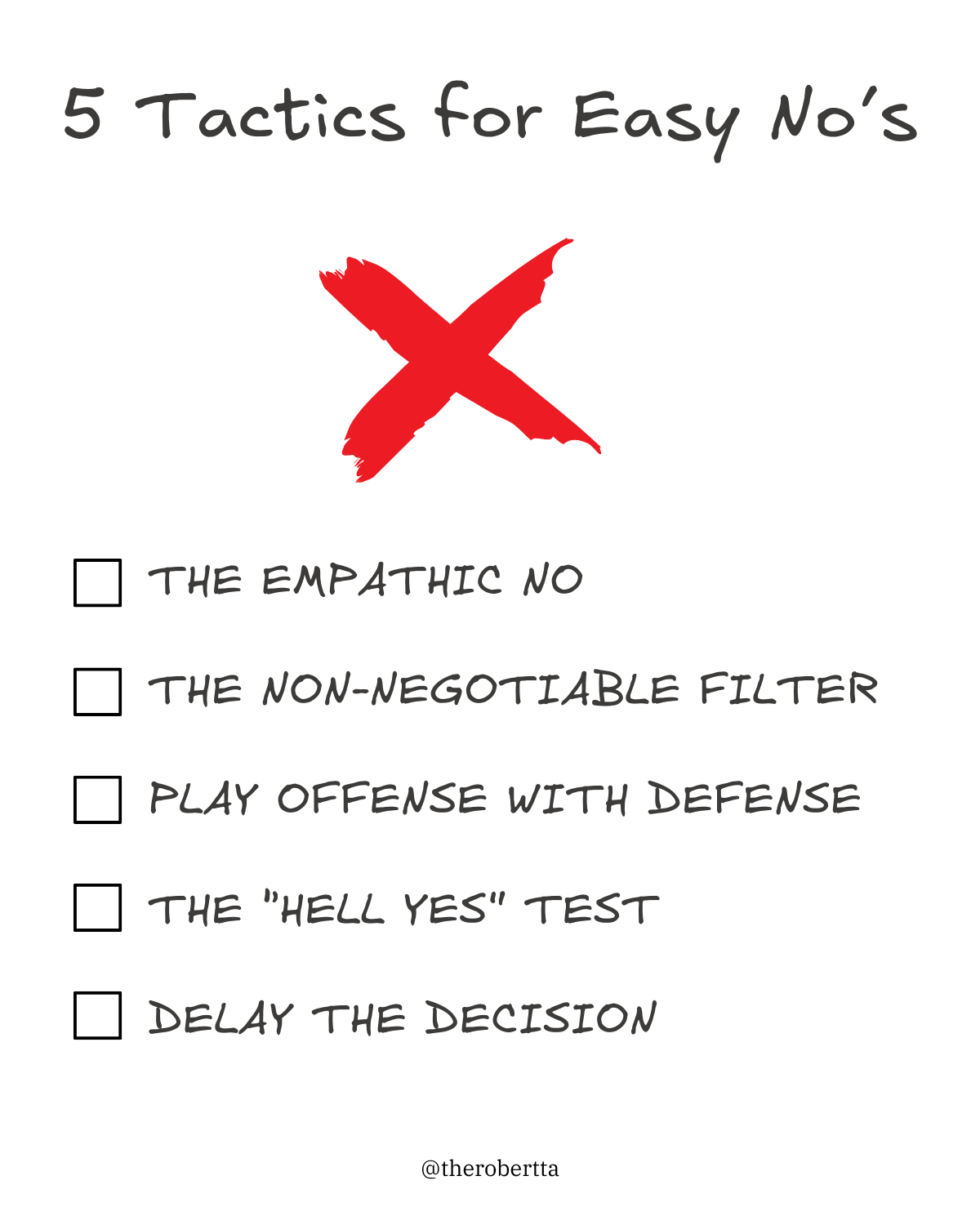
Here are 5 tactics I’ve learned to say “no”, that I wish I knew 10 years ago starting my career.
But what if the opposite is true?
What if saying yes to everything is the very thing eroding your leadership credibility?
0
yeses
1. The Empathic No
My go-to strategy.
Saying “no” gracefully and empathically is a great skill to learn.
You:
- Validate the intent: Acknowledge the value of the request.
- Clarify your current priorities: Show them what’s already on your plate.
- Offer an alternative: Provide a redirect or delay, if appropriate.
Example:
Offering an alternative, makes it graceful.
This protects your time while maintaining respect and collaboration.
“The difference between successful people and really successful people is that really successful people say no to almost everything.” —Warren BuffettNew initiative → “yes” New project → “yes” New idea → “yes”
“Yes” to the new initiative → “no” to my health “Yes” to the new project → “no” to my relationships “Yes” to the new idea → “no” to my priorities### 2. The Non-Negotiable Filter
This one’s simple but powerful.
If it doesn’t move you toward your personal or professional North Star—it’s a no.
Review them weekly.
“I really appreciate you thinking of me. Right now, I’m focused on [priority], and I wouldn’t be able to give this the attention it deserves. I’d recommend [another person] or I’d be happy to revisit this in [X time].”### 3. Play Offense With Defense
High performers often get bombarded with requests because… well, you’re a higher performer.
You’re competent.
Take that as a compliment.
You need to set boundaries—and I’ve learned being proactive and playing defense as if you’re playing offense, is key.
Proactive communication can prevent future overload.
Tactic: Tell people in advance what you’re focused on.
Examples:
This makes your no’s feel like part of a strategy—not a personal rejection.
4. The “Hell Yes” Test
Borrowed from Derek Sivers, this rule is blunt and effective:
This filter protects you from the death by a thousand yeses or maybes.
There are so many juicy, tantalizing ideas and opportunities when you’re a high performer.
You don’t need more opportunities.
You need better boundaries.
Ask yourself… “Is this a hell yes?”
Proceed accordingly.
5. Delay The Decision
Sometimes, the hardest part of saying no is the heat of the moment. You feel put on the spot.
Tactic: Create space. Protect yourself… from yourself.
Say something like:
This allows you to evaluate the ask against your priorities—not against your people-pleasing reflex.
What Happens When You Say No More Often?
You gain leverage.
You gain time.
You gain respect.
Here’s what saying no consistently signals:
- You have a clear vision.
- You respect your own boundaries.
- You’re not afraid of short-term discomfort for long-term impact.
And here’s the kicker: the world doesn’t fall apart when you say no.
Seriously.
It doesn’t.
Say no.
“Does this align with the version of me I’m building?” *“Does this take me closer to my priorities?”*Tactic: Before saying yes to anything, ask yourself: “Let me check my bandwidth and get back to you by tomorrow.”Write your “non-negotiables” down.
“This quarter, I’m heads-down on [X], so I won’t be able to take on new side projects.” “I’ve committed to deep work time in the mornings—feel free to book time in the afternoons.” *“I don’t have time for this meeting right now but I’m happy to talk this through asynchronously.”*Let them be your compass.
“If it’s not a hell yes—it’s a no.”But don’t let your ego suffocate you with yeses either.
Validating the other party shows them empathy.
Clarifying your current priorities, provides them space to give you empathy.
Continue reading
Get the full newsletter, free.
Join founders and builders who read Self Aligned every week.
What If You Still Feel Guilty?
You will.
Especially at first.
I did.
I have learned that guilt is not a reliable indicator of doing the wrong thing.
Especially if you grew up trained to be a people pleaser.
Treat it like a signal that you’re building a new boundary muscle.
Here’s a reframe:
Every time you say no to something misaligned, you’re saying yes to your mission, your health, your focus. You’re saying yes to you, and you’re saying yes to what matters.
And that’s not guilt.
That’s growth.
🚀 Breakthrough: Focus is Saying No—Steve Jobs
“Focusing is hard because it doesn’t mean saying yes, it means saying no. We decide not to do a lot of things, focus on a handful of things and do them well.” —Steve Jobs
You don’t have to take it from me.
Take it from Steve Jobs.
I revisit this clip every once in a while, and it shows me that the best of the best are ruthless with their priorities.
Saying no is hard, but that’s what it takes to deliver the best output at the highest levels.
Final Thought: What You’re Really Saying No To
When you say no…
You’re not just saying no to a task, a project, or a meeting.
You’re saying no to:
- Burnout
- Misalignment
- Resentment
- The slow erosion of your purpose
And you’re saying yes to:
- Clarity
- Vision
- Focus
- Impact
You don’t need to be harsh.
You don’t need to over-explain either.
You just need to be clear, kind, and firm.
💥 Challenge: 1 Minute Challenge—Say No
Write down your priorities and non-negotiables.
Doesn’t have to be fancy. Bullets work.
Look at your calendar.
Decline or defer an invite to something that does not matter against your priorities and non-negotiables.
Your future self will thank you.
Liked this article?
💚 Click the like button.
Feedback or addition?
💬 Add a comment.
Know someone that would find this helpful?
🔁 Share this post.
ABCs for Growth by Robert Ta is a reader-supported publication. To receive new posts and support my work, consider becoming a free or paid subscriber.
P.S. If you haven’t already checked out my other newsletter, ABCs for Building The Future, where I reflect on my founder’s journey building a venture in the open. Check out my learnings on product, leadership, entrepreneurship, and more—in real time!
P.S.S. Want reminders on entrepreneurship, growth, leadership, empathy, and product?
Follow me on..