
The CLEAR Framework
Instead of trying to capture “who you are” as a fixed snapshot, we model how you engage with life across five modalities.
From a philosophical perspective, our principled take is that your existence, what happens to you, and your reflections and perspectives on those experiences inform your beliefs.
Those hold who you are.
We needed a principled framework to look at subjective experience cleanly, and still allow for N=1 personalization.
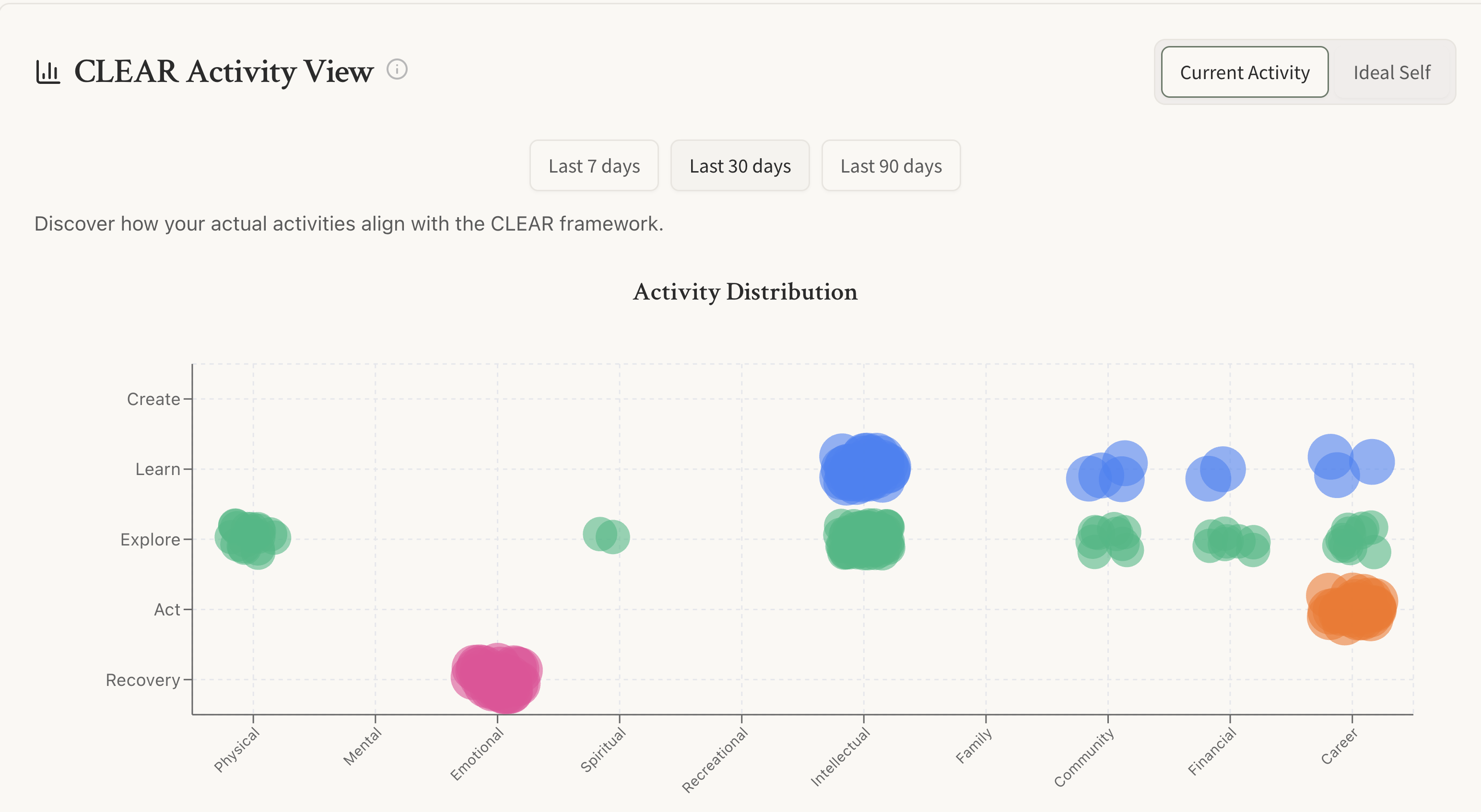
Create — Making new things, expressing yourself, bringing something into existence
Learn — Acquiring knowledge, building understanding, expanding your mental models
Explore — Curiosity-driven discovery, opening up to new possibilities
Act — Taking decisive action, executing on intentions, moving from thought to behavior
Recover — Rest, reflection, restoration, integrating experiences
Think of these as the five fundamental modes of human engagement.
At any moment, you’re operating primarily in one of these modes.
Across a month, you have a pattern.
It’s helpful to see where and how you’re spending your time and attention.
When it’s visible and measured, it’s more easily managed.
It’s: *which modes have you been existing in, and how does that affect your sense of self? *
What are your patterns?
The Pillars of Self
Modalities are only half the picture.
- Physical Health
- Mental Health
- Emotional Health
- Spiritual Health
- Recreational Health
- Intellectual Health
- Family & Relational Health
- Community Health
- Financial Health
- Career Health
We call these the Pillars of Self.
Look at the CLEAR Activity View dashboard again. You’ll notice that CLEAR time applies across the Pillars of Self.
Here’s the insight: your engagement pattern differs across pillars, in different seasons of life.
You might be in Create mode at work (building a new product) while stuck in Recovery mode emotionally (processing grief).
You might be thriving in Career Health while neglecting Recreational Health. (Ahem too much of me lately admittedly)
This creates a high-fidelity representation of how you’re actually living—not a static label, but a dynamic map of your engagement across all the domains that matter.
The Problem of Measuring Subjectivity
Now here’s where it gets interesting.
How do you measure something inherently subjective?
If I ask you “how aligned do you feel with your best self today?” on a scale of 1-10, that number means something different to you than it does to me.
Most systems treat this as a bug. We treat it as a feature.
Our philosophy:
Not compared to others.
Not against some external benchmark.
Against yourself.
You yesterday.
You last week.
You last month.
All you, over time.
Clarity maintains three “views” of you—your Self:
Becoming — Your trajectory, the direction you’re moving, the Self you’re becoming
Telos — Your Target Self, your best self you’re working toward
The magic happens when we compare these.
Are your actions moving you closer to your Telos? Or drifting away?
(In a future article I can show you how we get into the calculations)
The question isn’t “which mode is best?”
You also engage across different domains of life:
Clarity tracks the intersection: CLEAR modes × Pillars of Self.
This is where the Self-Model architecture comes in.
Being — Your current state Self, computed from recent episodes (last 7 days)
Aligned Actions
This brings me to a feature I’ve loved since we introduced it:
Aligned Actions.
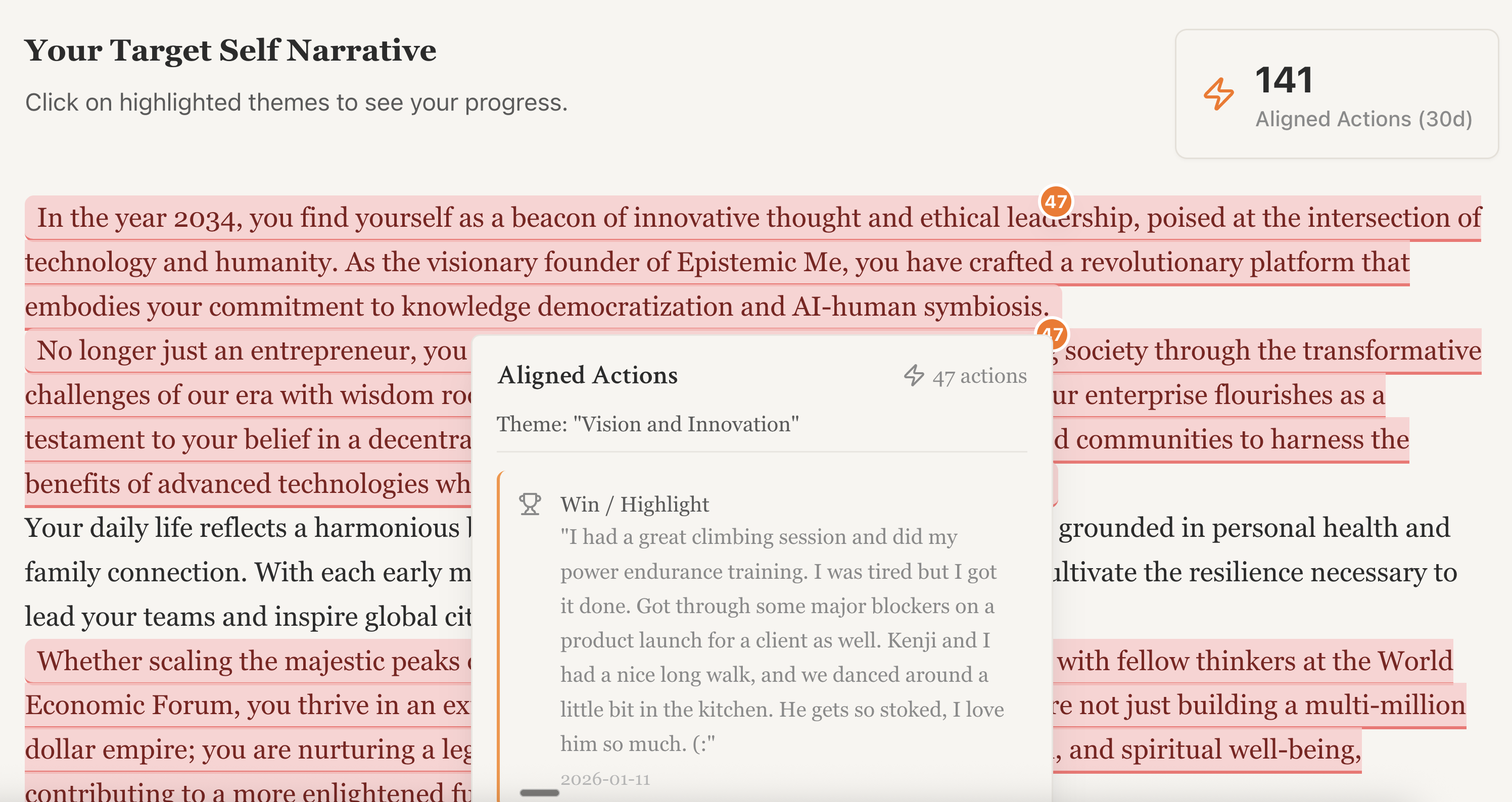
Here’s how it works:
You journal. You reflect. You capture your day in whatever way feels natural.
“I spent two hours helping my sister move.”“I skipped the gym to finish a report.”“I finally had that difficult conversation with my manager.”
But do you ever go back to your journals?
In my experience, not frequent enough if ever.
In Clarity, what you capture gets distilled into our frameworks and evaluated against your target self.
Since Clarity holds a model of your Being, Becoming, and Telos, we can more precisely come to identify Aligned Actions from your journals over time.
Not “is this action good” in someone else’s standards.
Not “is this action productive” by someone else’s standards.
But—is it aligned with your Telos? Your purpose?
This is where agency and gratitude connect to the technical architecture.
Agency in Clarity means: You define your target self. You set the criteria for alignment. The system doesn’t tell you who to become, it helps you track whether you’re becoming it.
Gratitude emerges naturally from our daily gratitude practice and tending to your Belief Garden intentionally.
When you see your aligned actions accumulating over time, even small ones, you start to appreciate your own progress.
And as your habits align with your desired identities (who you want to become, your Target Self), then in real life you’re more likely to enjoy the habits themselves.
At least, that’s been the case for me.
Why This Matters for AI Personalization
Here’s the thing most AI teams miss:
They try to personalize based on behavior.
Clicks. Time spent. Purchase history.
But behavior is downstream of belief.
What you do is shaped by what you believe—about yourself, about the world, about what’s possible and what matters.
We go the other way in our design philosophy of Clarity.
We start first with a high-fidelity representation of the user at the belief level, to personalize everything downstream. We have a very sophisticated engine for evidencing beliefs.
The question we’re asking: Is this action aligned with who you want to become?
And it’s the only way to do N=1 at scale without decaying into proxy-driven nonsense.
Continue reading
Get the full newsletter, free.
Join founders and builders who read Self Aligned every week.
What This Actually Looks Like (I Use It Myself)
I’m User Zero for Clarity.
I try really hard to be my best self, and I refine Clarity for that purpose.
I track my own engagement across all nine pillars, using the same tools we’re building for others.
Here’s my actual data from late 2025:
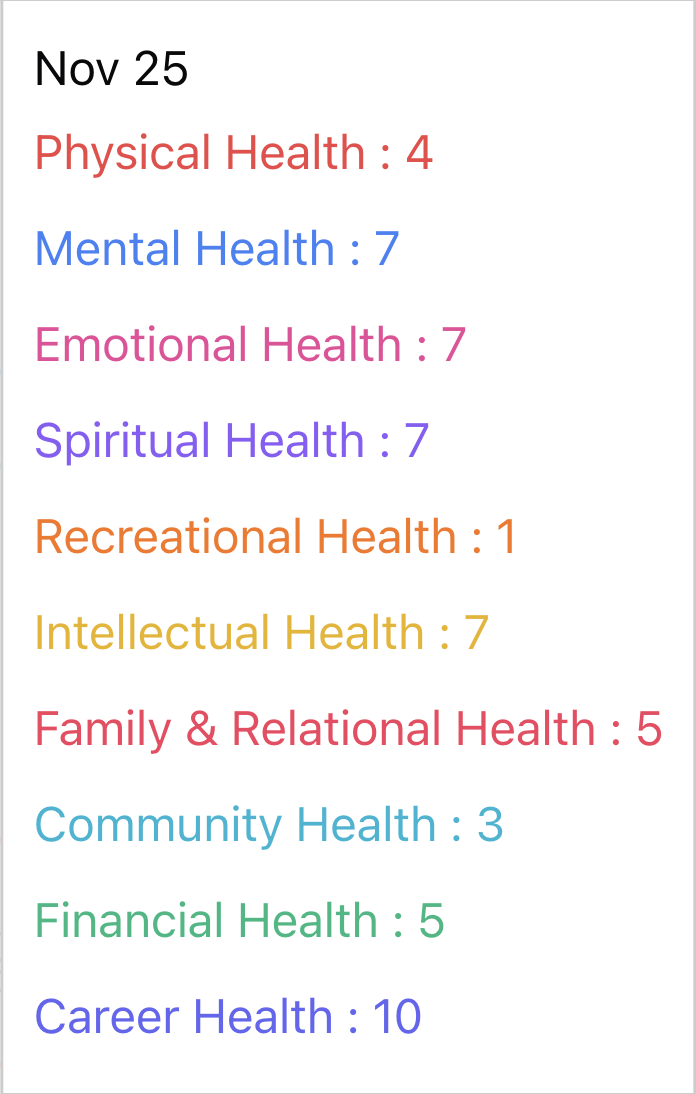
On November 25th, you can see the pattern. Career Health at 10—I was locked in on building. Transitioning off the day job into full time startup mode. It’s been a lot to juggle.
Intellectual Health at 7.
But Physical Health? A 4. I was injured )’:
Recreational Health? A 1. I haven’t had much play time recently.
I was grinding. And the data showed it.
I was on track to burn out for sure. I tend to be a bit of a workaholic. Especially if I’m stressed or injured.
Looking at the data helped me see the course I was on.
So the last 2 weeks of December after I quit my day job to go all in building Clarity I made sure to have intentional decompression time sprinkled into my transition.
I also spent a TON of time on my physical therapy, and was able to recover from my running injury and got back into form!
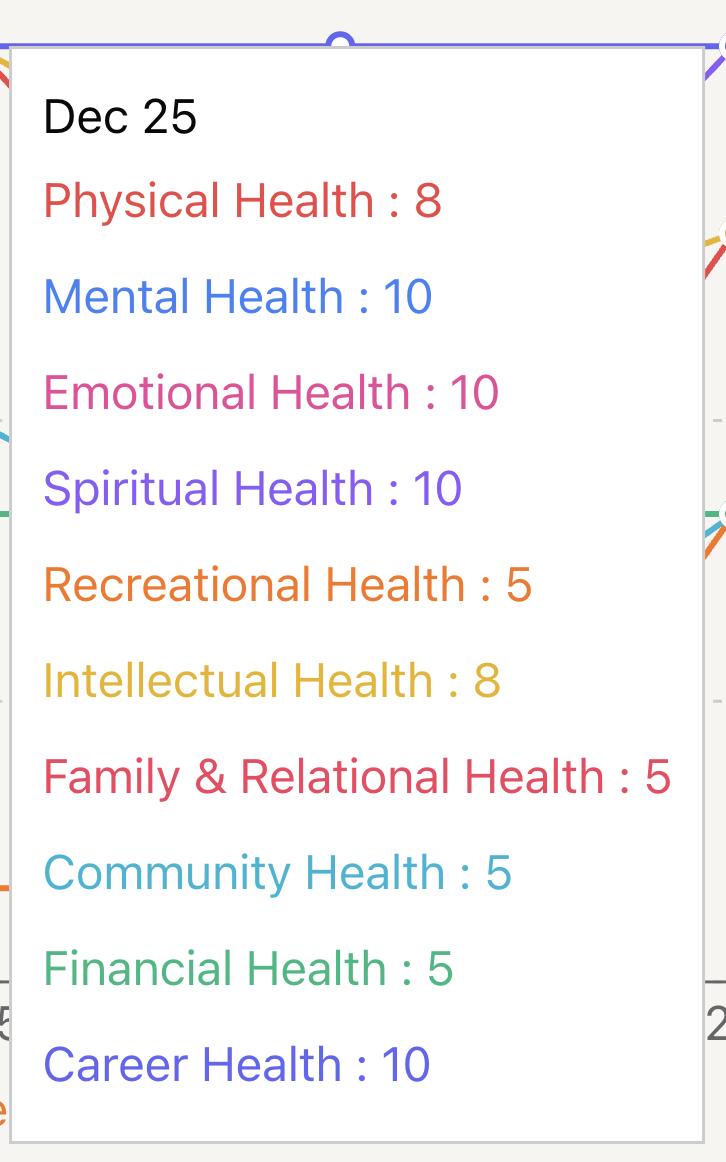
Then look at what happened in December.
You can see multiple pillars dipping around late November—and then the recovery trajectory as December progressed.
And here is my CLEAR Activity Distribution over 30 days. Each bubble shows where my engagement landed across pillars and modes.
See that big pink bubble in Emotional Health, down in the Recovery row? That’s me processing some of the emotionality in moving full time into my startup.
I explored a hell of a lot and you can see a huge concentration of action in Career Health.
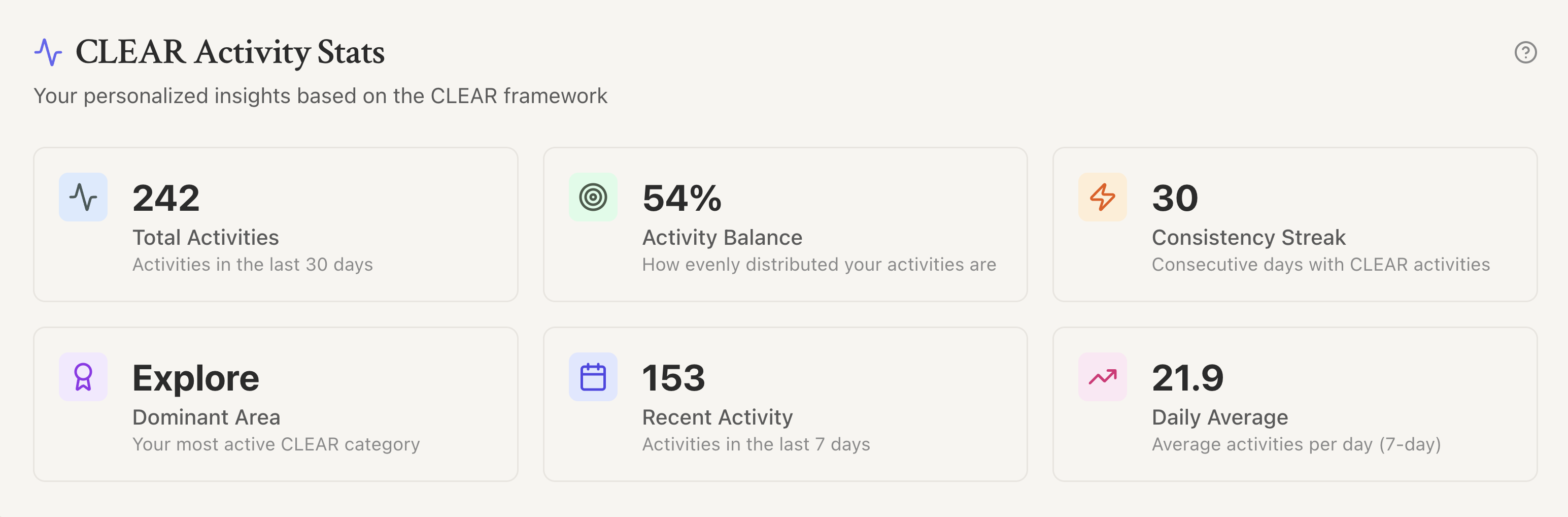
242 identified activities in 30 days. A 30-day consistency streak. 21.9 daily average.
This is what the feedback loop looks like in practice.
Journaling and self-reflection provide a feedback loop from your subjective experience to your intentional curiosity—expanding and growing your model of self over time.
You journal.
You see patterns. You notice what’s working and what isn’t.
You adjust. You try again.
The mirror and road to your best self gets clearer.
Having Clarity helped me dial in and adjust where I was spending my attention, time, and energy, to regain steadiness as quickly as possible in a tough transition period.
That optimized recovery time is such an advantage especially in startup life in my perspective. Startup life is a rollercoaster—as a Founder I’m challenged all the time emotionally. Emotionally regulating is a key competency to maintain optimal output to drive us forward.
Clarity has really helped me optimize emotional regulation, and the more subjective parts of life to feel full of purpose and more in flow day to day.
That’s everything to drive our startup forward, especially as we bring a couple customer use cases above the surface for our Clarity API B2B offering this quarter.
To all the high performers in the arena, keep getting after it.
I believe in you 💪
✌️Culture: Quantifying Subjectivity
For those who want to go deeper:
The Clarity Self-Learning Agent (SLA) API models users as dynamic systems, not static profiles. Because…
That’s what people are. Dynamic. Not static.
So we need to build up the snapshots of your model of Self throughout time, based on your experiences.
Episodes capture engagement states across the six qualities of experience: sensory awareness, agency, energy, drive, epistemic state, and provenance.
Modes are inferred from engagement patterns—we don’t ask you which CLEAR mode you’re in. We compute it from how you’re engaging and get more precise with more data.
Alignment is calculated by comparing your Being view (current state) to your Telos view (target state), producing:
- An overall alignment score (0-100)
- A “telos vector” showing direction of needed change
- An “on-course status” (strongly aligned, improving, stable, declining, etc.)
- Suggested actions based on primary focus areas
The result?
Clarity adapts to *you *and helps you find and live to your purpose.
That’s real hyper-personalization.
👉 Do you want to use Clarity, to become your best self and keep tabs on your own aligned actions?
Check out heyclarity.me and sign up for the waitlist
👉 Do you want to use Clarity API to make your AI/LLM products hyper-personalized with the right context at the right time?
Check out heyclarity.dev and get in contact with us, we’re taking limited early pilots to help AI dev teams solve personalization with grounded evals methodology and tech
Liked this article?
💚 Click the like button.
Feedback or addition?
💬 Add a comment.
Know someone that would find this helpful?
🔁 Share this post.
Self Aligned by Robert Ta is a reader-supported publication. To receive new posts and support my work, consider becoming a free or paid subscriber.
P.S. Want reminders on entrepreneurship, growth, leadership, empathy, and product?
Follow me on..
**We should arm you with the tools to track your own subjective experience over time as meaningfully as possible.**Here’s the problem with most of them: