
Let’s dive in and redefine leadership together.
Advice of the Week
Life Lesson: Influencing Without Authority
A few years ago, I was tasked with leading a crucial project with a team twice my age. I had no formal authority and struggled with Imposter Syndrome.
I decided to focus on building relationships. By understanding each member’s strengths and actively listening to their concerns, I built trust.
Here Are 3 Tips to Lead Without Direct Authority
Cultivate Psychological Safety
Establishing trust is foundational. Show that you value others’ contributions and respect their perspectives. Ask good questions to cultivate psychological safety, such as “Hey I really value your perspective, can you give me feedback on my recent work?”.
Do things like notice when someone hasn’t spoken up in a meeting, and prompt them for their perspective. They’ll remember.
People valued my input because they felt heard and respected. They knew I cared. I learned that true influence comes from connection, empathy, and communication—not control.
Do it in a group setting, to show you’re a student of your craft - because you are.
How could I align everyone without a title?
This approach helped me steer the project to success.
It’ll allow others to feel safe too, because you were vulnerable in a small way.
Foster Reciprocity
Humans are hardwired to reciprocate acts of kindness and effort. So go first.
Give value first to whoever you’re trying to influence. Do so much for them to the point where it would feel odd if they didn’t reciprocate.
Don’t overthink it.
It could even just be doing the stuff nobody likes doing: scheduling time for a meeting, taking the notes, sending the action items, being the one who volunteers first to take action items.
Be Consistent
No.
You call on the person who you can rely on.
Remember - your personal brand is everything. How you are perceived by others will unlock opportunities for you. Do your best to be known for following through, showing up on time, getting the job done even when it’s tough. If somebody perceives you as consistent and committed to the cause, they likely will too.
And they’ll likely say yes when you make an ask.
Skeptical that this matters?
Think about this: I’ve had many job offers in my career with minimal interviews required, simply because I’ve built up years of credibility with prior colleagues that I follow through, get the job done, and work really hard.
Remember that.
Others will.
Breakthrough Recommendation: “What’s Your Influencing Style?” - Harvard Business Review
Why It’s Awesome:
This article talks about**“Influence Styles”**, and gives insight into strategies for influencing others when you lack formal power. It emphasizes the importance of understanding your own influence style and those around you.
By doing so, you can best lead and drive the outcomes you want.
**Read it here: **What’s Your Influencing Style?
Unfortunately the the article is gated behind a user registration. It’s still free though - I would recommend checking it out as it’s worth it.

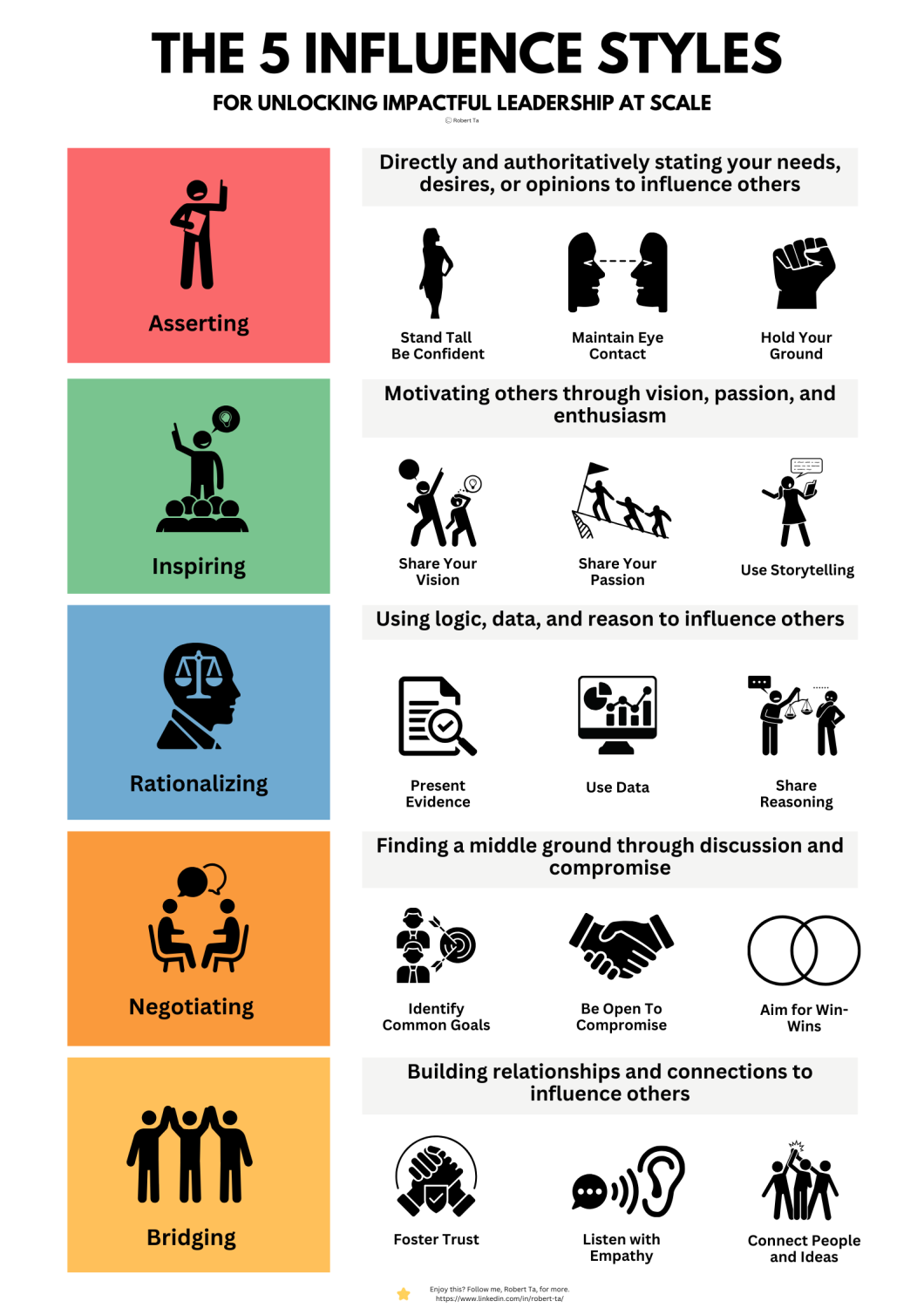
Here are the 5 Influence Styles, as defined by the HBR article above.
Rationalizing: Do you use logic, facts, and reasoning to present your ideas? Do you leverage your facts, logic, expertise, and experience to persuade others?
Asserting: Do you rely on your personal confidence, rules, law, and authority to influence others? Do you insist that your ideas are heard and considered, even when others disagree? Do you challenge the ideas of others when they don’t agree with yours? Do you debate with or pressure others to get them to see your point of view?
Negotiating: Do you look for compromises and make concessions in order to reach an outcome that satisfies your greater interest? Do you make tradeoffs and exchanges in order to meet your larger interests? If necessary, will you delay the discussion until a more opportune time?
Inspiring: Do you encourage others toward your position by communicating a sense of shared mission and exciting possibility? Do you use inspirational appeals, stories, and metaphors to encourage a shared sense of purpose?
Bridging: Do you attempt to influence outcomes by uniting or connecting with others? Do you rely on reciprocity, engaging superior support, consultation, building coalitions, and using personal relationships to get people to agree with your position?
You should.
**And you should start seeing other peoples’ influence styles too: **it comes out in the way they talk, and the way they act. It comes out in their priorities.
Pay attention, and you’ll build a muscle to instantly recognize which of these influence styles to use for any particular situation.
Consistency matters. Your brand follows you. See yourself in any of this?
Use this handy infographic I made for you, so you can use this in the future!
Go first - give without take.
And eventually you’ll see that people will help you and reciprocate.
Everybody has a flaky friend. Would you call on them when shit hits the fan?
Continue reading
Get the full newsletter, free.
Join founders and builders who read Self Aligned every week.
Actionable Takeaways
- Know Your Influence Style: Understand your preferred methods of influencing others. Use these 5 as a framework and starting point. Just keep in mind that it’s a spectrum. You probably lean on different ones in different contexts (being stressed, being tired, being energetic, etc.).
- Identify Others’ Styles: Recognize the influencing styles of your colleagues, friends, and family (especially to convince your parents to do anything different!). This insight helps you tailor your approach to better drive the outcomes you want.
- Adapt Your Style: Use the right influence style that fits the situation and the conversation. Match your approach to what will be most effective. One rule of thumb in any talk I give, is to make sure my talk resonates with all 5 influence styles so I have better odds.
What I did this week
I had a meeting with a cross-functional team that doesn’t report to me, and I had actions I needed help on.
Instead of dictating from a high castle, I showed effort by putting in a lot of work into prepping for the meeting. Most people don’t even attach an agenda to their meetings, so most meetings are a waste of time.
For mine, I had an agenda, activities, guest speakers, and more.
I showed effort through action. People wanted to reciprocate - because it was unlike most meetings.
When I made the ask - I got a couple dozen passionate volunteers.
It works.
Challenge: Figure Out Your Influence Styles
`This week, take some time to reflect on your preferred influence style. What do you lean towards? Once you’ve identified your style(s), share it in the comments and explain how you plan to use it in your interactions. Understanding and articulating your influence style can enhance your ability to lead effectively without formal authority.

It also helps with navigating personal relationships. Seriously. Try it out.`
Share your in the comments here! 💪👇
Why Subscribe?
Each week, you’ll receive 1 ABC (Advice, Breakthrough, and Challenge) on Growth:
- Advice:* Simple life lessons and stories with actionable steps to improve your professional and personal life.*
- Breakthrough Recommendation:* Discover powerful books, resources, quotes, and tools to grow your perspective, and why I think they’ll be helpful to you.*
- Challenge:* Small challenges you can undertake alongside a community to nurture your growth, one step at a time.*
Join a community of like-minded people who are all about growth!
Thanks for reading! You can get more actionable insights and advice to help you grow in my newsletter. Each week, I share 1 piece of advice, 1 breakthrough recommendation, and 1 challenge for people interested in growing. Join us!
Stay tuned for next week’s edition!
P.S. Want reminders on growth, empathy, and leadership? Follow me on LinkedIn.