
The Fragmentation Problem Of Journaling
It was great advice.
Everybody I’ve met who is interested in the pursuit of reducing anxiety, existential angst, and finding clarity in purpose and meaning, has been told to journal and either does regularly or intermittently.
Stress reduction and improved memory:Expressive writing, including journaling, can help reduce symptoms of stress, anxiety, and depression. Reflective writing about personal experiences can enhance memory recall and reduce unwanted, intrusive thoughts.
Increased mindfulness: Using journaling in a mindful way helps build greater self-awareness, more compassion toward oneself, and stronger emotional regulation.
Better problem-solving skills: Keeping a journal can sharpen your ability to solve problems and spark more creative ideas. You literally improve your decision making abilities through sharpening your problem solving skills.
So I started.
At first, I didn’t really know what prompts to use. I just sort of wrote and let the writing carry me forward.
Over time, I learned to optimize my journaling prompts to slow down and to appreciate the day to day.
iPad writing during flights.
Paper journals at home.
Obsidian for linking ideas.
Voice memos while driving.
Each tool made sense in isolation. Because the act of slowing down to reflect, is valuable in itself.
It’s like having your financial records split across ten different banks with no way to see the complete picture.
You’re journaling, but you never return to review because it’s scattered across platforms, cities, and years.
The act of journaling slows you down (which is good), but fragmented journaling does not allow you to see progress in who you’re becoming.
I wanted synthesis.
I needed to see patterns.
“Am I on the right track?”—me in between my therapy sessions.
Looking back, if the goal was to examine my actions tied to my limiting beliefs to change my habits, what I realized I have really needed all along was to watch my beliefs evolve over time.
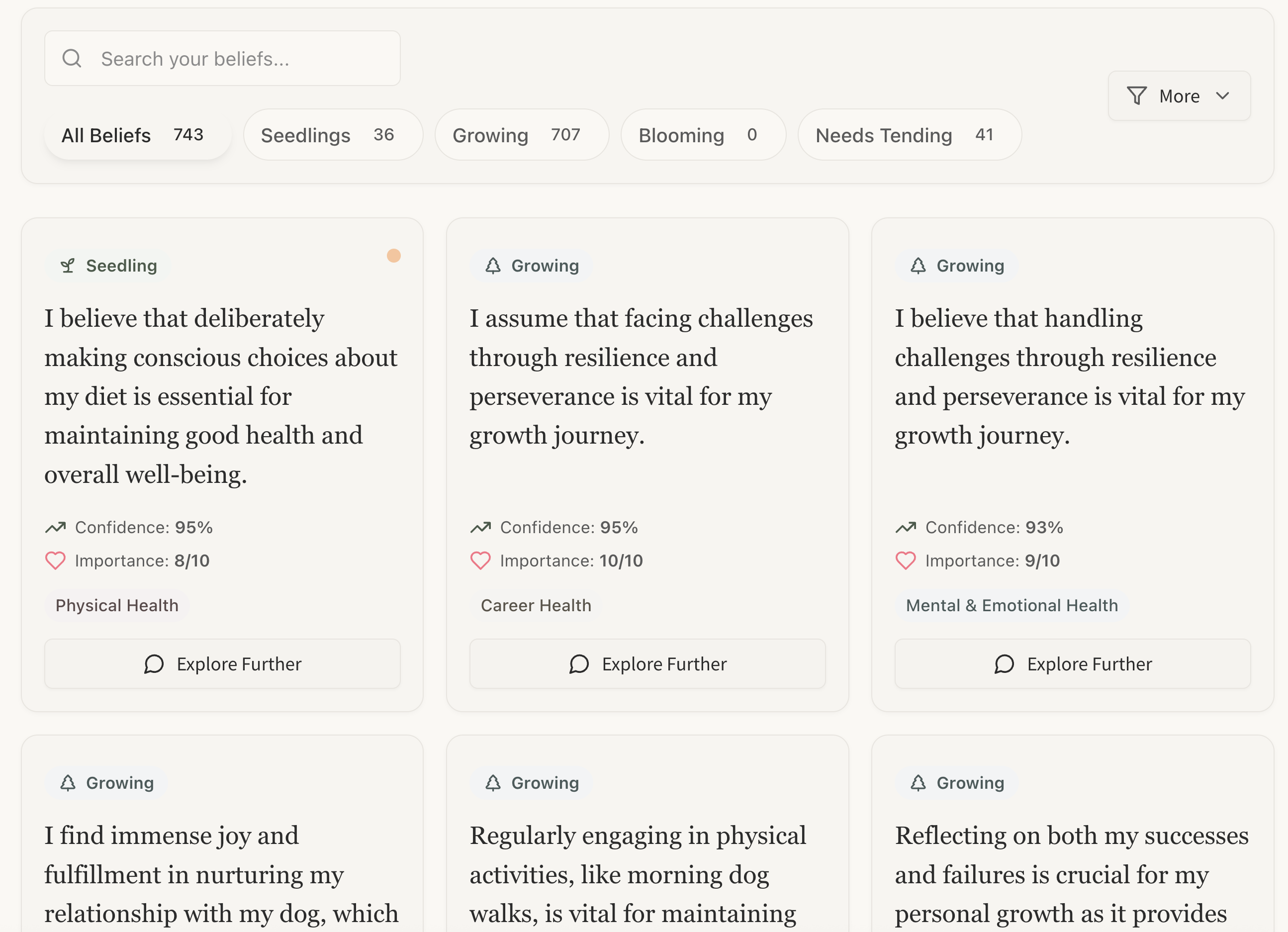
That’s why I built Clarity—to solve my own fragmentation problem. One place. All my reflections. All my beliefs.
Searchable, connected, evolving.
And I can see all of my beliefs, and the evidence of those beliefs tied to journal entriers.
I can challenge them. I can discard the ones that do not serve me.
My beliefs live in my Belief Garden, in Clarity.
Then, I started journaling in different places:
But… I never found myself going back to my musings or reflections. They were all fragmented.
Here’s what I discovered:
Someone once told me to journal, years ago.
My phone notes app in the morning.
Three Questions That Changed Everything
I’ve now been journaling for about a decade. I have refined my practice a lot. It’s taken me a while to get here, and I now have 3 primary questions I ask myself every day.
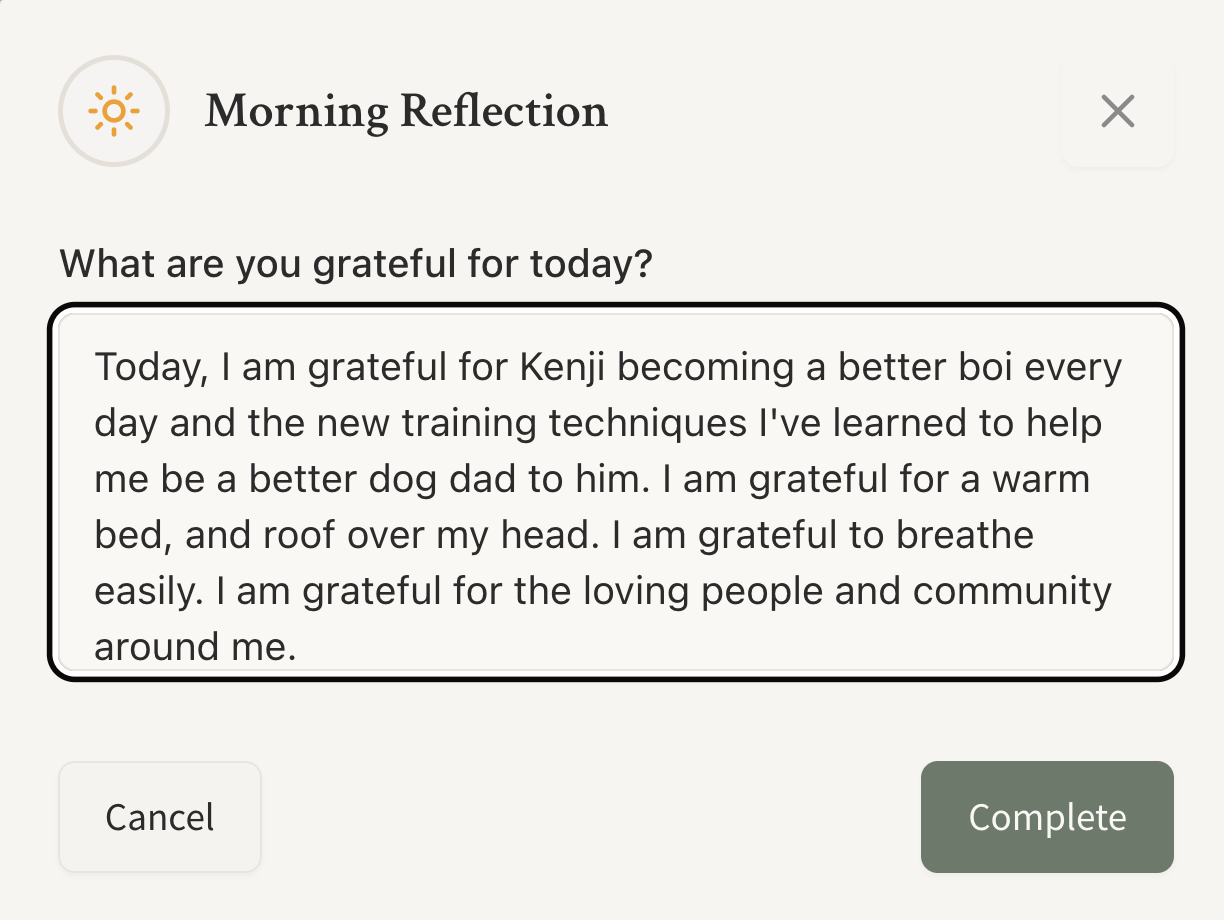
This primes my brain for abundance instead of scarcity. I usually start simply. I think of gratitude as bullshit armor—when you’re grateful for the little things, life’s chaos doesn’t seem so bad.
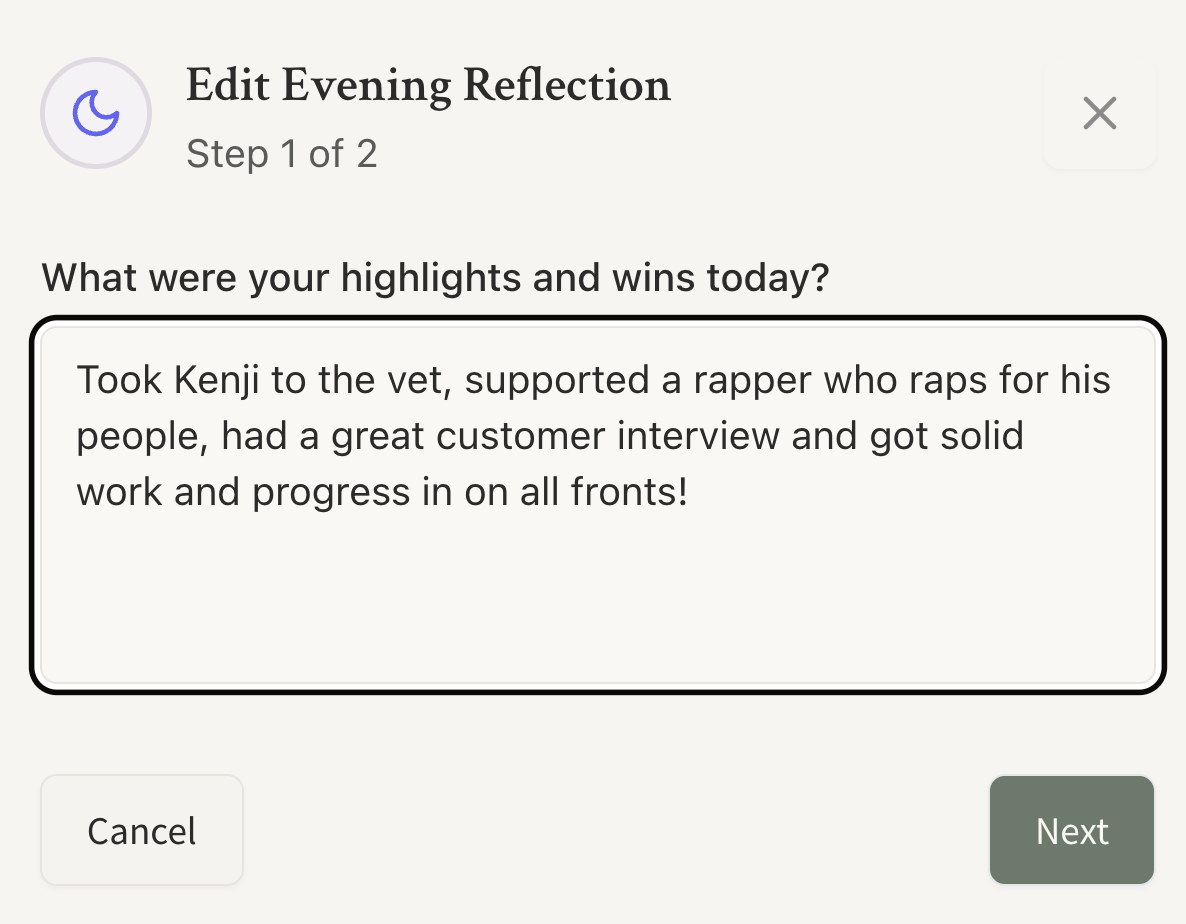
This has helped me tremendously with my “moving goalposts” constantly problem. It forces me to recognize the small little victories in my day to day, whereas before I never even took the time to let those marinate.
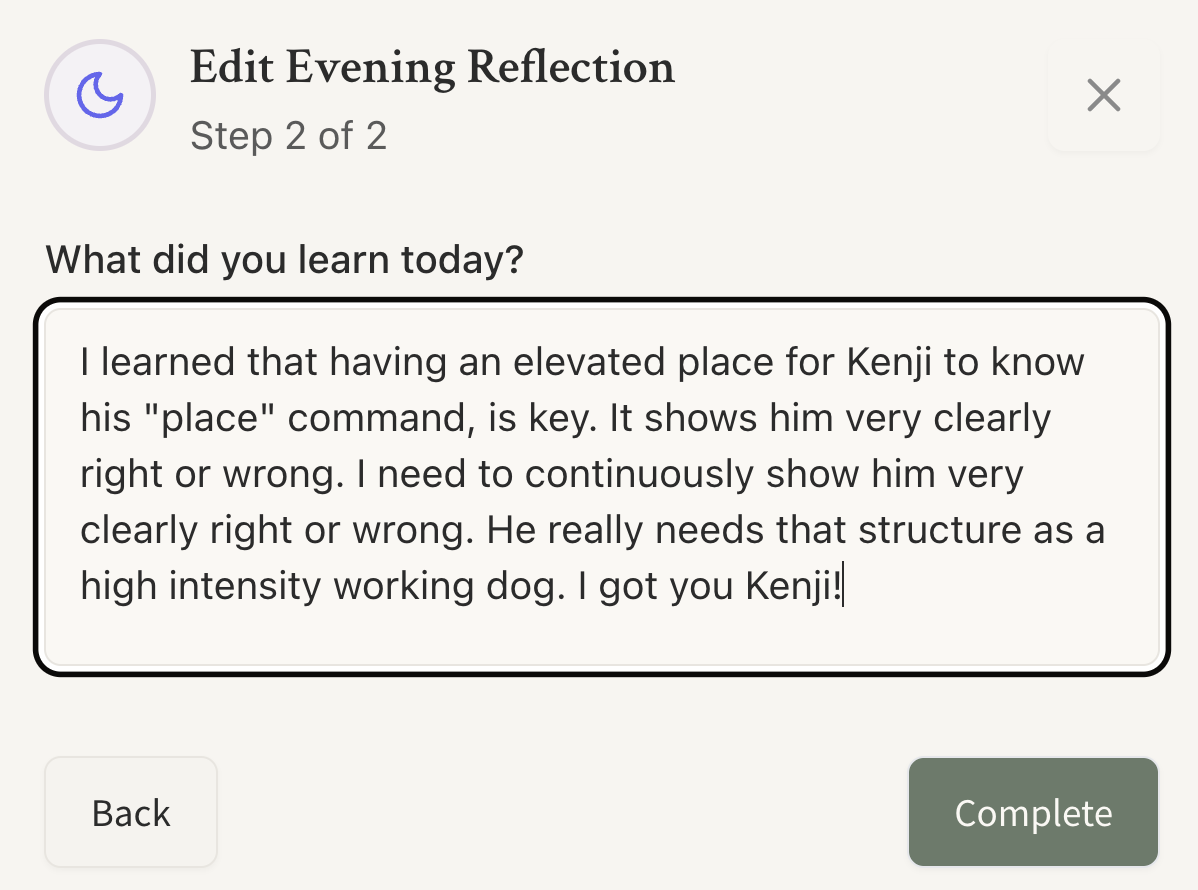
I identify as a forever learner.
How do I know I’m actioning on that identity that I hold dear?
I journal about what I learn, every single day. It can be small, medium, or large. It can be whatever. And it’s self-reinforcing, I love reflecting on what I learned. It just feels so good!
These three questions—just three—create a feedback loop between who you are and who you’re becoming.
They’re coordinates on a map showing whether you’re moving toward your destination or wandering in circles.
In Clarity, I decided to have the product surface to you your progress based on your journaling. Then came the Wins Dashboard.
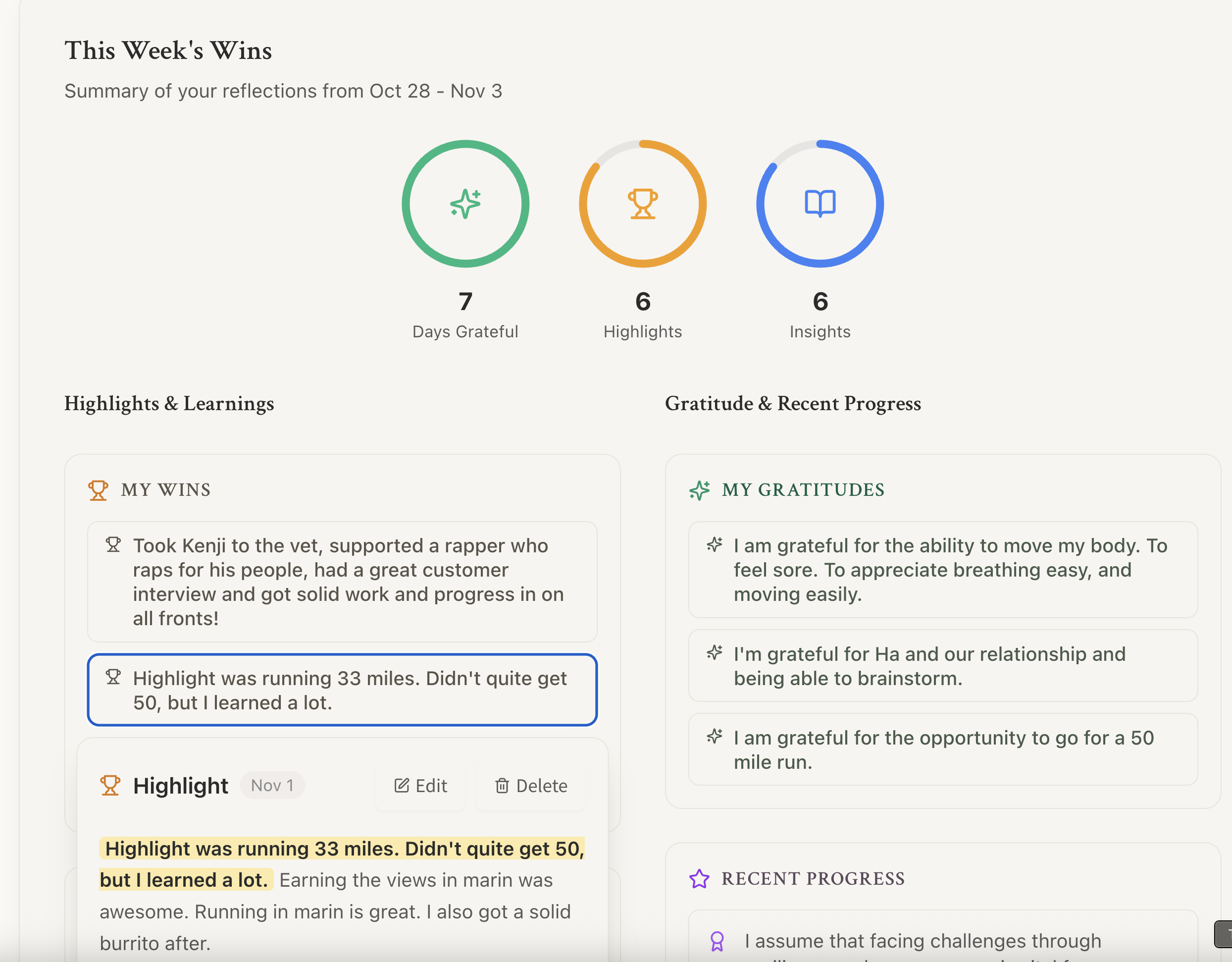
The Wins dashboard shows you your recent journals and highlighted experiences that are very aligned towards your best self.
It’s been such a pleasure to go in and journal in Clarity everyday, and see my Wins dashboard. It’s like getting a “best hits” of my own experiences.
What better way to slow down and smell the roses?
*“What are you grateful for today?”*Every morning—1 question:
*What did you learn today?”*Every evening—2 questions:
Okay but what about the fragmentation problem?
These are my personal prompts, that keep me grounded daily.
And now I do this journaling in Clarity.
Continue reading
Get the full newsletter, free.
Join founders and builders who read Self Aligned every week.
Build In Public Update: The Distribution Challenge
We’ve had some great wins recently on the distribution side as we gear up to expand our closed beta for Clarity.
Recently I got in touch with an Olympian who wants to improve their mental game. They saw a demo of Clarity, and wants to use it to improve overall wellbeing and performance.
Life coaches and therapists have reached out, asking if they can recommend it to clients. They see it as the missing piece between sessions.
We’re getting more and more signals that the demand is there.
But, startup life is about doing more with less. All of these channels take time to shape up to systematically acquire customers. This is something every entrepreneur needs to face—prioritization.
I’m one person with limited time and attention.
Do I chase the Olympians (high-status, great PR, narrow use case)?
Do I focus on coaches (multiplier effect, but longer sales cycle)?
Do I go with paid ads (proven acquisition but need to spend lots of time on the creative angles)?
This is the entrepreneur’s crucible: what’s the best move?
We know the ICP exists and the acquisition story is there (people that fit the ICP definition and see the demo want to use it) but needing to discover the single distribution channel that actually works will take time and resources.
Those are limited.
As I think through this problem, my thoughts drift back to the simplicity of finding 100 true fans first.
Brian Chesky found Product Market Fit with Airbnb this way:
“If you have 100 people who absolutely love your product, they’ll tell 100 people, and they’ll tell 100 people, and this thing will grow virally. In fact, almost all movements in history have grown this way as well—there are deeply passionate followers and they grow it, and they’re customer advocates.”
So our approach for now is to continue with our progressive closed beta.
We’re dogfooding religiously—using Clarity ourselves every day so we stay emotionally attached to making it better.
And we’ll open up the closed beta to the people who want it most, who are as invested in becoming their best selves as we are, so we can refine the rough edges gearing up for a bigger launch.
So if you’re interested, you can sign up for the waitlist. If you’re really interested, you can email me and I’ll put you closer to the front of the line.
*“What were your highlights and wins today?”*And the science backs it irrefutably—journaling makes you your better self: Ikigai.
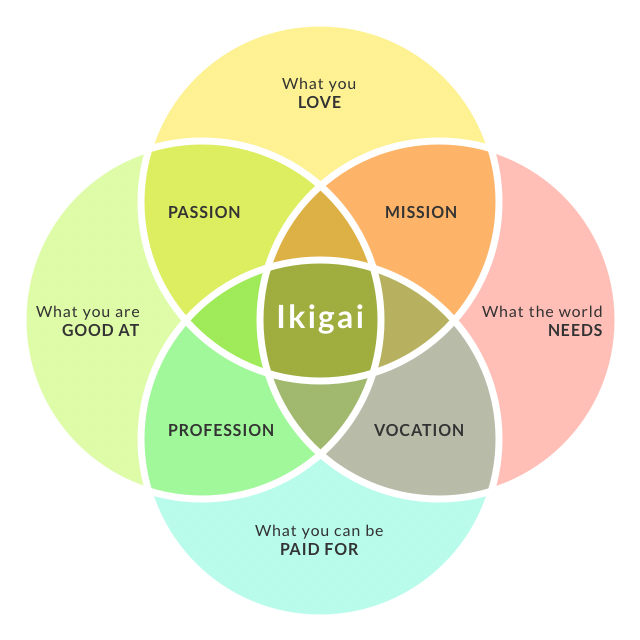
The Japanese concept that means “reason for being”—the thing that makes life feel worth living.
It sits at the intersection of what you love, what you’re good at, what the world needs, and what you can be paid for.
“The Okinawans call it ikigai … for both, it translates to ‘why I wake up in the morning.’”
Journalist Dan Buettner studied Okinawa’s centenarians—people living past 100 with vitality. Not one of them mentioned finding their “passion” or “purpose” in the Western sense (find your true calling type of stuff).
Their sense of purpose is natural, integrated, collective, and embedded in their daily life:
Your morning coffee.
The neighbor who waves.
The garden you tend.
Their satisfaction and purpose comes from daily micro-alignments.
Showing up for the small things that matters to you. Not anyone else—you.
That’s self-alignment.
Liked this article?
💚 Click the like button.
Feedback or addition?
💬 Add a comment.
Know someone that would find this helpful?
🔁 Share this post.
ABCs for Growth by Robert Ta is a reader-supported publication. To receive new posts and support my work, consider becoming a free or paid subscriber.
P.S. If you haven’t already checked out my podcast, ABCs for Building The Future, where I reflect on my founder’s journey building my AI startup in the open and invite awesome guests building the future to talk about theirs. Check out my learnings on product, leadership, entrepreneurship, and more—in real time!
P.S.S. Want reminders on entrepreneurship, growth, leadership, empathy, and product?
Follow me on..